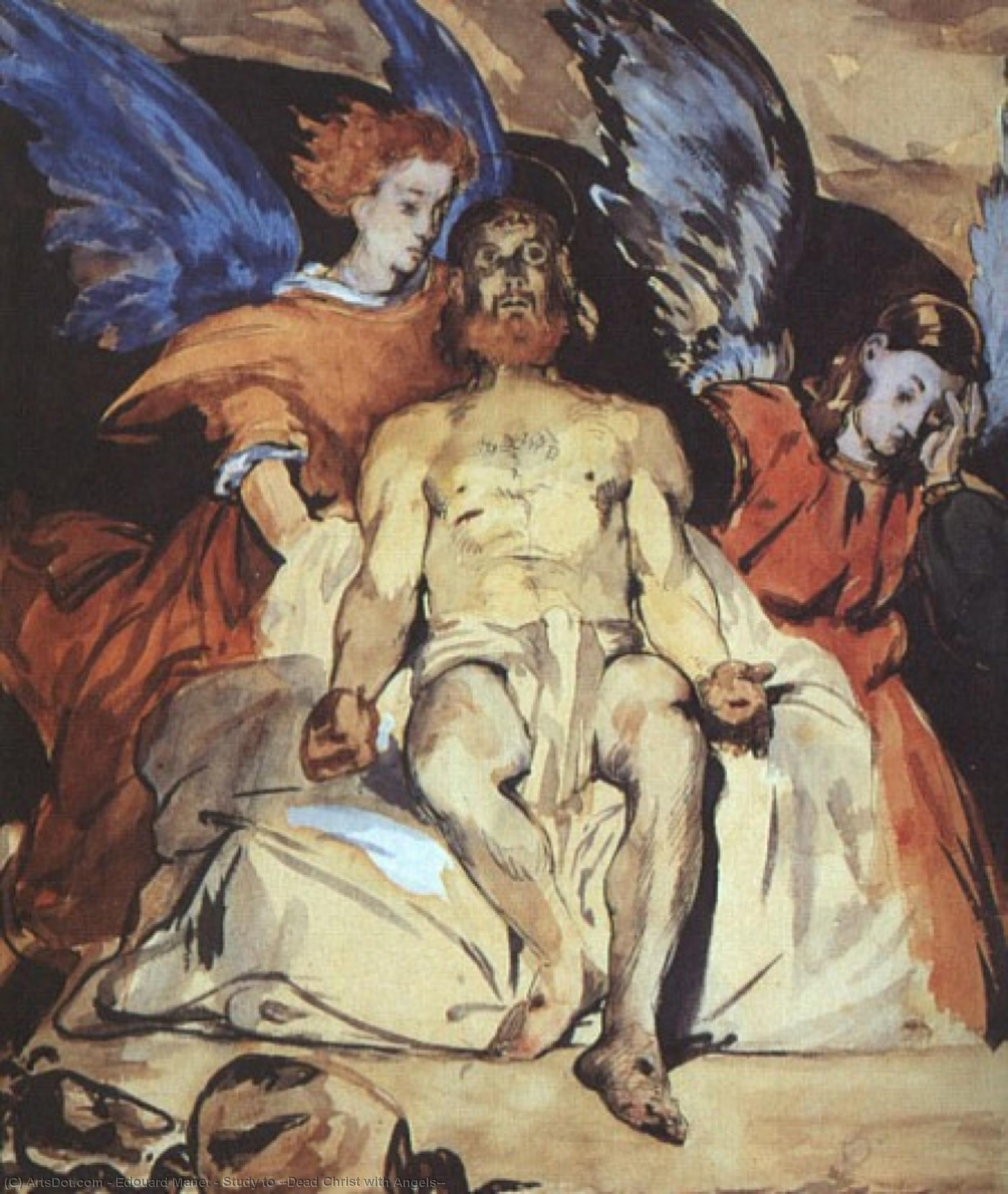
Study to ''Dead Christ with Angels''
Édouard Manet’s “Study to ‘Dead Christ with Angels’” stands as a pivotal moment in the artistic landscape of mid-19th century France, marking a decisive break from Romantic conventions and firmly establishing Realism as a dominant force. Painted in 1864, this gouache masterpiece isn't merely an image; it’s a carefully considered exploration of grief, faith, and artistic innovation—a testament to Manet’s unwavering commitment to portraying the world truthfully without embellishment.
Composition and Technique
The painting depicts three figures within a solemn religious tableau: Christ’s lifeless body sprawled upon the ground, cradled by two angels who express profound sorrow. The artist employs a masterful technique of layering colors—primarily reds, blues, yellows, and whites—to imbue the scene with palpable emotion. Notice how Manet utilizes subtle gradations of tone to convey depth and texture, capturing the materiality of the stone slab beneath Christ’s body and the drapery of the angels' robes. The composition itself is deliberately understated, prioritizing clarity and emotional resonance over elaborate ornamentation. This deliberate simplicity reflects Manet’s rejection of academic idealism—he sought to capture the essence of human experience rather than constructing an idealized vision.
A Departure from Romantic Idealism
Manet’s stylistic choices represent a radical departure from the prevailing Romantic aesthetic. Unlike his predecessors, who prioritized emotion and imagination above observation, Manet insisted on depicting reality as he perceived it—warts and all. This commitment to realism was fueled by influences such as Gustave Courbet's unflinching portrayals of everyday life and the groundbreaking work of Francisco Goya, whose unsettling depictions challenged societal norms. The painting’s muted palette and lack of dramatic chiaroscuro contribute to its contemplative mood, inviting viewers to contemplate themes of mortality and compassion.
Historical Context and Significance
“Study to ‘Dead Christ with Angels’” emerged during a period of intense intellectual debate concerning the role of art in society. The painting was exhibited at the Salon of 1864, where it provoked considerable controversy among critics and audiences alike. Some deemed it blasphemous for its lack of reverence—a scandalous affront to Christian iconography—while others praised Manet’s courage in confronting uncomfortable truths about human suffering. Its placement within the broader context of artistic experimentation underscores Manet's position as a pioneer of Modernism, signaling a shift away from traditional artistic conventions toward a more psychologically nuanced and emotionally honest approach. The painting’s influence can be seen in subsequent works by Impressionists and Symbolists who sought to capture fleeting moments of beauty and emotion with unprecedented accuracy.
Symbolism and Emotional Impact
Beyond its formal qualities, “Study to ‘Dead Christ with Angels’” is laden with symbolic meaning. The angels' weeping gestures convey universal sorrow—a poignant reminder of human vulnerability in the face of death. The artist’s careful attention to detail—the texture of the stone, the folds of the drapery, the expressions on the faces of the figures—creates a powerful illusion of reality that compels viewers to confront profound existential questions. Ultimately, Manet's masterpiece transcends mere representation; it aspires to evoke empathy and contemplation, leaving an indelible impression on anyone who encounters its solemn beauty.
- Artist: Édouard Manet
- Year: 1864
- Medium: Gouache
- Location: Musée d'Orsay, Paris