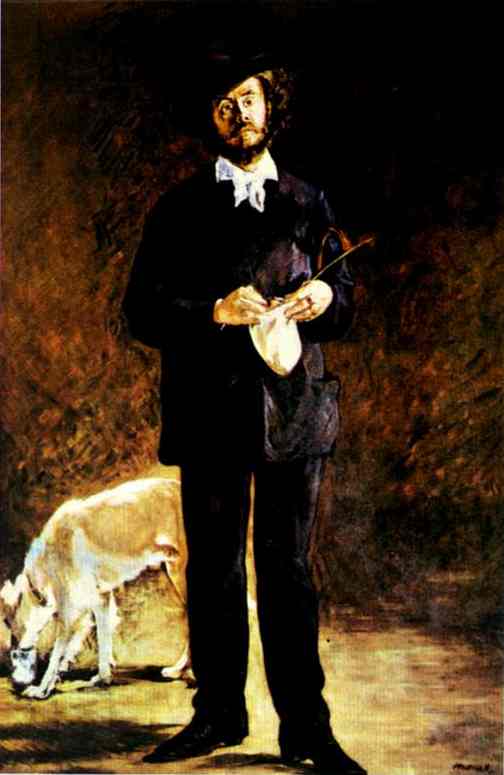
Portrait of Gilbert-Marcellin Desboutin
Gilbert-Marcellin Desboutin’s “Portrait of Gilbert Marcellin Desboutin,” painted by Édouard Manet in 1875, stands as a cornerstone of Impressionist art—a deceptively simple composition brimming with nuanced observation and psychological depth. More than just a likeness, it's an exploration of identity, perception, and the artist’s masterful manipulation of light to convey emotion. This remarkable oil painting resides within the Musée Fabre in Montpellier, France, offering visitors a chance to contemplate one of Manet’s most celebrated works alongside masterpieces by Degas and Renoir.
- Subject Matter: The portrait depicts Gilbert Marcellin Desboutin himself—a French painter and printmaker—seated in profile against a muted beige wall. His gaze is direct, unwavering, conveying an air of quiet contemplation that invites the viewer to engage in a silent dialogue.
- Style & Technique: Manet’s Impressionist style eschews academic conventions, prioritizing spontaneity and capturing fleeting moments of experience. Notice the loose brushstrokes—a hallmark of Impressionism—that create texture and luminosity without resorting to meticulous detail. The artist skillfully employs chiaroscuro—the interplay of light and shadow—to sculpt Desboutin's face and torso, emphasizing his form and creating a sense of three-dimensionality.
- Historical Context: Painted during the Belle Époque, “Portrait of Gilbert Marcellin Desboutin” reflects the artistic fervor of the era—a period marked by experimentation and a rejection of traditional artistic ideals. Manet’s work aligns with the broader Impressionist movement's challenge to represent reality as perceived by the senses rather than adhering to idealized representations.
- Symbolism: The subdued palette contributes to the painting’s contemplative mood, mirroring Desboutin’s inner state. Furthermore, the artist’s careful attention to detail—particularly in capturing the subtle nuances of Desboutin's expression—suggests a deeper psychological exploration beyond mere visual representation.
Provenance: The painting originated from Marcellin Desboutin’s estate and subsequently passed through the hands of Auguste Pellerin before being acquired by Martin Birnbaum for Grenville L. Winthrop, ultimately finding its home in the Fogg Art Museum at Harvard University. This journey underscores the painting's enduring significance within art history and its continued appreciation by collectors worldwide.
Additional Information: The Musée Fabre’s collection provides invaluable insight into Manet’s artistic vision—a testament to his ability to transform observation into evocative imagery. Examining “Portrait of Gilbert Marcellin Desboutin” alongside other Impressionist masterpieces allows for a richer understanding of the movement's aesthetic principles and its lasting impact on Western art.