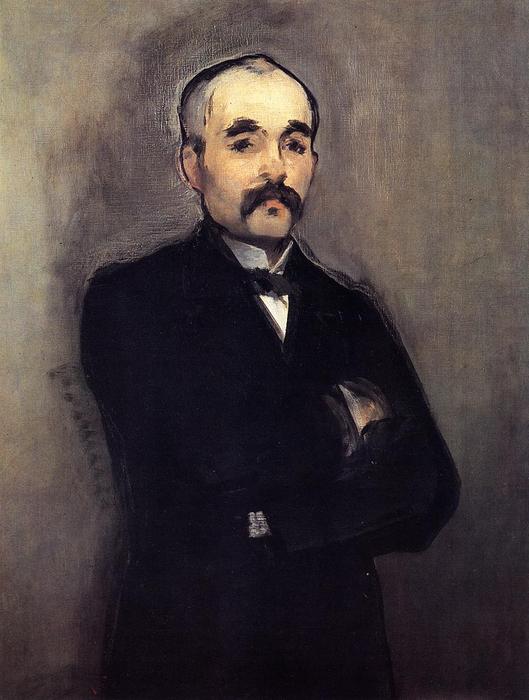
Portrait of Georges Clemenceau (Manet, Paris)
Édouard Manet’s *Portrait of Georges Clemenceau* stands as a testament to the artist's ability to capture not just likeness but also essence—a feat achieved through his masterful blend of Realism and Impressionistic techniques. Painted in 1879 during Manet’s formative years within the burgeoning Impressionist movement, this portrait delves into the complexities of Clemenceau’s character and reflects a profound respect for the figure who would become one of France's most influential statesmen. Let’s explore the intricacies of this remarkable artwork.
The Painting: A Study in Light and Texture
Measuring 94 x 74 cm, *Portrait of Georges Clemenceau* is executed in oil on canvas—a medium favored by Manet to imbue his canvases with rich textures and luminous colors. Unlike the polished surfaces characteristic of academic painting, Manet opted for loose brushstrokes that allowed light to dance across Clemenceau’s face and attire. The artist skillfully employed a palette dominated by muted browns and ochres, creating an atmosphere of contemplative seriousness. Notice how Manet captures the subtle nuances of skin tone—a hallmark of Impressionist realism—contrasting it with the textured fabric of Clemenceau's suit, hinting at the passage of time and experience.
Historical Context: Clemenceau’s Legacy
Georges Clemenceau (1841–1929) was a pivotal figure in French politics during the tumultuous years leading up to and encompassing World War I. Known for his uncompromising stance against German aggression and his unwavering determination to secure victory for France, Clemenceau embodied the spirit of resilience and strategic brilliance. Manet’s decision to portray him reflects not only admiration but also an understanding of Clemenceau's enduring influence on French history—a legacy cemented by his role as Prime Minister during the war years and his subsequent leadership in shaping the postwar settlement.
Artistic Significance: Impressionism's Bold Experimentation
Manet’s style exemplifies the bold experimentation that defined Impressionism, rejecting traditional conventions in favor of capturing fleeting moments of perception. He wasn’t interested in meticulously recreating Clemenceau’s appearance; rather, he sought to convey his inner state—a gaze directed downwards, suggesting introspection and contemplation. This subtle gesture speaks volumes about Manet's artistic vision—one that prioritized emotional resonance over photographic accuracy. The painting serves as a cornerstone of Impressionist art history, demonstrating the movement’s commitment to capturing the immediacy of experience.
Relevance Today: An Enduring Masterpiece
*Portrait of Georges Clemenceau* continues to captivate audiences today, offering insights into both artistic innovation and historical significance. Its masterful execution—characterized by luminous color palettes and expressive brushstrokes—remains a source of inspiration for artists worldwide. Moreover, the portrait serves as a poignant reminder of Clemenceau’s unwavering resolve during a period of profound upheaval—a figure whose legacy resonates powerfully across generations.
- Painting by 'Edouard Manet' | Edouard Manet: Portrait of Georges Clemenceau (94 x 74 cm, Impressionism, Oil On Canvas)
- Painting by 'Edouard Manet' | Edouard Manet: Portrait of Georges Clemenceau (115 x 88 cm, Kimbell Art Museum (Fort Worth, United States), Oil On Canvas)
ArtsDot.com offers high-quality, handmade oil painting reproductions of this masterpiece. Visit our website to explore more artworks by Edouard Manet and other renowned artists.
For further reading on the artist and his works:
Portrait of Stéphane Mallarmé Paul Cézanne