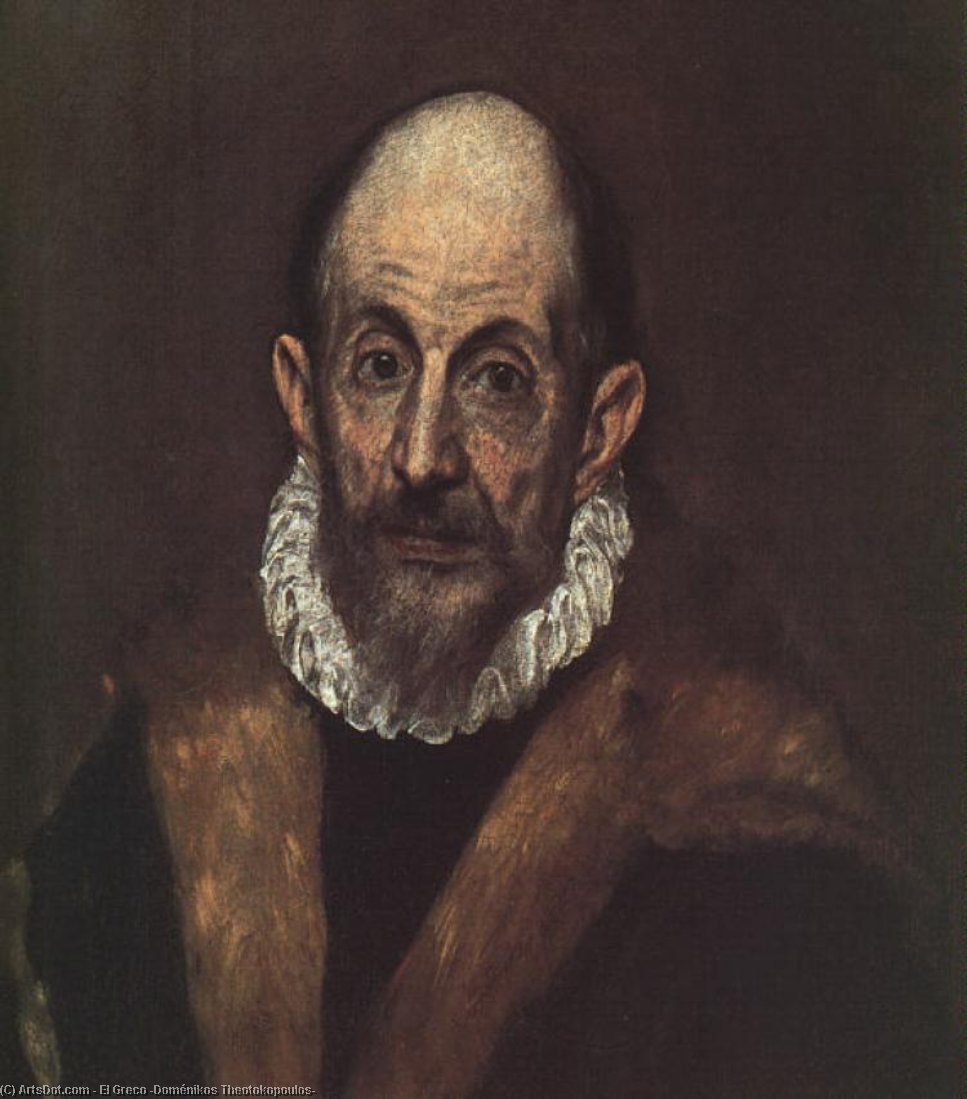
Portrait of an Old Man (Presumed Self-Portrait of El Greco)
The
Portrait of an old man (presumed self-portrait of El Greco), created in 1600, stands as a poignant testament to Doménikos Theotokópoulos’s artistic vision—a masterpiece that transcends mere representation and delves into the depths of human emotion. Attributed to El Greco, this oil on canvas painting measuring 52 x 46 cm resides within
The Museum Galleria Estense in Modena, Italy—a repository of Renaissance art celebrated for its exceptional collection.
The Artistic Context: Mannerism and Byzantine Legacy
El Greco’s artistic journey began within the traditions of Byzantium, where he honed his skills as an icon painter before embarking on a transformative voyage to Italy. This formative experience profoundly influenced his style, blending Byzantine iconography with Western techniques—a hallmark of Mannerism, a movement that prioritized expressive distortion and psychological intensity over classical ideals. The painting reflects this duality: the solemn stillness of Byzantine art juxtaposed against the dynamism inherent in Renaissance artistic sensibilities. Artists like Titian and Tintoretto served as inspiration for El Greco during his time in Venice, shaping his approach to color and composition.
A Detailed Examination of Technique
The
Portrait of an old man (presumed self-portrait of El Greco) showcases El Greco’s masterful command of oil paint—a medium he exploited with unparalleled sensitivity. Notice the elongated figure, a characteristic feature of Mannerist art, conveying a sense of spiritual contemplation. The artist employs subtle gradations of color and texture to depict the subject's skin tones, capturing the nuances of age and experience. Furthermore, the meticulous rendering of facial features—particularly the eyes—reveals an astonishing level of realism, imbued with profound emotion.
Symbolism and Emotional Resonance
Beyond its technical brilliance, the painting resonates with symbolic significance. The subject’s gaze directs outwards, suggesting a yearning for transcendence—a theme prevalent in El Greco's oeuvre. The robe worn by the figure symbolizes piety and humility, reflecting the artist’s own spiritual convictions. The muted palette contributes to the overall atmosphere of solemnity and introspection, inviting viewers to contemplate themes of mortality and faith. It is precisely this emotional depth that distinguishes El Greco’s work from its contemporaries—a timeless masterpiece that continues to captivate audiences centuries later.
Conclusion: An Enduring Masterpiece
The
Portrait of an old man (presumed self-portrait of El Greco) remains a cornerstone of Renaissance art—a profound meditation on human existence rendered with breathtaking artistry. Its enduring appeal stems from El Greco’s ability to convey complex emotions through deceptively simple forms and colors. For those seeking to immerse themselves in the legacy of this visionary artist,
handmade oil painting reproductions offer a remarkable opportunity to experience the beauty and power of El Greco’s artistic genius firsthand. Explore more about El Greco at
El Greco (Doménikos Theotokopoulos).