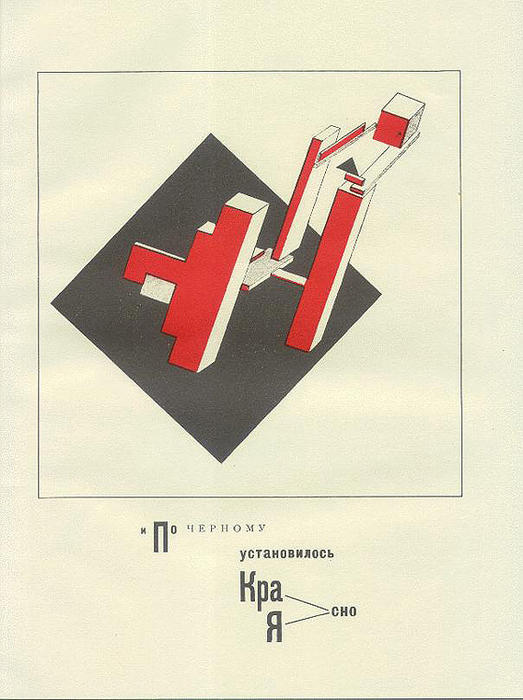
La obra 'Inserte el rojo y claro sobre negro' de El Lissitzky es una abstracción constructivista dinámica – audaces bloques rojos y blancos contra gris oscuro. Explore esta obra gráfica, maestra geométrica!
El Lissitzky (1890-1941) fue un artista, diseñador y arquitecto ruso fundamental para los movimientos Suprematismo, Constructivismo y Bauhaus. Explore su serie Proun, fotomontaje, tipografía y arte de propaganda soviética – dando forma al diseño gráfico del siglo XX.
Insert the Red and Clear on Black: A Revolutionary Vision
El Lissitzky’s “Insert the red and clear on black” (1920) stands as an emblem of Suprematism and Constructivism, representing more than just visual aesthetics; it embodies a profound philosophical stance rooted in the transformative fervor of the Russian Revolution. This striking composition immediately captivates with its bold simplicity – three interlocking angular blocks of crimson, white, and unpainted paper against a stark grey backdrop—a deliberate rejection of representational art in favor of pure geometric form.
Deconstructing Form & Color: The Essence of Suprematism
At first glance, the artwork appears deceptively straightforward. However, Lissitzky’s masterful manipulation of color and space reveals a sophisticated understanding of artistic principles. The central block isn't merely colored; it’s constructed from planes of pigment that subtly shift in perspective, creating an illusion of depth without resorting to traditional linear perspective. This technique—characteristic of Suprematism championed by Kazimir Malevich—aims to transcend the limitations of visual perception and capture fundamental truths about existence through abstract shapes. The angular blocks themselves aren't depictions of objects but rather embodiments of pure geometric forms – cubes and rectangles – symbolizing stability, order, and a rejection of illusionistic representation.
A Bridge Between Worlds: Suprematism & Constructivism’s Dialogue
“Insert the red and clear on black” occupies an intriguing position within the artistic landscape of its time, reflecting the tensions between Suprematism's spiritual quest for pure feeling and Constructivism’s pragmatic focus on building a new society through industrial design. Lissitzky’s deliberate use of angular forms—echoing Malevich’s iconic “Black Square”—suggests a desire to dismantle established conventions and forge a radically different visual language. Simultaneously, the arrangement of blocks subtly hints at architectural elements – perhaps even hinting at the fractured societal structure attempting to rebuild itself after the revolution—underscoring Constructivism's commitment to practical application and connection with the real world.
Technique & Materials: Precision in Minimalism
Executed with meticulous care using ink on paper, Lissitzky’s artwork exemplifies the graphic precision demanded by both Suprematism and Constructivism. The stark contrasts between black and color—particularly the vibrant red—are achieved through careful shading and layering of pigment, demonstrating a mastery of artistic technique. The flatness of the image reinforces the conceptual core of the piece: prioritizing form over representation. Lissitzky’s deliberate choice of materials – paper and ink – speaks to the austerity of the era and underscores the artist's commitment to conveying ideas with uncompromising clarity.
Symbolic Resonance: Beyond Aesthetics
Ultimately, “Insert the red and clear on black” transcends mere visual beauty; it carries symbolic weight. The color red—often associated with revolution and passion—contrasts powerfully against the grey background, symbolizing resilience and determination amidst adversity. The interlocking angular blocks represent unity and dynamism, mirroring the aspirations of a society striving for progress and transformation. Lissitzky’s artwork remains an enduring testament to the power of abstraction to communicate complex ideas and emotions – a timeless masterpiece that continues to inspire contemplation and admiration.