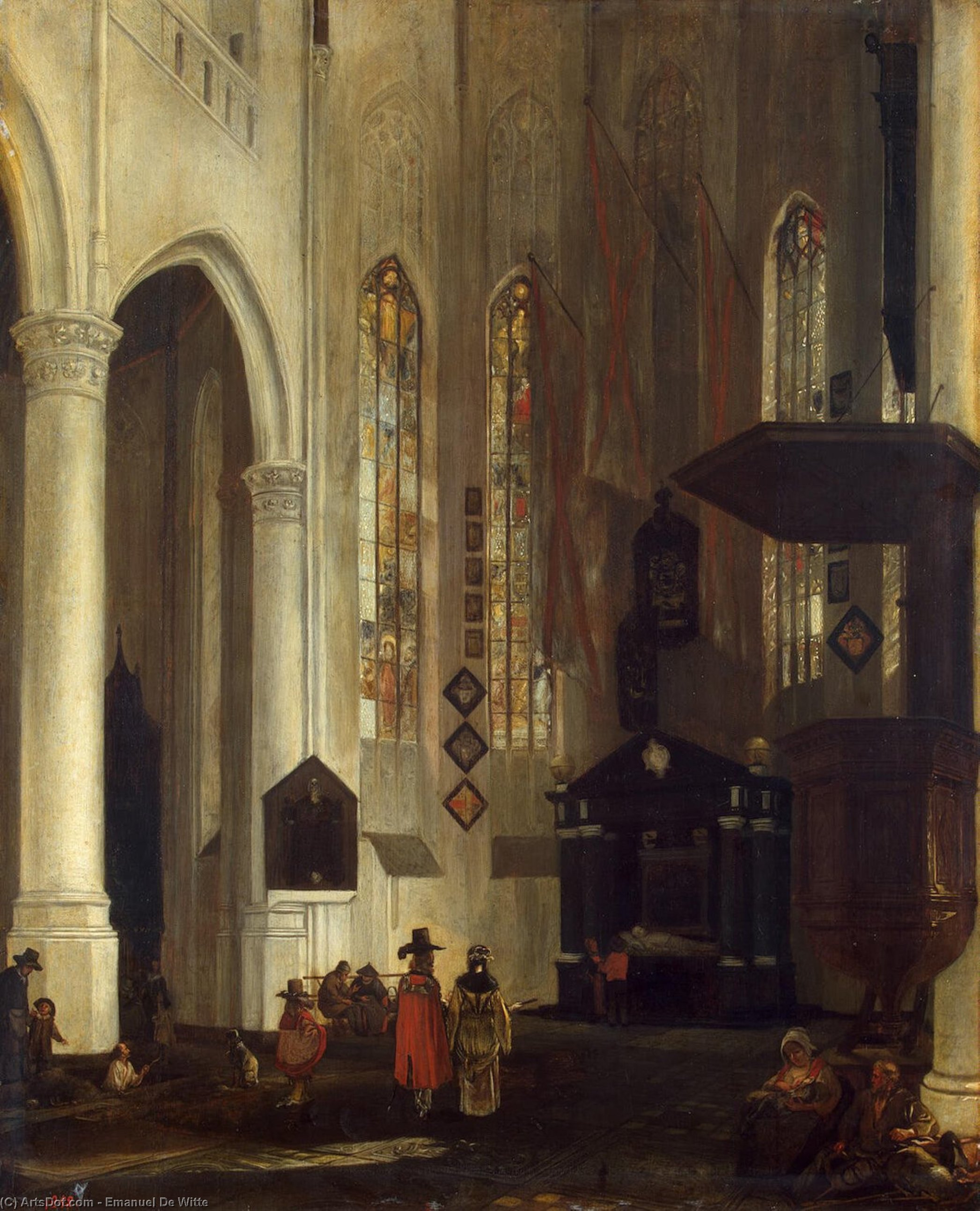
A Breathless Reverie: Emanuel de Witte’s Interior of Delft’s Oude Kerk
Emanuel de Witte stands apart from the towering figures of his contemporaries—Pieter Saenredam, Rembrandt—not in ambition or renown, but in a singular artistic vision. Rather than meticulously documenting architectural grandeur, De Witte sought to distill the very essence of sacred space: its palpable stillness, its luminous grace, and the subtle drama unfolding within its walls. This pursuit distinguishes him as a master of atmosphere, prioritizing feeling over factual precision—a characteristic that resonates powerfully with viewers encountering his paintings today.
Early Delft Training & The Shift Towards Interior Views
Born in Alkmaar in 1617, De Witte’s formative years were spent honing his skills under the tutelage of Johannes Vermeer and Pieter Saenredam—artists who shared a fascination for capturing light and texture. However, unlike Saenredam's dedication to architectural renderings, De Witte embarked on a distinct path in 1650, gravitating towards depictions of church interiors. This pivotal decision reflects a broader trend within Dutch Baroque art: a move away from grand narratives toward contemplative explorations of faith and spirituality.
Technique & The Illusionistic Brilliance of Light
De Witte’s approach to painting was characterized by an unwavering commitment to illusionism—a technique perfected during the Golden Age that aimed to create convincing representations of three-dimensional space. He achieved this remarkable feat through careful observation and masterful manipulation of light, employing chiaroscuro—the dramatic interplay between light and shadow—to sculpt forms and imbue his canvases with emotional depth. As evidenced by ‘Interior of the Oude Kerk,’ De Witte’s brushstrokes are remarkably subtle yet decisive, conveying a profound sense of realism.
Delft's Gothic Legacy & The Painting's Symbolic Resonance
'Interior of the Oude Kerk,' painted in 1650, captures Delft’s architectural heritage—a magnificent Gothic cathedral that had endured centuries of Reformation upheaval. The painting isn’t merely a visual record; it embodies the spiritual fervor of its time, reflecting the fervent piety of the Dutch Reformed Church. Notice the placement of the figures—grouped strategically to emphasize the solemnity of prayer and contemplation—and consider the diffused light filtering through the stained glass windows, symbolizing divine illumination.
A Moment Frozen in Time: Emotional Impact & Artistic Legacy
More than just aesthetically pleasing, De Witte’s ‘Interior of the Oude Kerk’ transcends its formal elements to evoke a powerful emotional response. The painting invites viewers into a realm of quiet reverence—a space where worldly concerns dissolve and spiritual contemplation reigns supreme. It stands as a testament to De Witte's artistic genius—a singular achievement that continues to inspire admiration and provoke discussion among art historians and collectors alike.
- Artist: Emanuel de Witte
- Born Year: 1617
- Death Year: 1692
- Birth City: Alkmaar
- Birth Country: Netherlands
Additional Research Links:
Artwork Details:
- Title: Old Church in Delft
- Artist: Emanuel de Witte
- Date: 1642
- Size: 95 x 82 cm
- Medium: Oil on Canvas