Scena di Toeletta: A Descent into Expressionist Anxiety
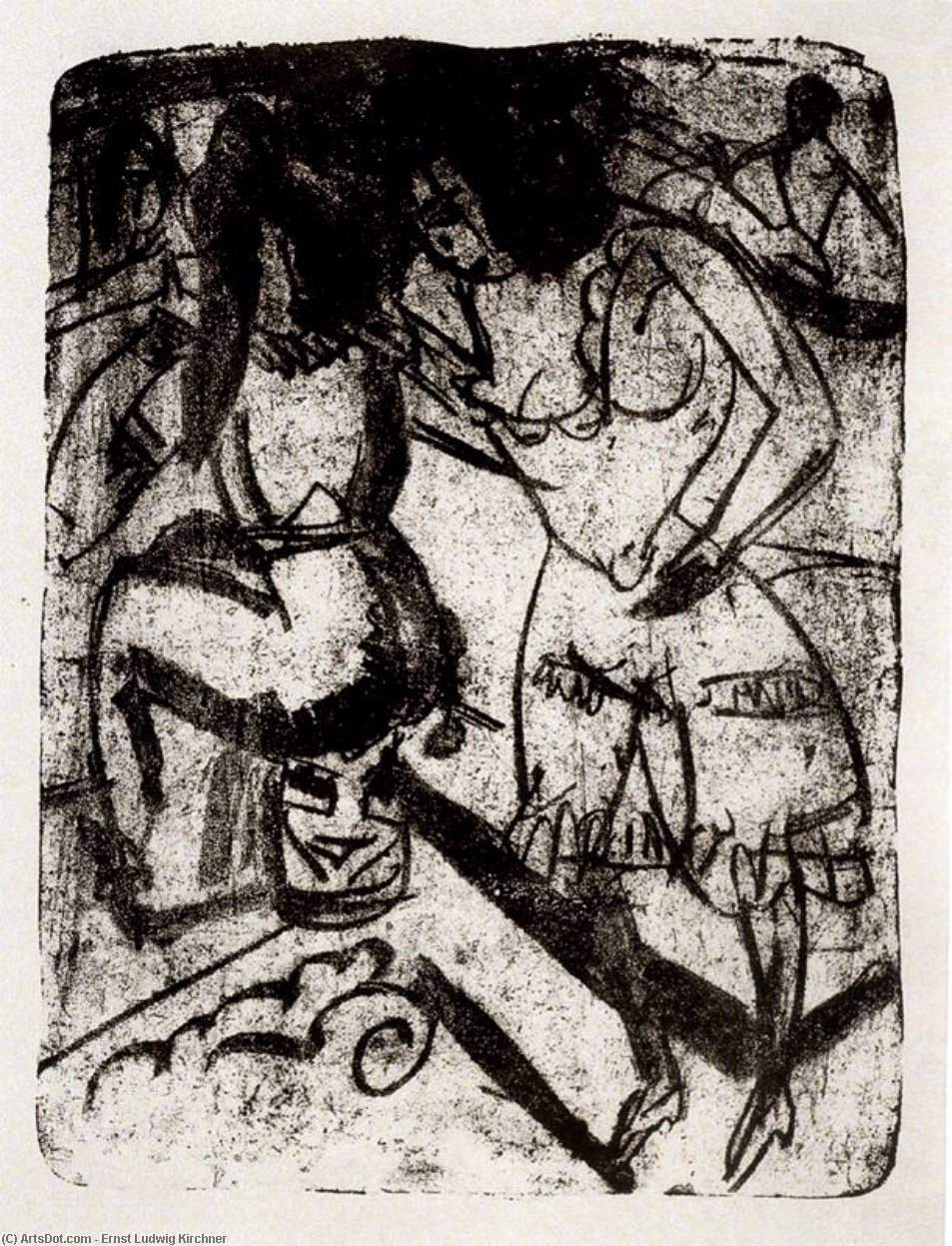
Ernst Ludwig Kirchner’s “Scena di Toeletta” (Dressing Scene) is not merely a depiction of figures engaged in an intimate act; it's a visceral plunge into the anxieties and uncertainties that defined the heart of German Expressionism. Executed as a woodcut print, this work immediately confronts the viewer with its raw energy – a chaotic composition dominated by jagged lines, stark contrasts, and a deliberately unsettling palette of black, white, and grey. The image’s power lies not in realistic representation but in its ability to evoke a profound emotional response, forcing us to confront themes of isolation, unease, and perhaps even the darker aspects of human interaction.
Kirchner, born in 1880 in Aschaffenburg, was a pivotal figure in the Expressionist movement. His early life, marked by frequent relocations due to his father’s profession as a surveyor, instilled within him a sense of displacement – a feeling that would become a recurring motif in his art. Rejecting the conventions of academic painting, Kirchner sought to express subjective experience through distortion and simplification, mirroring the turbulent social and political climate of early 20th-century Germany. “Scena di Toeletta” embodies this approach perfectly; the figures are not rendered with anatomical precision but as angular masses, their forms deliberately fractured to convey a sense of psychological distress.
Technique and Materiality: The Language of Woodcut
The artwork’s impact is inextricably linked to its technical execution. Kirchner masterfully employed the woodcut technique – a process that was central to Expressionist aesthetics. He meticulously carved intricate lines into a block of wood, creating a matrix from which multiple prints could be produced. Inking this block and pressing it onto paper resulted in a distinctive texture characterized by visible graininess and unevenness, a testament to the physicality of the medium. The deliberate roughness of the print adds another layer of emotional intensity, suggesting a sense of urgency and raw feeling.
The use of hatching and cross-hatching further enhances this textural effect, creating depth and dynamism within the composition. These techniques are not simply employed for shading; they contribute to the overall frenetic energy of the image, mirroring the psychological turmoil depicted. The limited color palette – a monochromatic symphony of black, white, and grey – amplifies the starkness and emotional impact, stripping away any distractions and focusing attention on the formal elements of the composition.
Symbolism and Emotional Resonance
“Scena di Toeletta” is rife with symbolic potential. The distorted figures, engaged in an activity that suggests intimacy, are presented within a claustrophobic space, creating a sense of unease and confinement. This spatial distortion mirrors the psychological state of the subjects, suggesting feelings of anxiety, isolation, and perhaps even voyeurism. The lack of a clear focal point further contributes to this unsettling effect, forcing the viewer to confront the ambiguity and uncertainty inherent in the scene.
The artwork’s emotional impact is undeniable. Kirchner's masterful manipulation of line, form, and color creates a powerful visual experience that resonates with viewers on a deeply visceral level. It’s a work that demands attention, prompting reflection on themes of alienation, psychological distress, and the anxieties of modern life – concerns that remain remarkably relevant today.
Historical Context and Artistic Significance
Created in the early 20th century, “Scena di Toeletta” stands as a powerful example of Kirchner’s engagement with the broader currents of Expressionism. The movement, emerging in response to rapid industrialization, urbanization, and social upheaval, sought to capture the subjective experience of modern life – often through intensely emotional and distorted imagery. Kirchner's work aligns perfectly with this ethos, reflecting the anxieties and uncertainties that characterized the era.
As a significant piece within Kirchner’s oeuvre, “Scena di Toeletta” offers a compelling insight into his artistic vision and his profound understanding of human psychology. Its enduring power lies in its ability to evoke a timeless sense of unease and anxiety – a testament to Kirchner's mastery as one of the most influential figures in the history of modern art.