Eine Klünstlerruppe: A Window into Kirchner's Soul
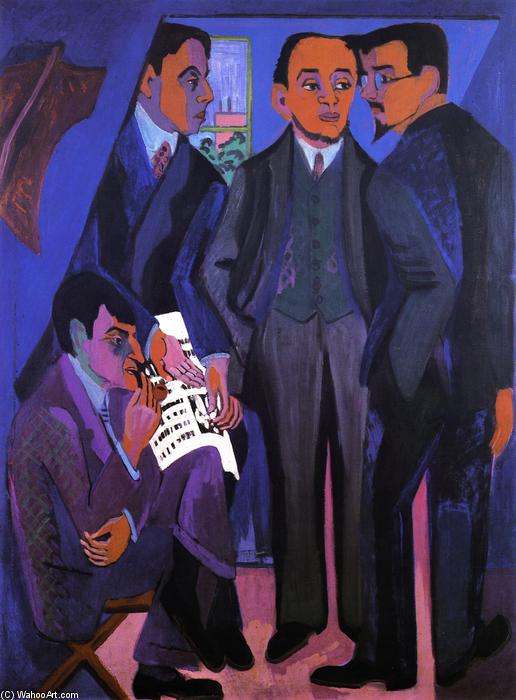
Ernst Ludwig Kirchner’s “Eine Klünstlerruppe” (A Group of Artists) – painted in 1926 – is more than just a depiction of four men engaged in conversation; it’s a profoundly evocative exploration of the anxieties and aspirations simmering beneath the surface of Weimar Germany. Measuring 168 x 126 cm, this oil-on-canvas work, currently residing within the Museum Ludwig in Germany, offers an intimate glimpse into Kirchner's world – a world characterized by intense emotion, fractured perspectives, and a relentless pursuit of authentic expression.
Kirchner’s masterful use of color and form immediately draws the viewer into the scene. The stark black and white palette, characteristic of his mature style, amplifies the sense of unease and tension. The figures themselves are rendered with distorted features and exaggerated proportions, a hallmark of Expressionism's rejection of naturalistic representation. The men’s suits, formal yet slightly rumpled, speak to the pressures of modern urban life, while their postures suggest a mixture of contemplation and perhaps, underlying frustration. The inclusion of details like the umbrella, chair, and book isn’t merely decorative; they contribute to the painting's narrative complexity, hinting at intellectual pursuits and the burdens of artistic endeavor.
The Expressionist Vision
Created during a period of significant social and political upheaval in Germany, “Eine Klünstlerruppe” reflects the broader anxieties of the era. Kirchner was deeply engaged with the burgeoning Expressionist movement, which sought to convey subjective emotions and experiences rather than objective reality. This painting exemplifies this approach through its deliberate distortion of form and color, aiming not to mirror the world as it appears but to reveal the emotional state of the subjects – and by extension, the viewer.
The artist’s technique is particularly noteworthy. Kirchner employed a vigorous brushstroke, applying paint with a raw energy that conveys a sense of urgency and movement. The layering of colors, though predominantly monochrome, creates subtle variations in tone and texture, adding depth and richness to the composition. Notice how the light falls across the figures, emphasizing their angular forms and contributing to the overall feeling of unease.
Symbolism and Context
Beyond its formal qualities, “Eine Klünstlerruppe” is laden with symbolic meaning. The gathering of artists can be interpreted as a representation of the creative process itself – a struggle for self-expression amidst societal pressures. The room’s furnishings—the umbrella, chair, and book—suggest intellectual engagement and perhaps a yearning for escape from the harsh realities of the outside world. Kirchner's earlier works, such as “Grünes Haus,” demonstrate his early experimentation with color and form, while pieces like "Dodo mit großem Federhut" showcase his ability to capture fleeting moments of beauty and emotion. These diverse works collectively reveal Kirchner’s evolution as a pivotal figure in the development of Expressionism.
Collecting and Appreciation
“Eine Klünstlerruppe” is a powerful testament to Ernst Ludwig Kirchner's artistic vision and enduring legacy. Its evocative imagery, masterful technique, and historical significance make it a compelling addition to any art collection. ArtsDot offers meticulously crafted hand-painted reproductions of this iconic work, allowing you to experience its emotional depth and artistic brilliance firsthand. Whether for personal enjoyment or interior design inspiration, a reproduction of “Eine Klünstlerruppe” is an investment in a piece of art history – a window into the soul of one of Germany’s most important Expressionist artists.