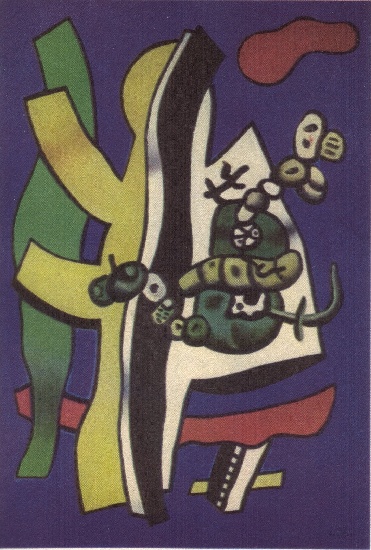
Still life on a blue background by Fernand Léger embodies modernist principles with bold colors and abstracted shapes depicting objects like a shoe, chair, bottle, and bowl against a striking azure backdrop.
Explore el arte de Fernand Léger (1881-1955), un pionero del Cubismo y 'Tubismo'. Descubre sus audaces pinturas figurativas que celebran la vida moderna, las máquinas y la forma humana. ¡Un precursor del Pop Art!
Still Life on Blue – A Reflection of Léger’s Vision
The painting “Still life on Blue,” executed in 1939 by Fernand Léger, isn't merely an arrangement of objects; it’s a deliberate manifesto of modernist aesthetics and a profound meditation on the relationship between humanity and technology. Léger, already established as a champion of geometric abstraction – notably his pioneering use of “Constructivist” principles – sought to distill the complexities of the industrial landscape into its most fundamental components: bold lines and simplified forms rendered in striking hues. This artwork exemplifies his unwavering commitment to portraying not just what is seen but also *how* it feels—the palpable energy of a world increasingly dominated by machines.
Composition and Technique
The canvas showcases Léger’s signature technique – a masterful blend of planar color fields punctuated by angular, geometric shapes. The dominant blue background isn't simply decorative; it serves as an active participant in the visual narrative, creating a sense of depth without resorting to traditional perspective. Overlaid upon this expanse are stylized representations of everyday objects: a shoe, a chair, a bottle, and a bowl—each rendered with meticulous precision but stripped down to their essential geometric forms. Léger’s brushstrokes are deliberately loose and expressive, conveying movement and dynamism despite the apparent stillness of the scene. He achieved this effect through layering thin washes of color and applying textured surfaces that subtly disrupt the flatness of the composition.
Historical Context: The Machine Age Emerges
“Still life on Blue” was created during a period of significant upheaval in Europe—the shadow of impending war loomed large, mirroring the anxieties surrounding rapid industrialization and urbanization. Léger’s artistic endeavors coincided with the burgeoning Constructivist movement in Russia, where artists like Vladimir Tatlin championed the use of geometric abstraction as a tool for social reform. This influence is evident in Léger's unwavering belief that art could contribute to shaping a more rational and efficient society—a conviction rooted in his fascination with the mechanical world and its transformative potential. The painting reflects not only Léger’s personal aesthetic preferences but also the broader cultural currents of his time.
Symbolism: Beyond Representation
While eschewing realistic depiction, Léger imbued “Still life on Blue” with symbolic resonance. The blue background represents stability and contemplation—a counterpoint to the turbulent forces shaping the era—yet it's simultaneously infused with an underlying tension, mirroring the anxieties surrounding technological advancement. The geometric shapes themselves symbolize order and logic, reflecting Léger’s conviction that reason could overcome irrationality and guide humanity toward a brighter future. Even the seemingly mundane objects – the shoe, the chair, the bottle – are transformed into emblems of human presence within the machine age, prompting viewers to consider the implications of this evolving relationship between man and technology.
Emotional Impact: A Quiet Assertion
Despite its bold visual language, “Still life on Blue” possesses a remarkable serenity—a quiet assertion of Léger’s artistic vision. The painting invites contemplation rather than immediate judgment, encouraging viewers to engage with its underlying themes of order, dynamism, and symbolic representation. It's a testament to Léger’s ability to convey profound ideas through deceptively simple forms, demonstrating that true artistry lies not in slavishly imitating nature but in capturing the essence of human experience—a feat accomplished with grace and unwavering conviction. The artwork continues to inspire those who appreciate the power of abstraction to communicate complex emotions and ideas.