A Symphony of Form and Futurist Vision
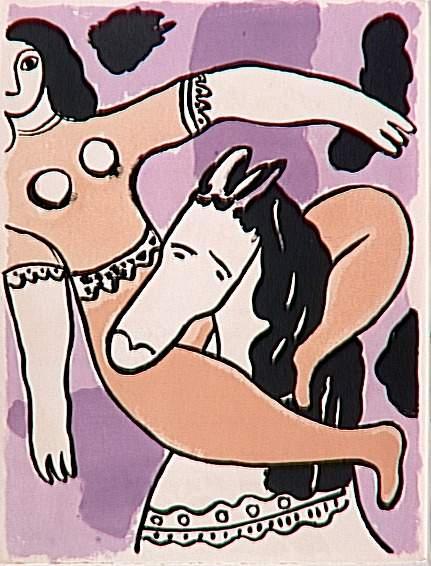
Fernand Léger's "The Album 'Circus'" (1950) stands as an arresting declaration of artistic ambition, capturing the electric anxieties and exhilarating rhythms of a world in transition. This monumental canvas transcends simple representation, immersing the viewer in a meticulously crafted universe where geometric abstraction dances with palpable physicality. In this work, Léger achieves a masterful synthesis of movement and structure, inviting us into a spectacle that is as much about the energy of the machine age as it is about the theatricality of the circus ring. The painting presents a striking scene: a woman in a vibrant purple dress, her form rendered with a raw, elemental grace, riding upon the back of a horse. This central figure, caught in a moment of dynamic tension, serves as the heartbeat of the composition, anchoring the swirling energy of the surrounding figures and fragmented forms.
The visual language of the piece is deeply rooted in the tenets of Futurism, an avant-garde movement that championed speed, technology, and the relentless progress of modern life. Léger breathes new life into these principles by rejecting traditional academic constraints in favor of a fragmented, rhythmic aesthetic. The horse’s torso and limbs are not merely anatomical studies but are instead rendered through starkly contrasting hues and interlocking planes, embodying a sense of kinetic energy that mirrors the pulsating rhythm of a live performance. Through this lens, the circus becomes a metaphor for the modern condition—a place where disparate elements collide, overlap, and create a beautiful, chaotic harmony.
The Mastery of Texture and Geometric Precision
What distinguishes "The Album 'Circus'" is Léger’s ability to marry rigorous geometric precision with a deeply tactile surface. He employs a sophisticated technique of layering, utilizing thick impasto strokes that create palpable ridges and valleys across the canvas. This deliberate texture serves a vital purpose: it counteracts the perceived coldness of pure abstraction, lending the work a sense of "flesh" and immediacy. The interplay of light across these raised surfaces adds a three-dimensional quality to the painting, making the colors appear to vibrate with their own internal light.
The composition is built upon a foundation of angular lines and interlocking shapes that guide the eye through the bustling scene. As we gaze upon the figures positioned near the periphery—elements of a larger, unseen crowd—we feel the scale of the event. For the collector or interior designer, this piece offers a profound sense of depth and movement. It is a work that does not merely sit upon a wall but actively engages with the space around it, projecting a sophisticated energy that can anchor a room with its bold, modernist spirit. To possess a reproduction of this masterpiece is to bring a fragment of the 20th century's most transformative artistic era into one's personal sanctuary.
An Emotional Resonance for the Modern Collector
Beyond its technical brilliance, "The Album 'Circus'" evokes a complex emotional landscape. There is a sense of liberation in the way Léger breaks down form, yet there is also a structured strength that provides comfort and stability. The painting captures the essence of a lively performance—the dust, the tension, the sudden bursts of color, and the shared breath of an audience. It is a celebration of life's dynamism and the beauty found within fragmentation.
For those seeking to curate a collection defined by intellectual depth and visual impact, this work offers unparalleled inspiration. It serves as a conversation piece that bridges the gap between the historical weight of the mid-century avant-garde and the sleek, minimalist aesthetics of contemporary design. Whether placed in a professional gallery setting or a private residence, Léger’s vision remains eternally modern, reminding us that even in a world of mechanical precision, there is an irrepressible, human pulse that refuses to be contained.