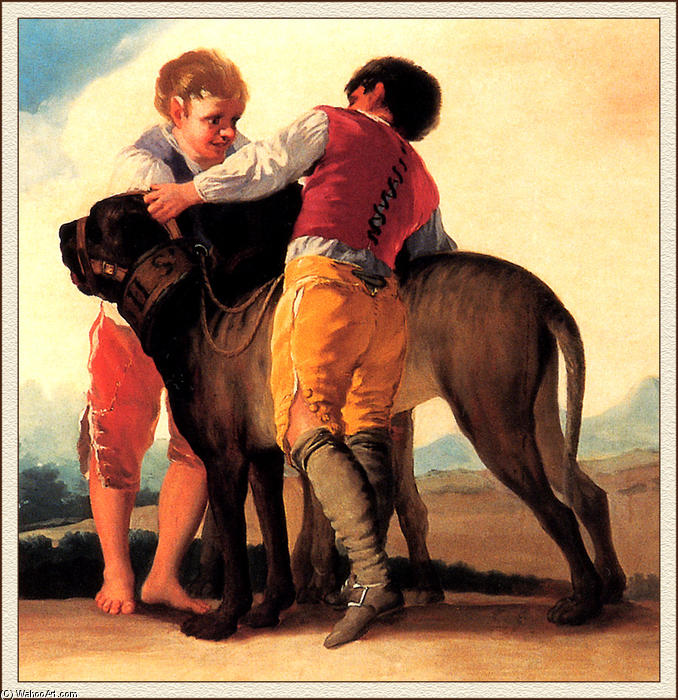
Boys With Mastiff: Exploring Goya’s Pastoral Vision
Francisco José de Goya y Lucientes' “Boys With Mastiff” stands as a poignant emblem of Romanticism’s fascination with the sublime beauty of nature intertwined with human emotion. Painted in 1786, this unassuming oil canvas transcends its seemingly simple depiction—two young boys accompanied by a noble mastiff and horse—to deliver a profound meditation on childhood innocence and the harmonious relationship between humanity and the natural world.
- Subject & Narrative: The scene unfolds in a tranquil Spanish countryside, capturing a fleeting moment of companionship. Goya eschews grand narratives, instead presenting an intimate tableau that speaks volumes about pastoral ideals prevalent during his time. It’s a deliberate contrast to the opulent grandeur favored by the aristocracy, prioritizing genuine connection and observation.
- Style & Technique: “Boys With Mastiff” embodies Goya's early stylistic trajectory—a departure from Rococo’s elaborate ornamentation yet retaining its foundational elegance. The artist employs soft brushstrokes and diffused light, creating an atmosphere of serenity and warmth. Crucially, Goya’s meticulous technique demonstrates a masterful understanding of texture; the rough weave of the boys’ clothing juxtaposes with the sleek fur of the horse and the muscular contours of the mastiff—a testament to his dedication to realism.
Historical Context & The Court Painter's Commission
The painting likely originated from a commission by a noble family seeking to portray an idealized vision of rural life – a motif frequently explored in 18th-century art. This reflects the broader cultural preoccupation with moral virtue and contemplation during Goya’s formative years as court painter, marking a significant shift away from Rococo’s frivolity.
- Transitioning Styles: While “Boys With Mastiff” showcases Goya's early Rococo influences, it simultaneously foreshadows his later artistic explorations into darker themes and social critique. The subtle emotional depth conveyed through the boys’ interaction with animals hints at a psychological complexity that would characterize his oeuvre.
Symbolism & Artistic Impression
Beyond its aesthetic qualities, “Boys With Mastiff” resonates with symbolic significance. The mastiff and horse represent strength and nobility—symbols of guardianship and dominion—yet they are presented alongside vulnerable children, highlighting the importance of protecting innocence and fostering a connection to the natural world. Goya’s masterful use of color – earthy browns and ochres accented by muted greens and splashes of red – contributes to the painting's nostalgic mood.
- Composition & Lighting: The shallow perspective draws viewers into the immediacy of the scene, emphasizing the figures and animals as central elements. Diffused lighting casts a gentle glow upon the subjects, enhancing their serenity and conveying a sense of timeless beauty.
Material Analysis & Artistic Craftsmanship
Executed in oil paints on canvas, “Boys With Mastiff” exemplifies Goya’s meticulous attention to detail. Loose brushwork imbues the painting with expressive dynamism while simultaneously capturing the textures of fabric and animal fur—a testament to his unparalleled artistic skill. The artist skillfully builds form through layering paint, creating subtle highlights and shadows that lend depth and realism to the composition.