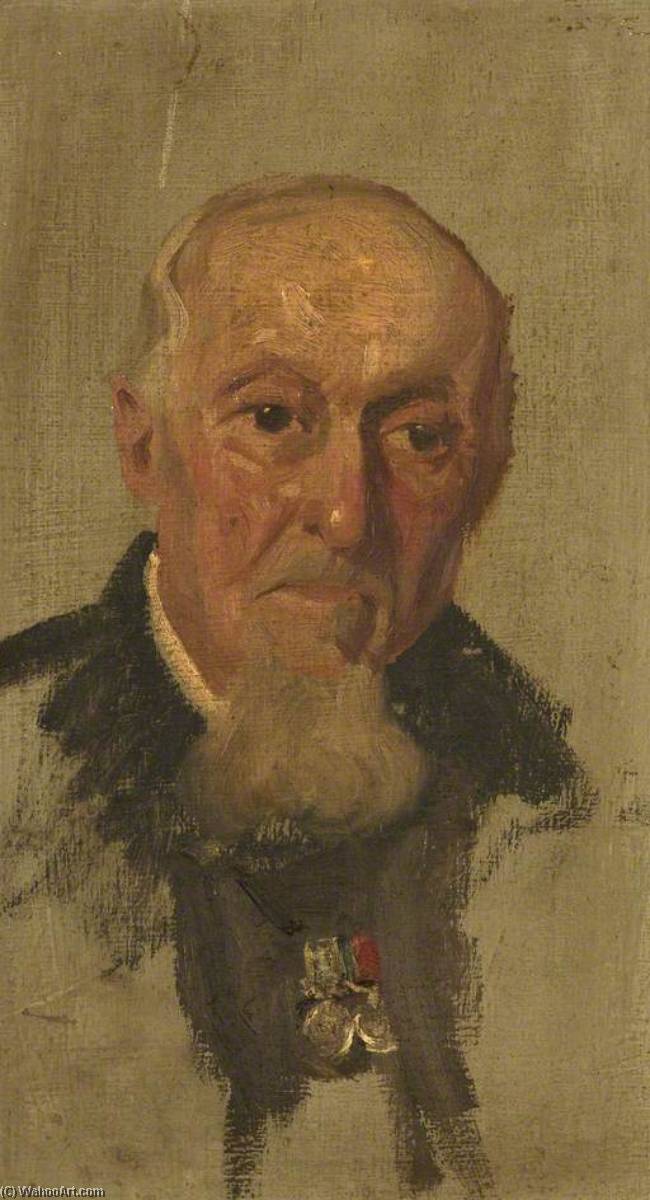
Admire 'J. Ashton, 4th Ft' by George Edmund Butler – a captivating portrait from 1920. A masterful oil painting showcasing a distinguished gentleman’s presence. Explore the art.
Descubre a George Edmund Butler (1872-1936), pintor británico de paisajes y retratos, artista oficial de la NZEF en la WWI y exhibidor en la Royal Academy. Explora sus óleos y acuarelas.
Descubre los tesoros del Bristol Museum - Art Gallery, desde momias egipcias hasta obras de Turner y Banksy, en un impresionante entorno eduardiano que te invita a explorar su rico legado cultural.
A Window into Victorian Sentiment: J. Ashton’s “J. Ashton, 4th Ft”
The painting "J. Ashton, 4th Ft" by George Edmund Butler, completed in 1920, isn't merely a portrait; it’s a carefully constructed window into the sensibilities of early 20th-century Britain – a period grappling with rapid industrialization, evolving social structures, and a lingering fascination with tradition. Butler, a British artist who spent formative years in New Zealand before returning to England, masterfully captures a man of quiet authority and understated dignity, rendered in a style that blends the formality of Victorian portraiture with the nascent influences of modernism. The piece immediately draws the eye with its rich palette – deep browns, muted greens, and subtle blues – creating an atmosphere of contemplative seriousness. The artist’s skill lies not just in replicating likeness but in conveying a sense of inner life through subtle shifts in expression and posture.
Technical Mastery and Artistic Influences
Butler's technique is characterized by a meticulous attention to detail, evident in the painstakingly rendered textures of the man’s suit, the delicate folds of his mustache, and the subtle sheen on his face. He employed oil paints on panel, a medium that allowed for layering and blending, contributing to the painting’s depth and luminosity. His training at institutions like the Wellington School of Design and later in Europe – particularly Antwerp Academy – exposed him to diverse artistic influences. Notably, Butler's work demonstrates an appreciation for the academic tradition while subtly incorporating elements of Impressionism, most notably in his use of light and shadow to create a sense of atmosphere. The slightly loose brushwork, especially around the edges of the figure, hints at a desire to capture fleeting moments rather than rigidly adhering to photographic realism – a hallmark of the era’s artistic shift.
A Portrait of an Era: Context and Symbolism
“J. Ashton, 4th Ft” was painted during a period of significant social change in Britain. The Victorian era, though formally ending in 1901, continued to exert a powerful influence on societal norms and values. The subject’s attire – the formal suit, the meticulously groomed mustache – speaks volumes about his status and adherence to these established conventions. While the sitter's name is not explicitly stated, the “4th Ft” designation suggests he may have been a military officer or a gentleman of considerable standing within a landed gentry family. The serious expression on his face invites speculation about his thoughts and experiences – perhaps reflecting the anxieties and uncertainties of a rapidly changing world. The background, deliberately muted and indistinct, serves to focus attention entirely upon the subject, reinforcing his importance and commanding presence.
Emotional Resonance and Lasting Appeal
Beyond its historical context, “J. Ashton, 4th Ft” possesses a profound emotional resonance. The painting’s quiet dignity and understated elegance evoke a sense of nostalgia for a bygone era – a time when social decorum and personal honor were highly valued. The subject's gaze, direct yet restrained, creates an intimate connection with the viewer, inviting us to contemplate his story and our own place within the continuum of human experience. It’s a painting that speaks not just to the eye but also to the heart, offering a glimpse into the soul of a man caught between tradition and modernity. Reproductions of this piece offer a beautiful way to bring a touch of Victorian sentiment into any interior space, serving as both an artistic statement and a tangible link to the past.