The Enigmatic Figure of George Edmund Butler’s “R. Germain, 4th”
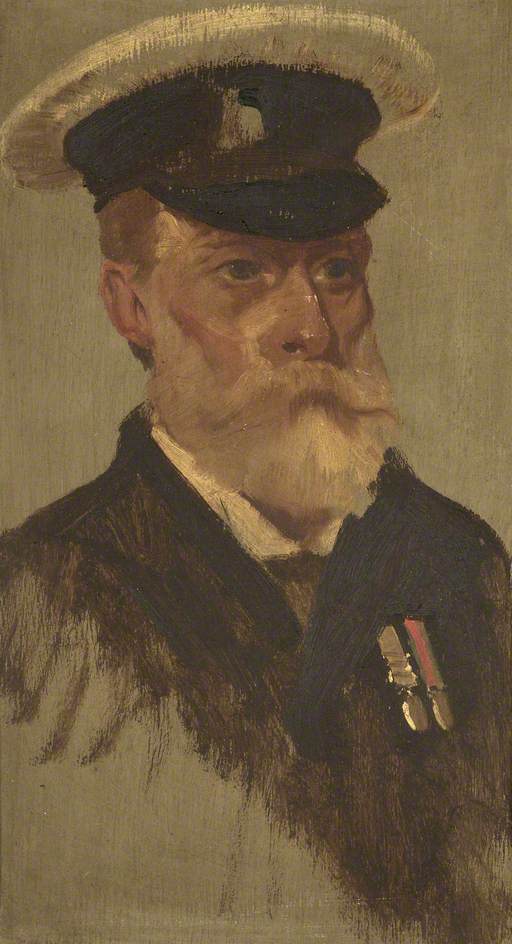
George Edmund Butler's "R. Germain, 4th," a captivating black and white portrait painted in 1920, isn’t merely a depiction of an individual; it’s a carefully constructed tableau of experience, bearing the weight of time and hinting at untold stories. Housed within the Bristol Museum – Art Gallery, this oil on panel work transcends its modest dimensions (23 x 13 cm) to evoke a profound sense of quiet contemplation—a feeling that lingers long after viewing. The painting immediately draws the eye to the subject’s face: weathered yet dignified, framed by a neatly trimmed white hat adorned with a subtle black stripe. His gaze is direct, almost challenging, suggesting a life lived fully and perhaps with a touch of melancholy. The muted palette—primarily browns, blues, and blacks—creates an atmosphere of vintage formality, reminiscent of early 20th-century naval uniforms and the stoicism expected of military officers.
Butler’s masterful use of impressionistic techniques elevates the portrait beyond a simple likeness. Visible brushstrokes dance across the panel, creating a textured surface that invites close inspection. The artist skillfully employs light and shadow to sculpt the subject's features, lending depth and realism while simultaneously maintaining an ethereal quality. The loose rendering of form—particularly in the folds of his jacket and the subtle shading around his eyes—suggests movement and life, preventing the image from feeling static or overly formal. It’s a deliberate choice that speaks to Butler’s artistic sensibility and his ability to capture not just appearance but also essence.
A Sailor's Story: Context and Historical Significance
Understanding “R. Germain, 4th” requires delving into the life of its creator, George Edmund Butler. Born in Southampton, England, in 1872, Butler’s journey took him from his childhood in New Zealand to a distinguished career as a portrait painter and, crucially, an official war artist during World War I. His background as a military observer—a veteran of the New Zealand Expeditionary Force—infuses the painting with a palpable sense of history and experience. The subject's attire – a white hat with a black stripe, a blue jacket, and medals – strongly suggests service in the Royal Navy, likely during the early years of the 20th century. The medals themselves are not merely decorative; they represent years of dedicated service and sacrifice, adding layers of meaning to the portrait.
Further research reveals that Butler’s work was deeply influenced by his time in New Zealand, a land he embraced with passion after emigrating as a child. His portraits often captured the spirit of the nation's rugged landscapes and its people—a blend of European heritage and indigenous influence. “R. Germain, 4th” embodies this duality, reflecting both the formality of military tradition and the understated dignity of the New Zealand character.
Symbolism and Emotional Resonance
Beyond its historical context, "R. Germain, 4th" resonates with a powerful emotional core. The subject’s expression—a mixture of quiet strength and perhaps a hint of sadness—suggests a man who has witnessed significant events and carries the weight of experience. The painting isn't celebratory; it doesn't exude youthful exuberance. Instead, it offers a glimpse into the contemplative soul of an older gentleman, inviting viewers to consider themes of duty, honor, and the passage of time. The stark black and white palette further amplifies this sense of gravitas, stripping away any superficial distractions and focusing attention on the essential elements of the portrait.
The painting’s enduring appeal lies in its ability to evoke a feeling of connection—a recognition of shared humanity across generations. It's a testament to Butler's skill as an artist and his capacity to capture not just a likeness but also the spirit and character of his subject, leaving us with a lasting impression of quiet dignity and understated grace.