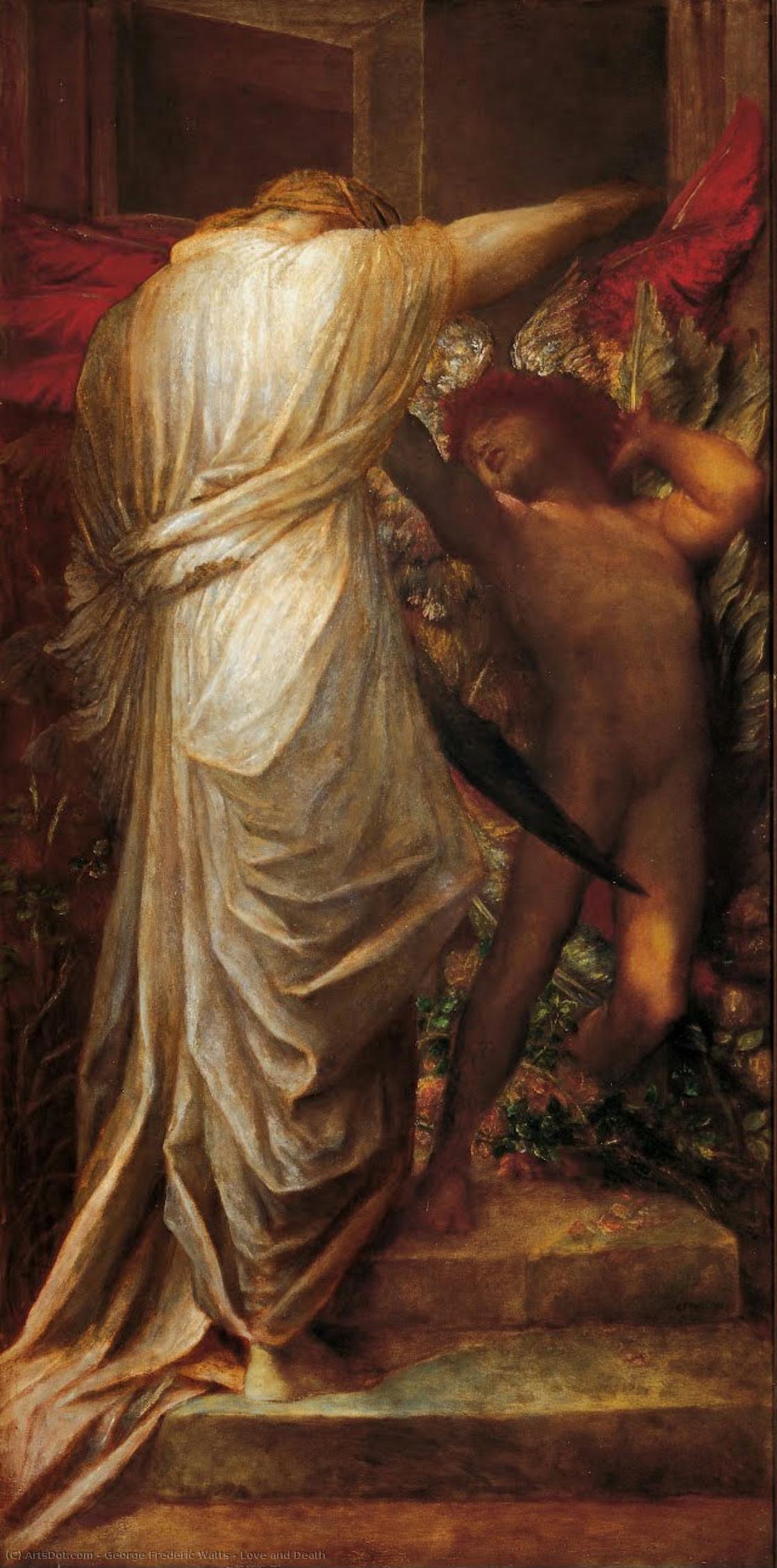
Experience George Frederic Watts' "Love and Death" – a dramatic Symbolist painting of mourning and passion. Explore its rich symbolism, intricate details, and the artist’s masterful composition.
A Dramatic Encounter Between Passion and Peril
George Frederic Watts’ “Love and Death” is not merely a painting; it is a visceral confrontation rendered in pigment, an enduring meditation on the volatile intersection of human emotion and mortality. The scene immediately arrests the viewer with its palpable tension. At the heart of the composition unfolds a dramatic tableau: a woman, clad in ethereal white, seems caught between embrace and struggle. Her long, flowing hair acts almost as a curtain around her plight, while the menacing presence of a man wielding a knife introduces an element of sharp, inescapable danger. Surrounding this central conflict are other figures—witnesses whose gazes seem to absorb the very drama unfolding before them. The atmosphere is thick with unspoken narratives, making the viewer complicit in the intensity.
Symbolism and Symbolist Echoes
As a key figure within the Symbolist movement, Watts imbued this work with layers of profound meaning that invite endless interpretation. The contrast between the purity suggested by the woman’s white gown and the sharp violence embodied by the knife speaks volumes about the fragility of life's most intense attachments. Love, in this depiction, is not a gentle caress but a force capable of inflicting deep wounds. Death, represented by the blade, looms as an inevitable counterpoint to passion. The surrounding figures often serve as allegorical elements—are they observers, participants, or perhaps embodiments of fate itself? Watts masterfully uses these symbols to elevate what might otherwise be a mere narrative moment into a universal statement about human experience.
Mastery in Technique and Composition
Examining the technique reveals the artist’s profound skill. The handling of light across the white dress contrasts sharply with the darker tones surrounding the conflict, drawing the eye inexorably toward the central drama. Watts employs a rich, dramatic palette characteristic of his period, allowing the emotional weight of the subject matter to take precedence over mere realism. The composition is dynamic; nothing rests in perfect repose. Every gesture—the man’s grip on the knife, the woman’s posture, the onlookers' stances—contributes to a swirling vortex of energy that keeps the eye moving across the canvas. This masterful arrangement ensures that even when contemplating its reproduction, one feels the original sweep and power of Watts’ brushwork.
A Timeless Emotional Resonance for Your Space
Bringing “Love and Death” into your home or gallery space is to invite a conversation piece of immense depth. It speaks to those who appreciate art that does not whisper but rather resonates with the full force of human feeling—the ecstasy, the terror, the inescapable pull between two opposing forces. For collectors and designers alike, this work offers dramatic focal power. A high-quality reproduction allows you to harness this potent emotional energy, transforming a room into a space charged with artistic contemplation. It is an heirloom piece that promises not just decoration, but deep, ongoing engagement with the sublime complexities of the human heart.