A Symphony of Chance and Texture
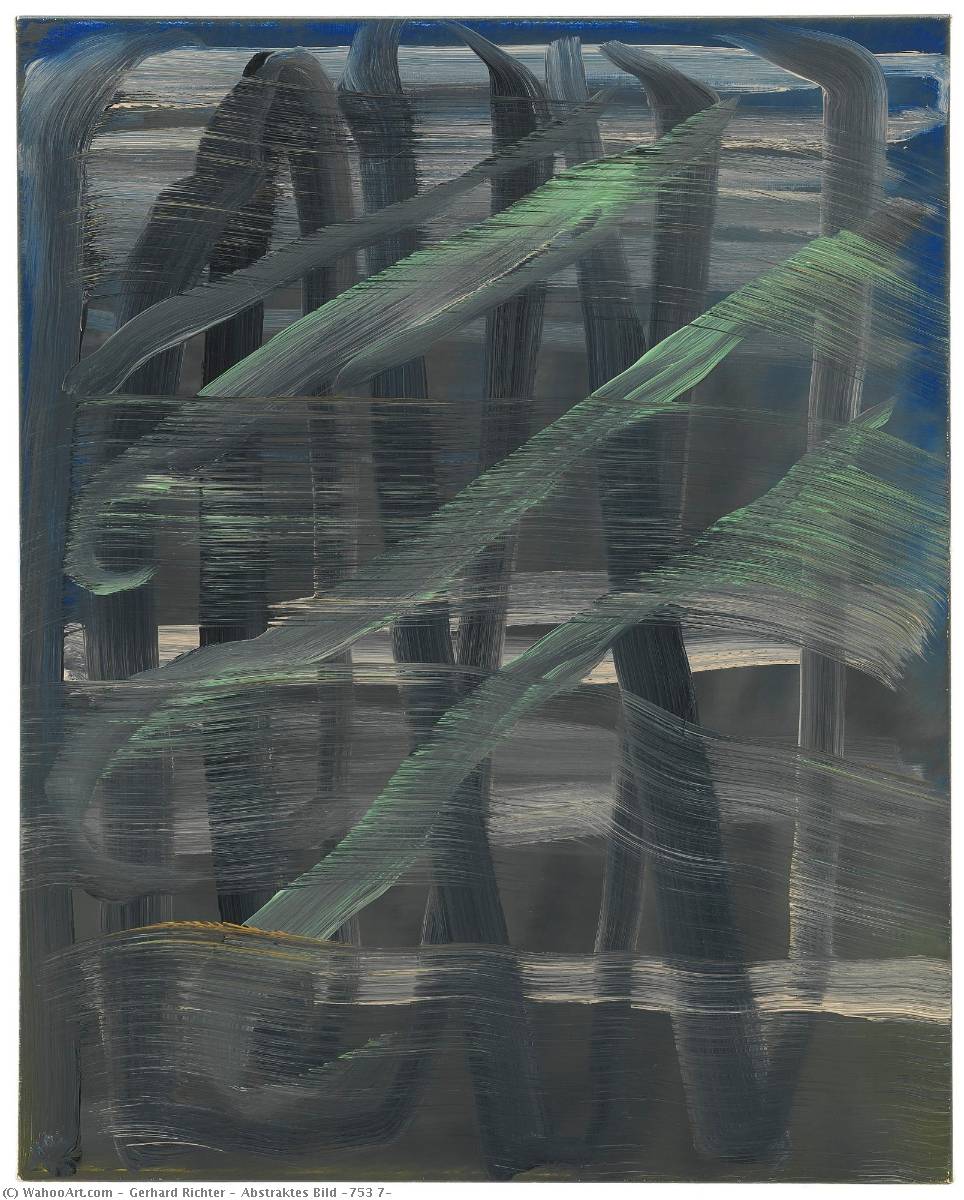
In the vast landscape of contemporary abstraction, few works command the same quiet intensity as Gerhard Richter’s "Abstraktes Bild (753 7)." This masterpiece serves as a profound meditation on the nature of perception, where the boundaries between what is seen and what is felt begin to dissolve. At first glance, the canvas presents a rhythmic arrangement of vertical forms, reminiscent of a dense, mist-shrouded forest or a cluster of reeds swaying in an unseen breeze. Yet, to look closer is to enter a realm where certainty vanishes. Richter does not seek to depict a landscape, but rather to capture the very essence of atmosphere, using layers of color and light to create a dreamlike state that invites the viewer into a deep, introspective journey.
The true soul of this painting lies in its revolutionary technique. Eschewing the traditional precision of fine art, Richter employs a method of diffusion—a deliberate process of applying paint and then scraping or wiping it away across the surface. This creates a mesmerizing, blurred aesthetic that defies the eye's attempt to find a sharp focal point. Through this rhythmic disruption, subtle ridges and textures emerge from beneath the surface, giving the work a physical depth that feels almost sculptural. The interplay of blues, greens, and muted grays creates a sense of receding space, where certain forms appear to float forward while others vanish into a soft, ethereal background of light blue and white.
Historical Resonance and Emotional Depth
To understand the gravity of "Abstraktes Bild (753 7)," one must consider the era from which it emerged. Painted during a period of significant cultural reconstruction in post-war Germany, Richter’s work reflects a broader movement toward Minimalism and a rejection of overt, didactic imagery. In an age seeking to move past the rigid certainties of the past, Richter embraced the beauty of the accidental and the ambiguous. His ability to balance controlled composition with the unpredictable nature of chance mirrors the complexities of human experience—the way memory blurs the edges of our most significant moments.
For the discerning collector or interior designer, this artwork offers more than mere decoration; it provides an emotional anchor for a space. The restrained color palette and tranquil subject matter evoke feelings of serenity and contemplation, making it an ideal centerpiece for environments that demand sophistication and calm. Whether placed in a modern gallery setting or a curated residential lounge, the painting’s ability to shift with the light and the viewer's mood ensures it remains a living, breathing part of the room. It is a piece that does not shout for attention but rather rewards those who take the time to linger, offering new layers of mystery with every encounter.