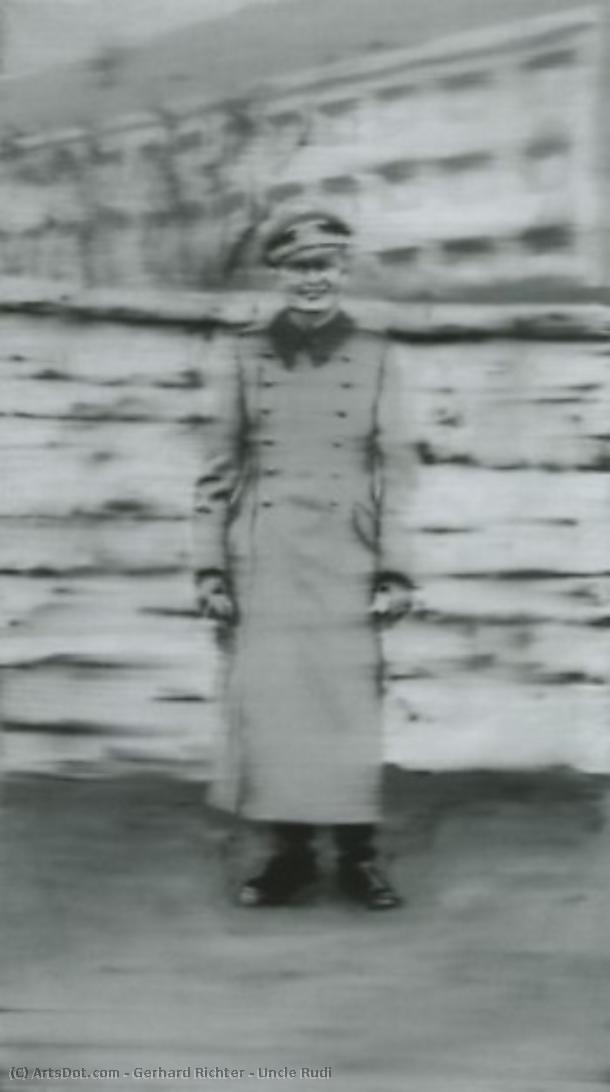
Una obra maestra de Gerhard Richter que captura la esencia de una familia en blanco y negro, explorando temas como el silencio, la memoria y la representación fotográfica con una maestría inquietante.
Uncle Rudi: A Meditation on Memory and Uncertainty
Gerhard Richter’s *Uncle Rudi*, created in 1965, isn't merely a portrait; it’s an exploration of the elusive nature of memory and the inherent ambiguity within photographic representation. This seemingly simple black and white image—a square canvas dominated by a solemn figure dressed in military uniform—holds layers of significance that extend far beyond its surface appearance.
- Subject Matter: The photograph depicts a man identified as “Uncle Rudi,” Richter’s uncle, who perished during World War II. This familial connection imbues the artwork with personal history and underscores the artist's preoccupation with loss and remembrance.
- Style & Technique: Richter employs his signature technique of "photorealistic painting," but crucially alters it—he meticulously wipes away sections of the canvas after applying paint, creating a textured surface that simultaneously mimics and disrupts photographic realism. This deliberate obfuscation is central to Richter’s artistic philosophy.
- Historical Context: Produced shortly after the devastation of Dresden during Operation Tempelhof—a British bombing raid that resulted in catastrophic civilian casualties—the painting reflects the anxieties and moral dilemmas of its time. It speaks to the trauma experienced by individuals grappling with the horrors of war and the difficulty of capturing reality accurately.
- Symbolism: The blurred background contributes to a sense of detachment, mirroring the emotional distance Richter seeks to convey. The rigid posture of the subject symbolizes formality and duty, yet his face remains impassive, hinting at unspoken grief and unresolved questions.
- Emotional Impact: *Uncle Rudi* evokes a feeling of melancholy and contemplation. It invites viewers to consider not just what is seen but also what is absent—the memories and emotions surrounding the deceased uncle. Richter’s masterful manipulation of texture and color creates an unsettling yet profoundly beautiful image that lingers in the mind long after viewing.
Richter's decision to wipe away portions of the canvas isn’t simply a stylistic choice; it’s a conceptual statement about the impossibility of achieving absolute certainty. He acknowledges that photographs capture only fragments of experience, and painting attempts to reconstruct them—often imperfectly—reflecting the subjective nature of perception.
The photograph itself serves as a catalyst for Richter's artistic process, prompting him to confront questions about representation and memory. *Uncle Rudi* is thus more than just an image; it’s a meditation on grief, history, and the enduring power of art to grapple with uncomfortable truths.