A Window Into Dutch Domesticity
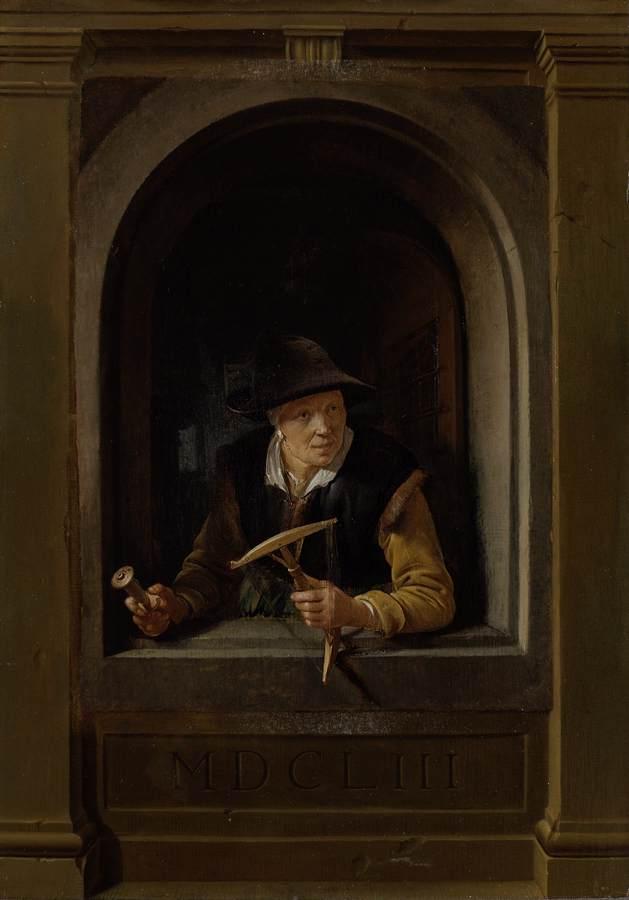
In the quiet, intimate corners of the seventeenth-century Netherlands, Gerrit Dou captured moments that felt both profoundly ordinary and eternally significant. His masterpiece, "A Fisherman's Wife," painted in 1653, serves as a breathtakingly detailed window into the domestic soul of the Dutch Golden Age. This is not merely a portrait of a woman; it is an evocative study of patience, longing, and the quiet dignity found within the home. As the viewer approaches this small-scale marvel, they are immediately enveloped by a sense of stillness, as if stepping into a private sanctuary where time itself has slowed to the rhythm of a heartbeat.
The composition centers on a woman seated upon a windowsill, her posture suggesting a contemplative pause in her daily labors. Her gaze, directed toward an unseen point beyond the frame, invites the observer to wonder about her thoughts—perhaps she is watching for the return of a husband from the sea, or perhaps she is lost in the simple beauty of the passing afternoon. The presence of a man leaning nearby adds a layer of narrative depth, suggesting a shared domesticity that is both grounded and deeply emotional. Through this arrangement, Dou transforms a simple genre scene into a poignant meditation on connection and solitude.
The Mastery of the Leiden Fijnschilders
To understand the sheer brilliance of this work, one must look closer at the technique that defined Dou’s legacy as a leader of the Leiden fijnschilders, or "fine painters." This group was renowned for an almost superhuman dedication to detail, and in "A Fisherman's Wife," Dou demonstrates his unparalleled ability to manipulate light and texture. He utilized a meticulous process of applying multiple thin, translucent glazes over opaque layers, a method that creates a luminous, polished surface. This technique allows the painting to glow from within, capturing the way natural light filters through a window to dance across fabric and skin.
The artist’s command of chiaroscuro—the dramatic interplay between light and shadow—is nothing short of masterful. The soft shadows that pool in the corners of the room contrast sharply with the bright, focused illumination on the subject, creating a three-dimensional depth that pulls the viewer into the scene. Every element, from the rough texture of a stone sill to the delicate folds of a garment, is rendered with such precision that it borders on trompe l'oeil. For the collector or interior designer, this level of detail ensures that the painting remains a captivating focal point, offering new discoveries with every glance.
A Timeless Addition to the Modern Interior
Beyond its historical significance, "A Fisherman's Wife" possesses an enduring emotional resonance that transcends the centuries. It embodies a sense of tranquility and warmth that is increasingly rare in our fast-paced modern world. The painting’s palette, rich with earthy tones and soft highlights, makes it an incredibly versatile piece for sophisticated interior curation. Whether placed in a sunlit reading nook or as a centerpiece in a classically styled gallery wall, the work brings a sense of historical weight and quiet elegance to any space.
For those seeking to surround themselves with art that tells a story, this reproduction offers more than just decoration; it offers an invitation to reflect. It is a piece designed for the discerning eye—one that appreciates the intersection of scientific precision and poetic sentiment. Owning a piece of the Dutch Golden Age means bringing home a fragment of history that continues to breathe, much like the quiet, watchful presence of the woman in Dou's timeless vision.