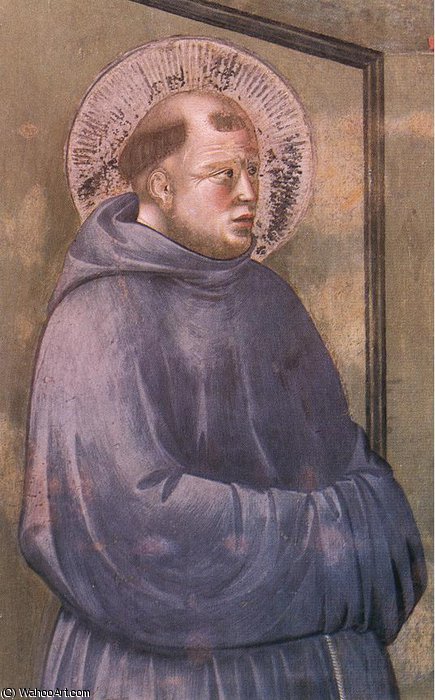
Apparition at Arles (detail): A Revolutionary Glimpse of the Divine
Giotto di Bondone’s “Apparition at Arles,” painted around 1297-1300, stands as a monumental achievement – not merely in its scale, but in its profound shift away from the rigid formalism of Byzantine art and toward the burgeoning realism that would define the Renaissance. This particular detail, focusing on a key figure within the larger scene, offers an intimate window into Giotto’s revolutionary approach to depicting human emotion and spiritual presence. The image captures a moment of intense contemplation, a silent witness to a divine visitation, rendered with startling immediacy.

At the heart of this composition is a man – a figure both austere and profoundly human. His bald head, rendered with meticulous attention to texture and shadow, suggests age or perhaps a deliberate symbolic representation of spiritual purity. The robe he wears, simple yet dignified, speaks to his role as a participant in a sacred event. His gaze, directed off-camera, invites the viewer into the scene, creating an immediate connection and fostering a sense of shared wonder. Giotto’s masterful use of light and shadow – a technique pioneered during this period – dramatically emphasizes the man's face, highlighting the stern expression that betrays both solemnity and a deep, almost unsettling, awareness.
Proto-Renaissance Innovation: A Departure from Tradition
Created in the Proto-Renaissance style, “Apparition at Arles” represents a crucial turning point in Western art. Giotto rejected the flattened perspectives, stylized figures, and gold backgrounds characteristic of Byzantine iconography. Instead, he embraced a more naturalistic approach, striving to represent the world – and particularly human emotion – with unprecedented accuracy. Note the subtle modeling of the figure’s form, the realistic rendering of his clothing, and the attempt to convey a sense of three-dimensionality. This was not simply about depicting a religious scene; it was about capturing the essence of human experience within a spiritual context.
The background figures – two individuals observing the apparition – further enhance the painting’s dramatic impact. Their presence suggests a community deeply moved by this extraordinary event, reinforcing the idea that faith and spirituality were not isolated experiences but shared communal endeavors. The slightly blurred quality of their forms contributes to the overall sense of mystery and awe.
Symbolism and Emotional Resonance
The “Apparition” is inextricably linked to the legend of St. Francis of Assisi, who appears as a ghost to his followers after his death. Giotto’s depiction captures this moment of profound spiritual encounter with remarkable sensitivity. The painting isn't merely a historical record; it’s an exploration of faith, doubt, and the human need for transcendence. The man’s expression – a blend of solemnity and perhaps even fear – speaks to the unsettling nature of encountering the divine. It is a moment of vulnerability, of confronting questions beyond human comprehension.
A Masterpiece Recreated
ArtsDot offers meticulously crafted hand-painted reproductions of “Apparition at Arles,” allowing you to bring this iconic work of art into your own space. Our skilled artisans employ traditional techniques and high-quality materials to faithfully recreate Giotto’s vision, capturing the painting's emotional depth and artistic brilliance. This reproduction is more than just a print; it’s a tangible connection to one of the most important moments in the history of Western art.