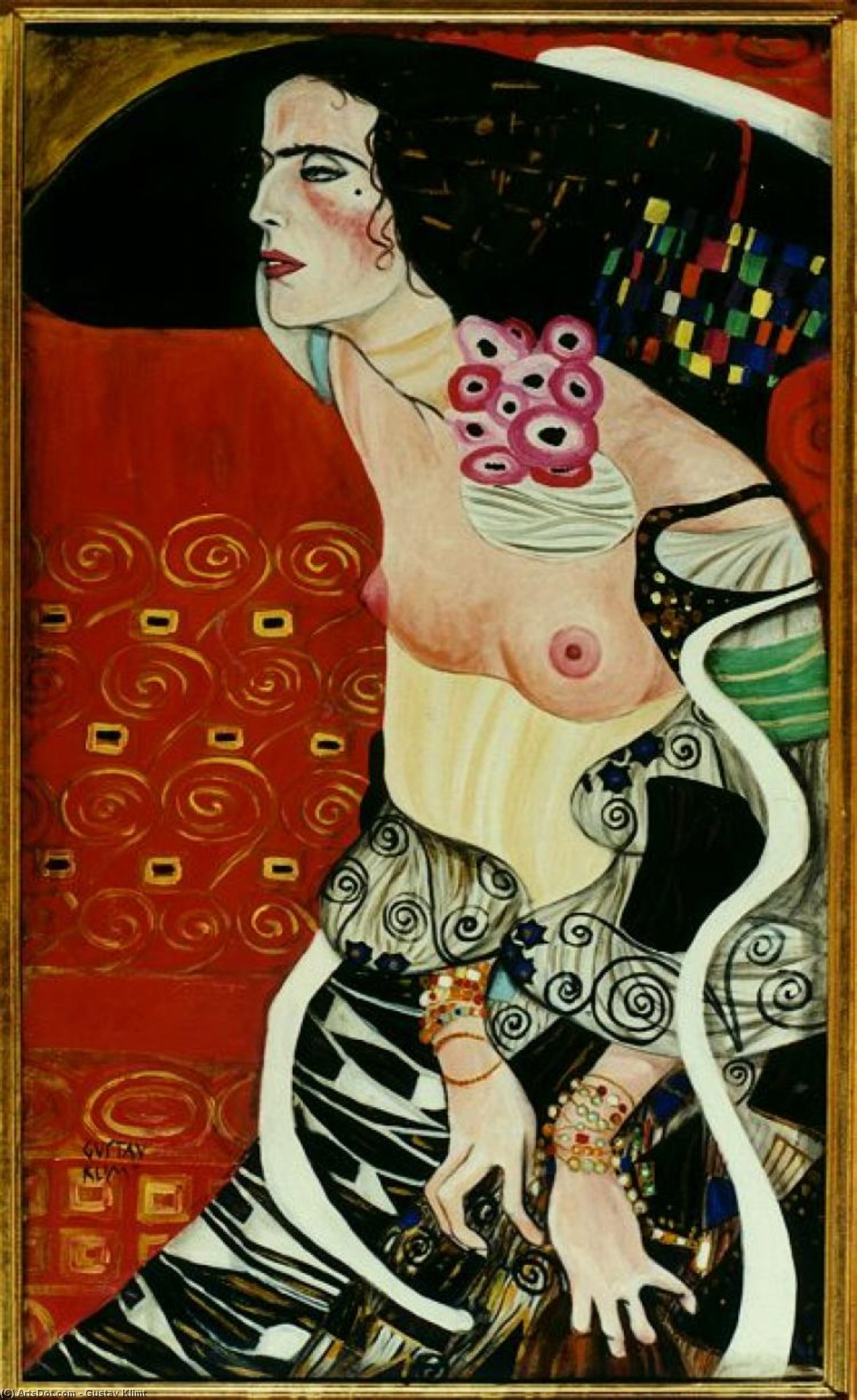
Judith - Oil on Canvas – A Symphony of Gold and Symbolism
The painting Judith by Gustave Klimt stands as an emblem of Art Nouveau, a movement that sought to liberate art from academic constraints and embrace organic forms infused with decorative splendor. Created in 1909, this monumental oil on canvas transcends mere representation; it’s a deliberate orchestration of visual elements designed to evoke profound contemplation about beauty, desire, and mortality. Klimt's masterful command of technique—particularly his innovative use of gold leaf—elevates Judith beyond the realm of portraiture into a transcendent experience for the viewer.
- Style: Art Nouveau – Characterized by flowing lines, curvilinear shapes, floral motifs, and an obsession with naturalistic detail. Klimt’s Judith embodies this aesthetic perfectly, rejecting geometric rigidity in favor of graceful curves that mimic the contours of drapery and human anatomy.
- Technique: Klimt employed a layered approach to painting, applying thin glazes over textured surfaces created by impasto—thickly applied paint—to achieve remarkable luminosity and depth. The extensive use of gold leaf wasn’t merely decorative; it symbolized divine illumination and spiritual transcendence – a core principle of Klimt's artistic vision.
The Narrative Landscape of Desire
Judith herself is depicted in repose, seated on the right side of the frame, her gaze downward as if contemplating the weighty consequences of her actions. She wears a sumptuous gown adorned with intricate patterns reminiscent of Byzantine mosaics and Islamic textiles—a deliberate allusion to Klimt’s fascination with Eastern cultures. The knife she holds symbolizes both violence and feminine power – a duality that encapsulates the painting's central theme: the confrontation between instinctual urges and moral restraint. Her posture exudes vulnerability, yet her unwavering gaze conveys an inner strength that defies easy interpretation.
Vienna Secession and Artistic Rebellion
Judith’s genesis lies within the Vienna Secession movement, a group of artists who vehemently opposed the conservative artistic conventions of their time. Led by Gustav Klimt himself, Emil Schiele, Josef Maria Olbrich and Viktor Münzberger, the Secession rejected academic painting in favor of expressive experimentation and stylistic innovation. They established their own gallery—the Österreichische Galerie Belvedere—to showcase their work and challenge the prevailing aesthetic standards. This bold defiance fueled Klimt’s artistic exploration, propelling him toward groundbreaking achievements that continue to inspire artists today.
Beyond Decoration – Symbolism Unleashed
More than just a beautiful image, Judith is laden with symbolic significance. The clock represents time—the relentless march of existence and the inevitability of death—while the vases symbolize fertility and abundance. Klimt’s meticulous attention to detail extends beyond mere visual representation; he seeks to communicate profound ideas about human psychology and spirituality. As a testament to Klimt's genius, Judith remains an unforgettable masterpiece – a captivating fusion of artistic skill and intellectual depth that transcends time and cultural boundaries.
A Legacy Enduring Inspiration
Judith II (Salome), alongside Klimt’s Lady with Hat and Featherboa and The Kiss, solidified Klimt’s position as one of the most influential artists of the 20th century. His work continues to resonate with audiences worldwide, demonstrating the enduring power of art to provoke emotion and stimulate contemplation. Explore reproductions of Judith on ArtsDot.com for a glimpse into this iconic artwork's timeless beauty.