Body of a Girl
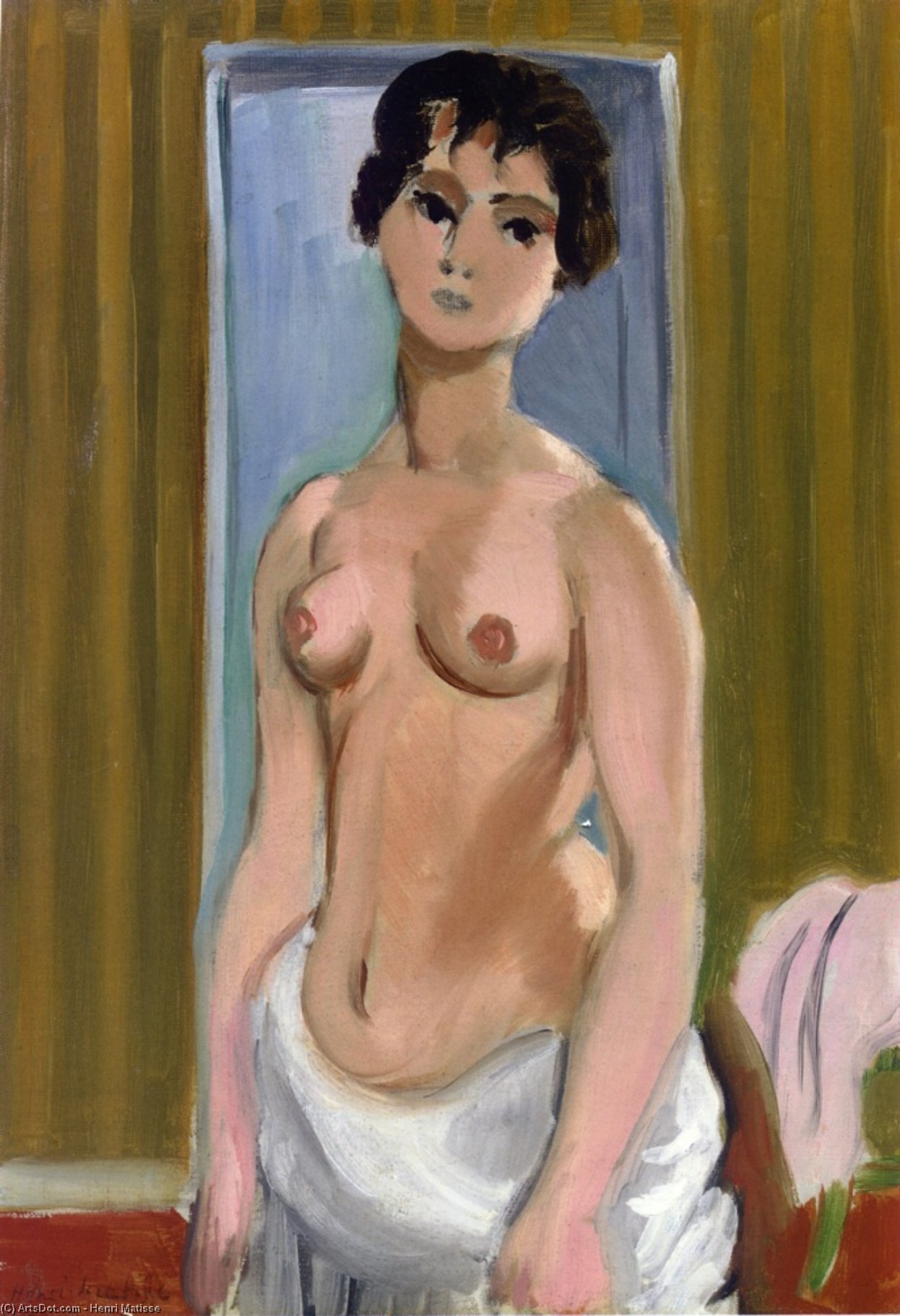
“Body of a Girl” by Henri Matisse, created in 1918, stands as an emblem of Post-Impressionism’s daring exploration of form and color. This artwork, measuring 35 x 24 cm and executed in oil on canvas, isn't merely a depiction; it’s a distillation of Matisse’s singular vision—a testament to his ability to capture the essence of femininity with remarkable sensitivity.
Artistic Style and Technique
Matisse revolutionized artistic expression through his innovative use of color and fluid draughtsmanship. In “Body of a Girl,” he abandons traditional representational conventions, opting instead for bold hues—primarily reds, yellows, and blues—that pulsate with vibrancy. Geometric shapes – circles and rectangles – are strategically employed to generate depth and spatial illusion, guiding the viewer’s gaze toward the central figure.
The woman's face dominates the composition, rendered with meticulous detail despite its simplified form. Matisse skillfully captures her expression, conveying a quiet contemplation that speaks volumes about inner life. The dress is depicted in flowing drapery, emphasizing curves and softness—a deliberate choice reflecting Matisse’s fascination with organic forms.
Historical Context
The early 20th century witnessed seismic shifts within the art world, fueled by movements like Cubism and Proto-Cubism. Matisse's work during this period represents a crucial bridge between academic painting traditions of the past and the burgeoning abstraction that would soon reshape artistic landscapes. “Body of a Girl” embodies this transitional phase, demonstrating Matisse’s willingness to experiment with new visual languages.
The influence of Cézanne is palpable in Matisse's approach—particularly evident in his use of flattened planes and simplified contours. However, unlike Cézanne’s analytical Cubism, Matisse pursues a more expressive style, prioritizing color and tonal harmony over precise geometric dissection. This stylistic divergence underscores the dynamism of artistic innovation during this era.
Influence and Legacy
Henri Matisse is revered alongside Pablo Picasso as one of the architects of modern art—a pioneer who irrevocably altered perceptions of beauty and representation. His impact extends far beyond his own lifetime, inspiring generations of artists and shaping movements like Fauvism and Abstract Expressionism.
The Gwynedd County Council Collection in Caernarfon, United Kingdom, proudly showcases Matisse’s oeuvre—a remarkable assemblage of paintings, prints, and sculptures that exemplify the artist's enduring legacy. Viewing “Body of a Girl” alongside other masterpieces offers invaluable insight into Matisse’s artistic evolution and his profound contribution to the history of art.
Relevance to Modern Art
The trajectory of painting throughout history reveals an ongoing dialogue between tradition and innovation—a constant striving for new forms of expression. Cubism, spearheaded by Picasso and Georges Braque, fundamentally challenged conventional perspectival representation, fragmenting objects into geometric components. Matisse’s exploration of color and simplified shapes anticipates these developments, demonstrating his astute awareness of artistic currents.
“Body of a Girl” serves as a poignant reminder that art transcends mere imitation; it communicates emotion and intellect—inviting viewers to contemplate the complexities of human experience. For those seeking inspiration or desiring to adorn their homes with exceptional artwork, ArtsDot offers high-quality reproductions of Matisse’s paintings – allowing you to immerse yourself in the brilliance of his vision.