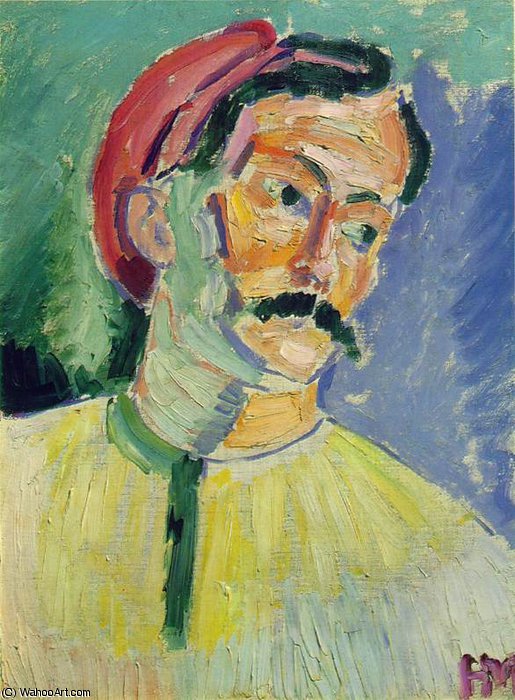
Portrait of Andre Derain, Summer
André Derain (1880–1954) stands as a pivotal figure in the Fauvist movement, alongside Henri Matisse and Maurice de Vlaminck—artists who irrevocably altered the landscape of early 20th-century painting. Their collaboration during the summer of 1905 in Collioure, France, represents not merely an artistic partnership but a catalyst for revolutionary stylistic innovation. This encounter would propel them into the spotlight as pioneers of Fauvism, a movement characterized by its audacious embrace of color and expressive brushwork—a deliberate rejection of Impressionistic subtlety.
The painting itself captures Derain in a moment of contemplative seriousness, gazing directly at the viewer with an intensity that transcends mere representation. He wears a striking red hat—a bold chromatic choice emblematic of Fauvist aesthetics—against a backdrop dominated by the azure expanse of the Mediterranean sky. This juxtaposition serves as more than just visual contrast; it embodies the movement’s core principle: prioritizing sensation over observation, translating inner experience onto canvas with unrestrained vibrancy. Matisse's influence is palpable in Derain’s technique – loose, energetic brushstrokes layered upon one another to create a textured surface that pulsates with life. The artist eschewed meticulous blending, favoring instead visible marks that convey movement and emotion—a deliberate departure from the polished surfaces favored by academic painters of the time.
- Artist: André Derain
- Year: 1905
- Medium: Oil on Canvas
- Dimensions: Approximately 39 x 29 cm
The Collioure landscapes—particularly those depicting the harbor and its boats—became a focal point for Derain’s artistic exploration. He sought to capture not just what he saw but how he *felt* – an impulse that aligns perfectly with Fauvist philosophy. The intense reds, yellows, and blues of his palette weren't merely decorative; they functioned as conduits for conveying mood and atmosphere—a conscious effort to evoke the emotional resonance of the scene. Critics initially denounced Derain’s work as “wild beasts,” highlighting its jarring departure from established artistic conventions. However, this provocative stance ultimately cemented his place in art history as a champion of expressive color and innovative brushwork.
Context in Art History
Fauvism emerged as a reaction against Impressionism's preoccupation with capturing fleeting moments of light and atmosphere. Artists like Matisse and Derain deliberately rejected naturalistic representation, opting instead for bold colors that prioritized emotional impact over optical accuracy. This stylistic rebellion foreshadowed the broader developments in modern art—particularly Cubism—which would dismantle traditional perspective and challenge conventional notions of form. The Fauvist movement’s influence extended beyond painting, impacting sculpture and decorative arts, demonstrating its transformative power across various artistic disciplines.
Symbolism
The red hat worn by Derain carries significant symbolic weight within the context of Fauvism. Red is often associated with passion, energy, and vitality—qualities that Matisse and Derain sought to embody in their artwork. It represents a deliberate assertion of individuality against the prevailing artistic norms of the era, mirroring the movement’s broader ethos of rebellion and experimentation. The artist's gaze toward the viewer serves as an invitation to engage emotionally with the painting—a gesture that underscores Fauvist art’s commitment to conveying subjective experience rather than objective observation.
Technique
Derain’s masterful brushwork exemplifies the distinctive stylistic hallmarks of Fauvism. He employed loose, expressive strokes—often applied directly from the tube—to create a textured surface that vibrates with color and movement. Unlike Impressionists who meticulously blended pigments to achieve subtle tonal gradations, Derain favored visible marks that conveyed emotion and dynamism. This technique—characterized by bold contrasts and energetic brushstrokes—became synonymous with Fauvist art, establishing it as one of the most recognizable visual languages of the early 20th century. The resulting canvases are imbued with a palpable sense of immediacy and spontaneity—a testament to Derain’s unwavering dedication to capturing the essence of his subject matter through innovative artistic expression.