A Vision of Suffering and Redemption
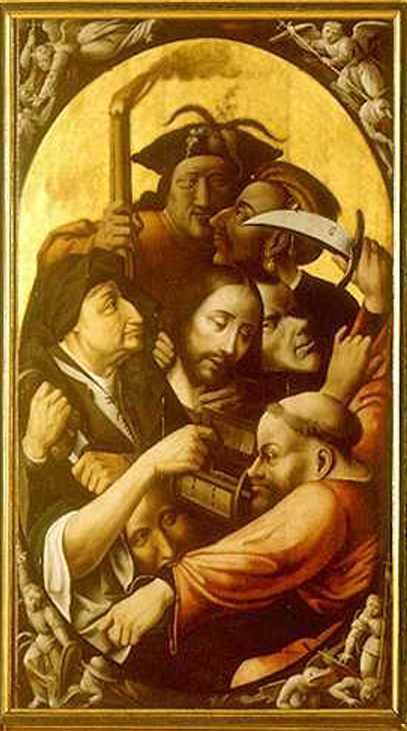
To encounter Hieronymus Bosch’s “Passion of the Christ” is to step beyond the threshold of the mundane and into a psychological landscape where the boundaries between the divine and the demonic dissolve. Created around 1515, this monumental work serves as a chillingly beautiful testament to the spiritual fervor and profound anxieties of the Northern Renaissance. Bosch does not merely depict a historical event; he plunges the viewer into a fever dream of theological intensity. The painting captures the central agony of the Crucifixion with an unflinching gaze, presenting a scene where the physical suffering of Christ is inextricably linked to a much larger, more cosmic struggle between sin and salvation.
The composition is a masterclass in dramatic tension, pulling the eye through a labyrinth of figures and symbolic details. At its heart, the crucified figure of Jesus stands as a beacon of light amidst a swirling sea of human emotion and chaos. Surrounding him is a dense tapestry of witnesses—soldiers with glinting weapons, religious figures caught in moments of profound contemplation, and common folk whose faces reflect a spectrum of grief, indifference, and cruelty. This meticulous arrangement creates an atmosphere of intense drama, where every gesture and every gaze contributes to the overwhelming weight of the narrative.
The Alchemy of Detail and Dreamlike Realism
Bosch’s technical prowess is evident in his ability to marry meticulous realism with a surreal, almost hallucinatory atmosphere. Utilizing oil paint on panel—a medium that allowed for unparalleled textural complexity—the artist achieved a luminosity that makes the scene feel both tangibly present and otherworldly. His brushstrokes are deliberate and precise, capturing minute details that reward prolonged study. One might find themselves captivated by the way light catches a blade or the subtle, haunting expression on a bystander's face, only to be startled by the more grotesque, fantastical elements lurking in the periphery.
This "dreamlike" style is what defines Bosch’s unique contribution to art history. He employs a technique where the familiar becomes unsettling; animals may appear twisted into monstrous forms, and shadows seem to harbor secrets of their own. For the collector or the enthusiast of fine art, this complexity offers an endless journey of discovery. The painting does not offer easy answers but instead invites a continuous dialogue between the viewer and the canvas, making it a piece that grows in depth every time it is observed.
A Legacy of Symbolism and Emotional Resonance
Beyond its visual splendor, the “Passion of the Christ” is a profound allegory of the human condition. Emerging from the turbulent era of the Hussite Wars and the social upheavals of the late Middle Ages, Bosch’s work reflects a world grappling with moral decay and spiritual uncertainty. The symbolism embedded within the work—from the presence of certain figures to the subtle inclusion of objects like a clock on the wall—serves to remind the viewer of the relentless passage of time and the inevitability of judgment. It is an exploration of mortality, temptation, and the enduring hope for redemption.
For interior designers and connoisseurs seeking to anchor a space with a piece of profound historical significance, this artwork offers more than mere decoration; it provides a focal point for contemplation. A high-quality reproduction of this masterpiece brings into a room not just the aesthetic beauty of the Northern Renaissance, but a sense of gravity and intellectual depth. It is an invitation to reflect on the eternal themes of sacrifice and resilience, making it a timeless addition to any curated collection or thoughtfully designed environment.