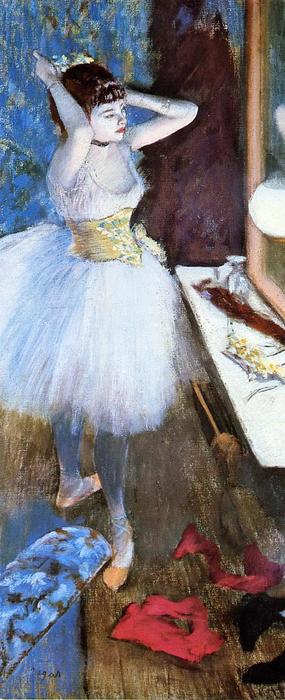
Dancer in Her Dressing Room: A Window Into Impressionist Intimacy
The world of art holds treasures that continue to captivate our imaginations—among them,
Dancer in Her Dressing Room by Edgar Degas, a masterpiece born from the crucible of Impressionism. Created in 1879, this pastel on paper painting transcends mere depiction; it’s an invitation into a fleeting moment of artistic brilliance and psychological nuance.
Composition and Style: Capturing Movement and Emotion
Degas' genius lies in his ability to distill complex emotion onto canvas with remarkable precision. The scene unfolds within the confines of a dressing room, bathed in the diffused glow of a single gaslight—a deliberate choice that underscores the painting’s atmosphere of quiet contemplation amidst artistic preparation. The composition is strikingly asymmetrical, drawing our eye towards the dancer's torso and back as she adjusts her hair, creating a dynamic interplay between stillness and subtle movement. This technique aligns perfectly with Degas’s Impressionist style, prioritizing capturing the ephemeral qualities of light and color—a hallmark of his era.
Technique: Pastel Mastery – Delicate Layers of Color
Degas employed pastel, a medium known for its velvety texture and ease of blending, to achieve an unparalleled level of subtlety. Unlike oil paints, pastels allow for rapid layering and reworking, mirroring the artist’s own process of experimentation and discovery. The pastel pigments are mixed with turpentine—a solvent that ensures they adhere to the paper surface without obscuring underlying tonal variations. This meticulous approach is evident in the delicate gradations of color—particularly noticeable in the dancer's flesh tones—which contribute significantly to the painting’s luminous effect. The artist skillfully utilizes a brush to apply pastel over peinture à l’essence (oil colors thinned and mixed freely with turpentine), resulting in an astonishing fusion of mediums that elevates the artwork's expressive power.
Historical Context: Parisian Life Reflected Through Art
“Dancer in Her Dressing Room” encapsulates the spirit of Belle Époque Paris—a period characterized by artistic innovation, social change, and a fascination with modern life. Degas’s subject matter—the ballet dancers—represented a departure from traditional academic painting, aligning him squarely with the burgeoning Impressionist movement. Influenced by artists like Claude Monet and Pierre-Auguste Renoir, Degas sought to portray subjects as they appeared to the eye—capturing fleeting impressions rather than striving for idealized representations. The painting’s inclusion in the sixth Impressionist exhibition solidified Degas's position as a pioneer of this revolutionary artistic style.
Symbolism: Beyond Representation – An Exploration of Inner States
More than just a portrait, “Dancer in Her Dressing Room” delves into themes of femininity, vulnerability, and performance anxiety—subjects that resonate deeply with viewers today. The dancer’s posture conveys both grace and apprehension as she prepares for her performance, reflecting the psychological complexities inherent in artistic expression. The inclusion of props like bottles and chairs adds to the painting's narrative richness, suggesting a backstage environment brimming with anticipation and expectation. Degas’s masterful use of color—particularly the dominant pink hue—further enhances the emotional impact of the piece, inviting contemplation on beauty, fragility, and the transformative power of art.
Where to Find More Inspiration: Exploring Degas’ Legacy
For those eager to immerse themselves in the broader artistic landscape of Degas's time, consider visiting the Cincinnati Art Museum (
Cincinnati Art Museum) to admire
Dancer in Her Dressing Room alongside other iconic works by Degas and his contemporaries—artists who fundamentally reshaped the course of modern art. You can also delve into Degas’s biography on ArtsDot (
Edgar Degas) to gain a deeper understanding of his artistic vision and influences—particularly the pioneering work of Paul Cézanne (
Paul Cézanne), whose Post-Impressionist paintings ushered in a new era of artistic experimentation and innovation. Finally, explore the influence of Cézanne on modern art through his
Wikipedia profile.