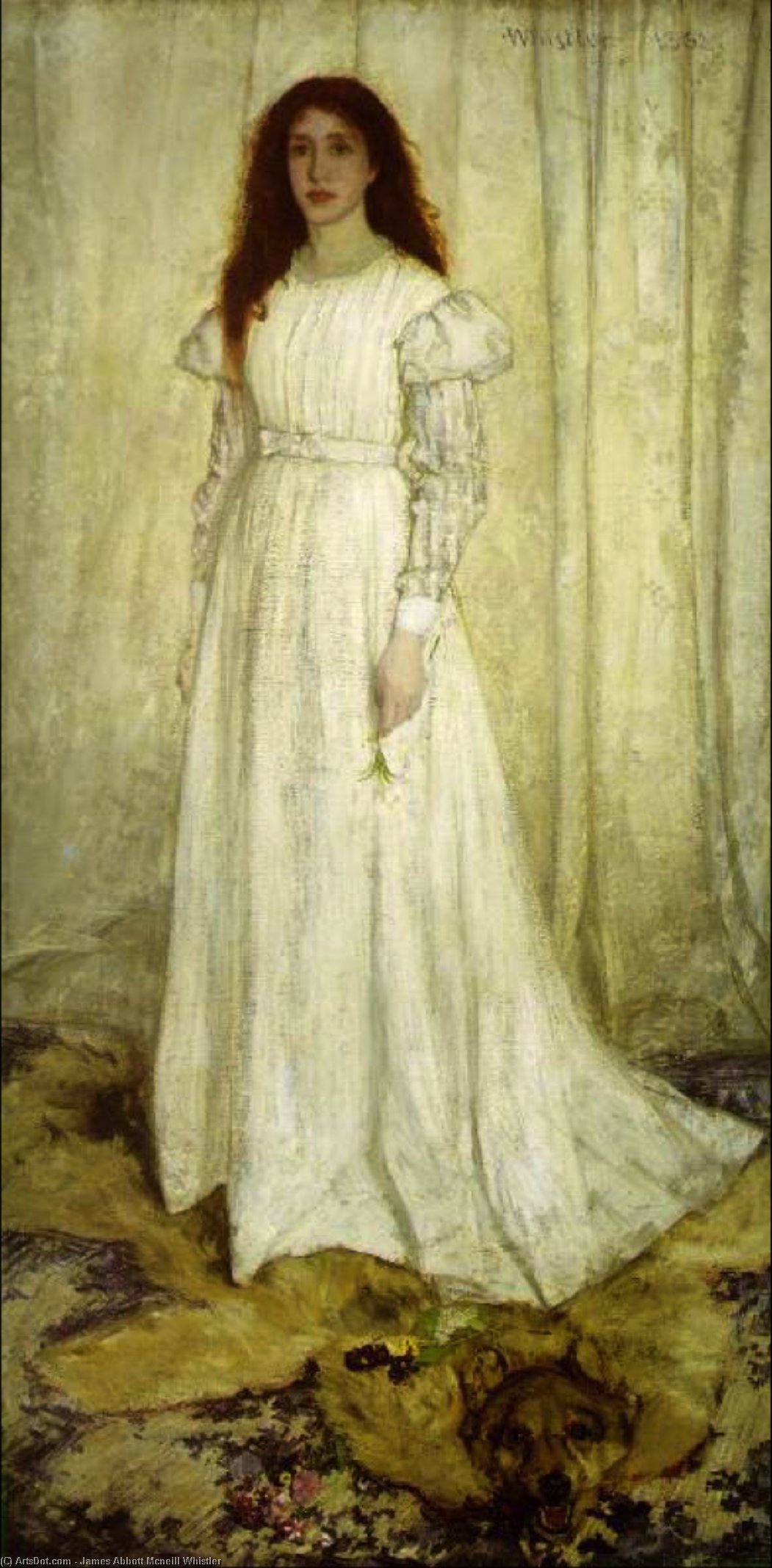
A Symphony of Serenity: The Ethereal Allure of Whistler’s White Girl
In the quiet corners of art history, few images possess the haunting, luminous grace of James Abbott McNeill Whistler’s "White Girl." At first glance, the viewer is met with a portrait of deceptive simplicity: a young woman, draped in a flowing gown of pristine white, accompanied by a faithful canine companion. Yet, beneath this tranquil surface lies a profound exploration of atmosphere and light. The subject, often identified as Whistler’s muse and collaborator Joanna Hiffernan, does not demand attention through dramatic gesture or intense emotion; instead, she invites the viewer into a state of quiet contemplation. The way her long hair cascades against the pale fabric of her dress, paired with the intimate positioning of the dog at her side, creates a sense of vulnerability and companionship that resonates deeply with anyone seeking a piece that embodies peace and refined elegance.
The painting serves as a masterful manifesto of the Aestheticism movement. During an era when much of the art world was preoccupied with heavy-handed moral lessons and complex Victorian narratives, Whistler dared to champion the principle of "art for art’s sake." He sought to strip away the burden of storytelling, focusing instead on the sensory experience of color, form, and tonal harmony. In "White Girl," there is no overt drama to decipher; rather, there is a rhythmic arrangement of whites, creams, and subtle shadows that function much like a musical composition—hence why Whistler often titled his works as symphonies or nocturnes. For the discerning collector or interior designer, this makes the piece an unparalleled choice for creating a sophisticated, calming focal point in a room, offering a timeless aesthetic that transcends fleeting trends.
Mastery of Light and Tonalism
Technically, the work is a triumph of Tonalism, a style that prioritizes mood and atmosphere through a limited palette. Whistler’s brushwork exhibits a delicate balance between realism and Impressionistic sensibility. He meticulously captured the way diffused natural light interacts with different textures—the heavy drape of the silk, the softness of skin, and the subtle sheen of the dog's fur. By focusing on these minute tonal gradations, he achieved a luminous quality that seems to glow from within the canvas itself. This mastery of light ensures that the painting remains visually engaging from every angle, as the subtle shifts in shade create a sense of depth and movement within an otherwise still composition.
Beyond its technical brilliance, the emotional impact of "White Girl" lies in its ability to evoke a sense of transcendence. It captures a fleeting moment of stillness, a breath held in time, making it much more than a mere portrait. For those looking to adorn a space with art that inspires introspection and provides a sanctuary from the chaos of modern life, this reproduction offers a window into a world of pure, unadulterated beauty. It is an investment in atmosphere, bringing the sophisticated spirit of the Gilded Age into the contemporary home through its enduring elegance and soulful presence.