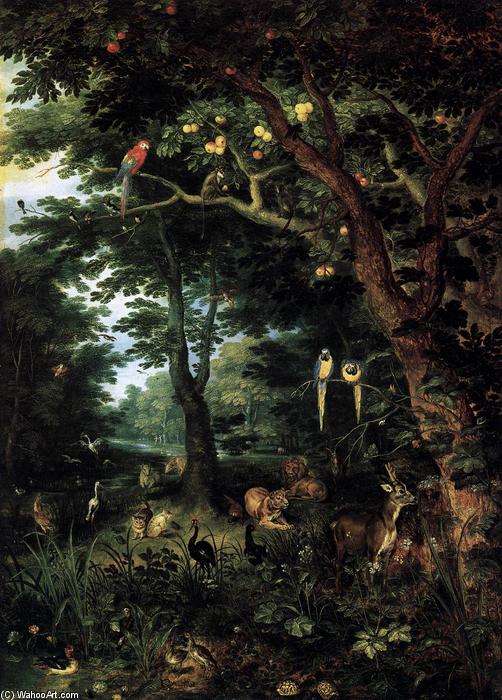
Paradise by Jan Brueghel the Younger – A Symphony of Observation and Biblical Narrative
Jan Brueghel the Younger’s “Paradise,” completed in 1620, stands as a testament to the enduring fascination with biblical themes within the Baroque period. Housed at Staatliche Museen Berlin, this monumental landscape painting transcends mere depiction; it's an immersive experience designed to transport the viewer into Eden itself – albeit one rendered with meticulous detail and infused with a distinctly humanist perspective.
The artwork’s stylistic lineage is firmly rooted in the Mannerist tradition championed by his father, Jan Brueghel the Elder. However, Younger Brueghel deftly incorporates elements of Flemish landscape painting conventions alongside influences from Rubens and Caravaggio, resulting in a visual language that balances grandeur with psychological depth. The composition unfolds across a vast expanse of verdant terrain populated by an astonishing array of animals – a veritable zoological catalogue reflecting the burgeoning scientific curiosity of the era.
Dominating the scene is Noah’s Ark, positioned centrally amidst a profusion of fruit trees and flowering shrubs. This iconic biblical tableau isn't merely presented as a historical record; it serves as a powerful metaphor for humanity’s relationship with God and the natural world. The animals entering the ark represent the diversity of creation, symbolizing harmony and interdependence – concepts central to humanist thought during Brueghel’s time.
Technically masterful, “Paradise” showcases Brueghel's exceptional skill in oil painting on canvas. Layers upon layers of pigment create a breathtaking illusion of depth and luminosity, capturing the dappled sunlight filtering through the foliage with remarkable accuracy. The artist employs hatching and cross-hatching techniques to sculpt form and texture, conveying the palpable atmosphere of Edenic tranquility.
Beyond its aesthetic beauty, “Paradise” resonates emotionally with viewers due to Brueghel’s masterful use of color and light. Vibrant hues – particularly reds, yellows, and greens – dominate the palette, evoking feelings of warmth, exuberance, and spiritual contemplation. The artist's gaze is not merely observational; it invites us to ponder the profound questions posed by Genesis—questions about morality, responsibility, and our place within the grand scheme of existence.
The painting’s enduring appeal lies in its ability to capture a moment of sublime beauty while simultaneously grappling with weighty theological concerns. “Paradise” remains an unforgettable masterpiece – a captivating blend of artistic innovation and humanist reflection that continues to inspire awe and contemplation centuries after its creation.