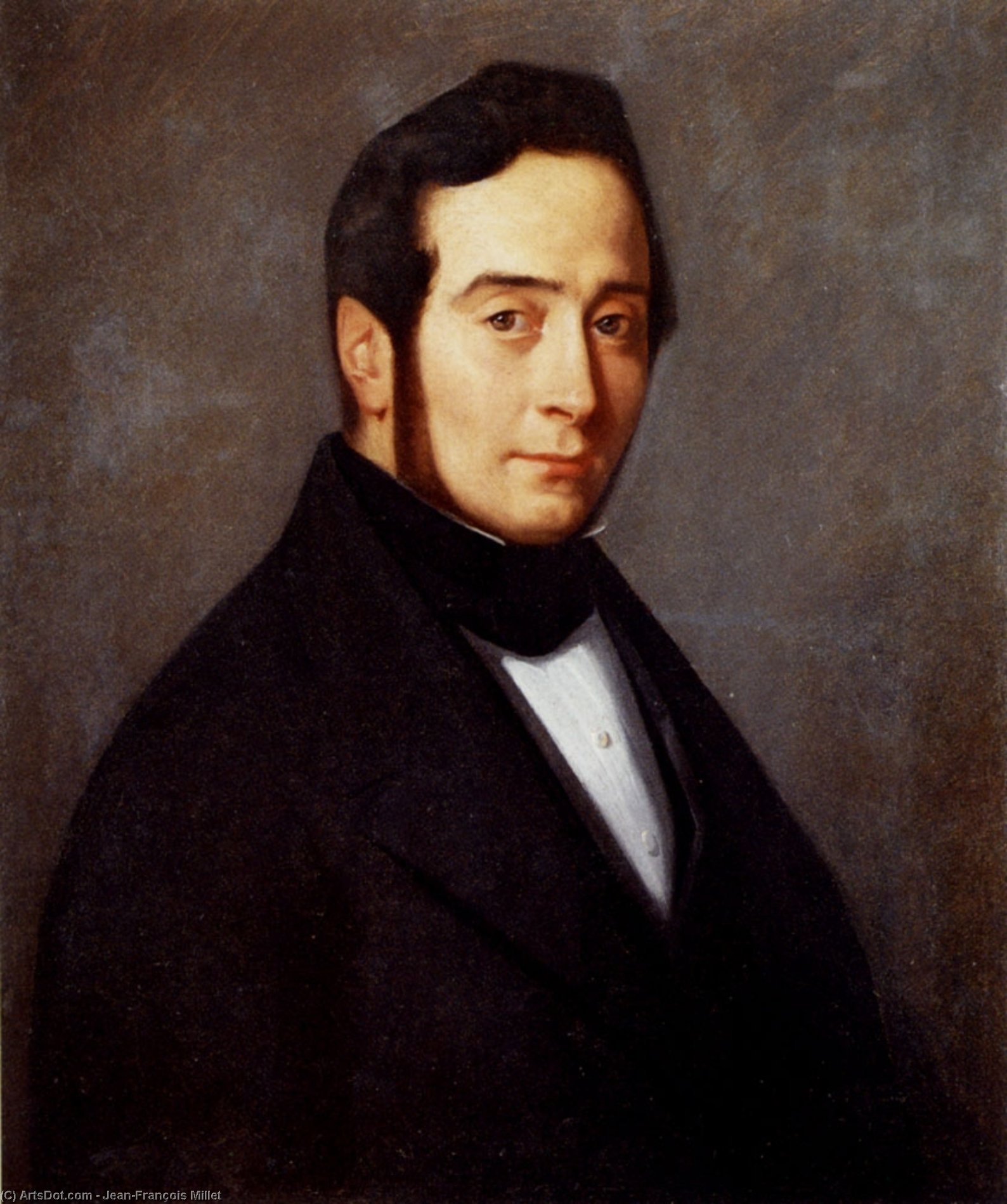
Portrait Of Eugene Canoville
Jean-François Millet’s “Portrait of Eugène Canoville,” painted in 1840, stands as a cornerstone of Realism within the Barbizon School movement—a testament to his unwavering dedication to portraying the human condition with unflinching honesty. Measuring 64 x 54 cm (approximately 25 ¼ x 21 ¼ inches), this oil on canvas transcends mere representation; it captures a moment in time, imbued with palpable emotion and meticulous detail.
### Artistic Style: A Shift Towards Sobriety
Millet’s artistic journey began amidst the pastoral influences of his formative years, mirroring the aesthetic sensibilities of the preceding century. However, by the 1840s, he decisively embraced a more austere and purposeful style under the considerable sway of Honoré Daumier—a stylistic evolution that fundamentally reshaped his oeuvre. This pivotal change is vividly evident in “A Winnower,” arguably Millet’s breakthrough work, marking a decisive departure from idealized landscapes toward a deeper engagement with social realities. "Portrait Of Eugene Canoville" embodies this newfound conviction, demonstrating Millet's mastery of conveying psychological depth alongside technical precision—a hallmark of his distinctive artistic vision.
### The Subject: Dignity Amidst Circumstance
The portrait depicts Eugène Canoville, a gentleman distinguished by his formal attire – a meticulously crafted suit complemented by a bow tie – embodying the aspirations and anxieties of bourgeois society during a period marked by profound social upheaval. Millet’s gaze is direct, conveying confidence and intellectual curiosity; it invites contemplation on the sitter's inner life. The monochromatic palette—a deliberate choice—amplifies the subject’s features and accentuates the textures of his clothing, prioritizing clarity and emotional resonance over decorative embellishment.
### Historical Context: France Under Louis-Philippe
The 1840s witnessed a dramatic escalation in homelessness amongst rural populations across France – a consequence of economic recession exacerbated by the collapse of King Louis-Philippe’s monarchy following the tumultuous events of 1848. Millet's artistic output consistently reflected these pressing societal concerns, as powerfully articulated in “Retreat from the Storm,” which portrays the vulnerability and resilience of a woman and her child confronting the anxieties of this turbulent era. "Portrait Of Eugene Canoville" serves not merely as an aesthetic achievement but also as a poignant snapshot of its time—a reflection of Millet’s profound empathy for the everyday struggles of ordinary people.
### Artistic Significance: Influence Beyond Technique
“Portrait Of Eugene Canoville” is undeniably remarkable for its technical execution, yet its significance extends far beyond mere craftsmanship. Alongside masterpieces like “Jeanne-Marguerite Lecadre in the Garden” by Claude Monet—which similarly championed realism and humanist values—Millet’s work established him as a pivotal figure in shaping the trajectory of art history. His unwavering commitment to portraying human experience with sensitivity and accuracy continues to inspire artists today, cementing his legacy as one of the most enduring voices of Realism.
- Artist: Jean-François Millet
- Year: 1840
- Medium: Oil on Canvas
- Dimensions: 64.5 x 54.5 cm
Explore a stunning reproduction of this iconic artwork at ArtsDot.com!