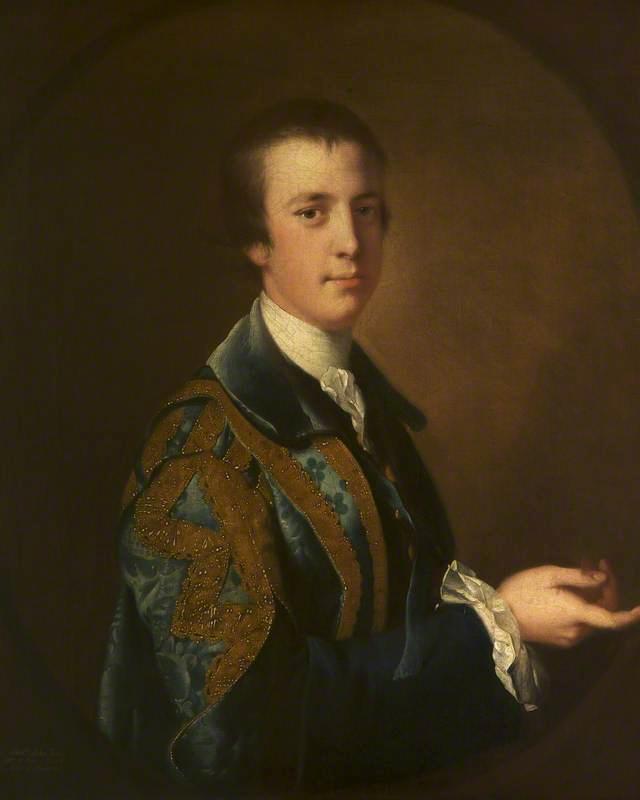
Joseph Wright’s ‘The Honourable John Grey,’ painted in 1764, showcases Wright’s signature chiaroscuro technique and captures the intellectual fervor of the Industrial Revolution era. Located at Dunham Massey Estate, UK, this iconic artwork exemplifies scientific observation and philosophical contemplation.
The Luminary of Derby: Joseph Wright of Derby and “The Honourable John Grey”
Joseph Wright of Derby (1734-1797) stands as an undeniable titan amongst the artists who captured the burgeoning spirit of the Industrial Revolution, marking a pivotal moment in human history. Far from merely documenting the era’s advancements—though he certainly did so with meticulous detail—Wright fundamentally reimagined how art could engage with and interpret these transformative changes. His canvases weren't simply representations of scientific breakthroughs or aristocratic gatherings; they pulsed with an intellectual fervor that sought to illuminate not just what was happening, but *why* it mattered.
Born in Iron Gate, Derbyshire, Wright’s formative years instilled within him a grounding in the practical realities of his father’s legal profession – a foundation that arguably fueled his later fascination with precision and observation. This dual influence is powerfully evident in “The Honourable John Grey,” painted in 1764 and currently residing at Dunham Massey Hall.
A Portrait Steeped in Enlightenment Thought
"The Honourable John Grey" transcends the conventions of traditional portraiture, presenting a figure not merely depicted but actively engaged in contemplation. Wright’s masterful use of chiaroscuro—the dramatic interplay between light and shadow—immediately establishes an atmosphere of intellectual seriousness. The muted palette contributes to this mood, emphasizing the subject's inner life rather than outward grandeur.
Wright meticulously rendered Grey’s pose – hunched over a table illuminated by candlelight – conveying a palpable sense of concentration. This posture isn’t accidental; it reflects the philosophical currents of the Enlightenment, where thinkers wrestled with questions of reason and empiricism. The inclusion of scientific instruments—a microscope and a quadrant—further underscores this intellectual preoccupation.
Technique and Symbolism: Mastering Light and Representing Knowledge
Wright's technique is characterized by an unparalleled command of oil paint, allowing him to achieve astonishing levels of tonal gradation and textural detail. He skillfully captures the subtle nuances of light reflecting off Grey’s clothing and instruments, creating a luminous effect that draws the viewer’s eye inward.
Beyond mere visual representation, “The Honourable John Grey” operates on multiple symbolic levels. The microscope symbolizes scientific inquiry and the pursuit of understanding—a cornerstone of Enlightenment ideals. Similarly, the quadrant represents astronomical observation and the exploration of natural phenomena. Together, these elements convey a message about the importance of reason and empirical evidence in shaping human experience.
Dunham Massey’s Legacy: A Window into Victorian Intellectual Life
Currently housed at Dunham Massey Hall, this artwork offers visitors an invaluable glimpse into the intellectual landscape of Victorian England. It serves as a testament to Wright's ability to transform historical subjects into vehicles for profound philosophical reflection—a legacy that continues to inspire artists and collectors alike.
Further Exploration