A Poignant Echo of Arthurian Tragedy
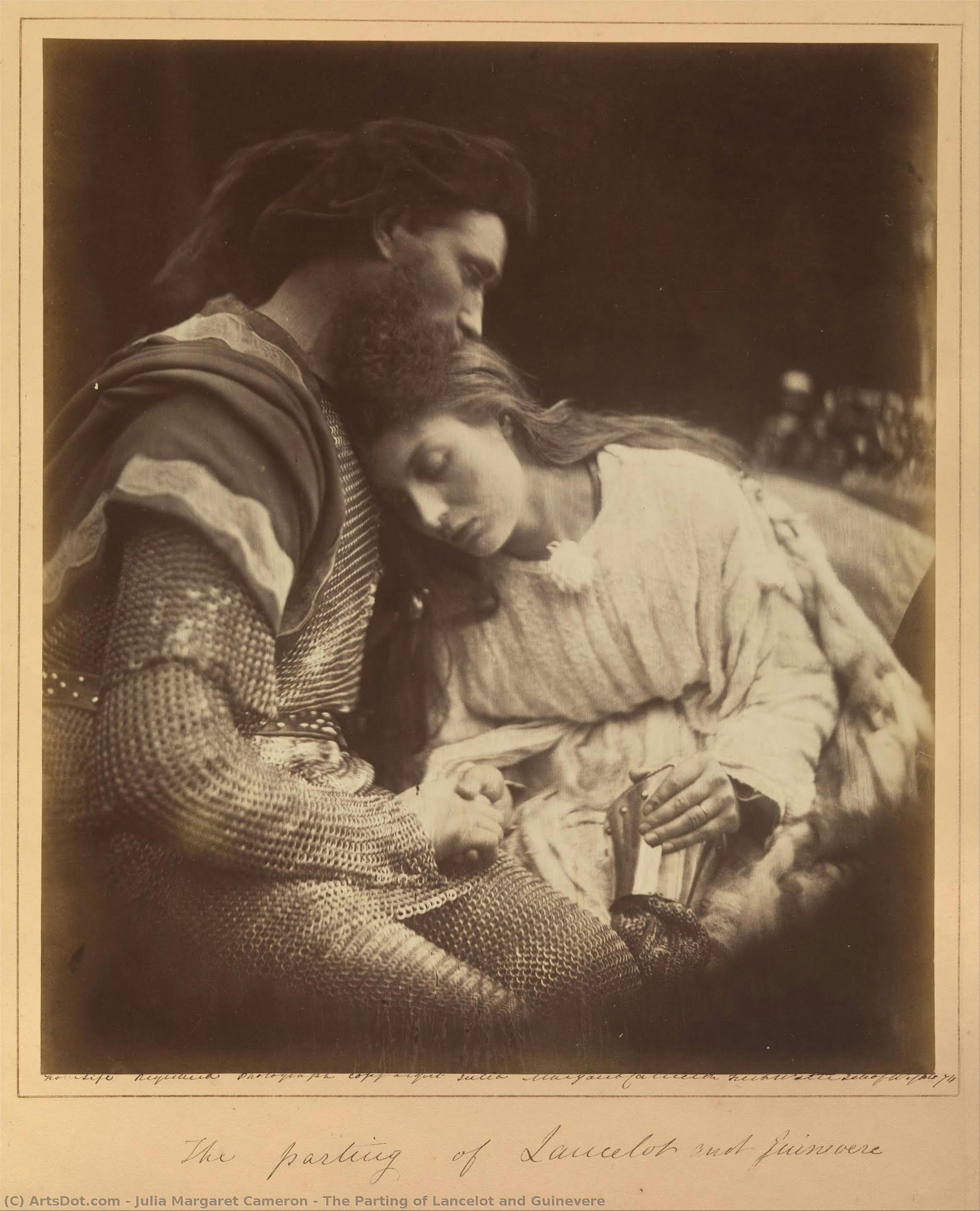
In the soft, silvered shadows of Julia Margaret Cameron’s 1874 masterpiece, "The Parting of Lancelot and Guinevere," we encounter more than a mere photographic record; we witness a soul-stirlyng fragment of legend brought to life. This evocative work captures the precise, agonizing moment of farewell between the legendary knight and his queen, as they prepare to part ways following their clandestine passion. Commissioned by the poet Alfred Lord Tennyson for his epic Idylls of the King, the image serves as a visual bridge between the written word and the photographic lens, translating the rhythmic sorrow of Tennyson’s verse into a tangible, haunting atmosphere. To gaze upon this piece is to step into a world where the boundaries between reality and myth dissolve, leaving only the raw, palpable ache of impending loss.
The composition is a masterclass in emotional intimacy, positioning the two figures in a closeness that suggests both their profound connection and the tragic weight of their separation. Clad in medieval-inspired attire that evokes the romanticism of the Pre-Raphaelite era, Lancelot and Guinevere are rendered not with the clinical sharpness of traditional portraiture, but with a dreamlike tenderness. The woman leans against the man’s shoulder, a gesture of vulnerability and reliance that speaks volumes about their shared history. For collectors and decorators, this piece offers a profound sense of narrative depth, making it an ideal centerpiece for spaces designed to evoke contemplation, nostalgia, or a sophisticated appreciation for historical romanticism.
The Alchemy of Soft Focus and Light
What truly distinguishes Cameron’s work is her revolutionary departure from the technical standards of her era. While her contemporaries sought the crisp, unyielding clarity of the Daguerreotype, Cameron embraced the aesthetic of Pictorialism. She deliberately utilized soft-focus techniques to create an ethereal haze, a deliberate blurring that mimics the way memory itself functions—fragmented, hazy, and colored by emotion rather than precise detail. This technique allows light to bleed softly around the edges of her subjects, creating an atmospheric illusion that feels less like a photograph and more like a fading dream.
This intentional lack of sharp definition serves a higher purpose: it prioritizes the essence of the human experience over the mere documentation of physical features. The muted, monochromatic palette emphasizes texture and shadow, drawing the eye to the subtle interplay of light on fabric and skin. For an interior designer, this soft-focus quality provides a unique advantage; the artwork does not demand attention through jarring brightness but rather invites the viewer into its quiet, melancholic orbit, complementing sophisticated, moody, or classically inspired decor with an understated elegance.
A Legacy of Symbolism and Artistic Vision
Beyond its technical brilliance, "The Parting of Lancelot and Guinevere" is steeped in a rich tapestry of symbolism. Every element, from the heavy drapery to the somber postures, reinforces the themes of duty, desire, and inevitable heartbreak. Cameron’s ability to capture the intangible—the weight of a secret, the sting of a goodbye—marks her as a pioneer who saw the camera not just as a tool for science, but as a medium for high art. Her work resonates with those who value art that tells a story, offering a window into the Victorian fascination with Arthurian legend and the Romantic movement's obsession with the sublime.
Owning a high-quality reproduction of this photograph allows one to bring this piece of history into a contemporary setting, bridging the gap between the 19th century and the present day. Whether placed in a private library, a grand hallway, or a curated gallery wall, the image acts as a silent storyteller, providing an anchor of historical depth and emotional resonance that continues to captivate the modern imagination.