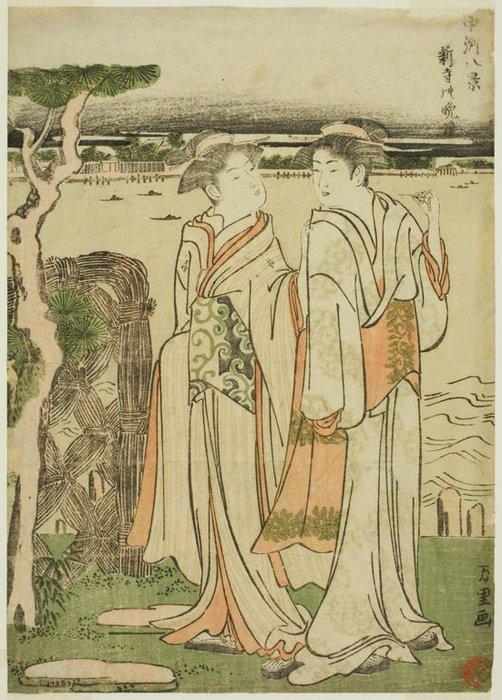
El timbre vespertino en el templo de Hokusai captura la serenidad del paisaje japonés Edo, destacando la maestría técnica y simbolismo religioso de este icono artístico.
Descubre a Hokusai (1760-1849), maestro del ukiyo-e japonés! Explora 'La Gran Ola', paisajes, manga e impresiones en madera. ¡Influencia en el Impresionismo y más!
Evening Bell at Mii Temple – A Tranquil Reflection of Edo Era Japan
The artwork “Evening Bell at Mii Temple,” attributed to Katsushika Hokusai, stands as a cornerstone of Japanese landscape painting and exemplifies the aesthetic sensibilities of the Edo period (1603-1868). More than just a depiction of scenery, it’s an invitation into a moment of contemplative beauty—a carefully crafted visual experience designed to evoke serenity and appreciation for the natural world. Hokusai's masterful use of Prussian blue pigment, imported from Europe during this era, elevates the print beyond mere observation; it transforms it into a symbol of artistic innovation and cultural exchange.
Composition and Technique: Mastering Ukiyo-e Aesthetics
Hokusai’s technique—woodblock printing (ukiyo-e)—was revolutionary for its time. The artist meticulously carved detailed linework onto wooden blocks, transferring ink to paper with precision and layering colors to achieve astonishing tonal depth and luminosity. Notice the dominant vertical line that anchors the composition, mirroring the towering Mount Fuji in the background – a motif frequently employed by Hokusai to convey grandeur and permanence. The placement of the temple building itself is deliberately asymmetrical, creating visual balance while subtly emphasizing the importance of spiritual contemplation amidst the vastness of nature. Furthermore, the artist skillfully utilizes atmospheric perspective—a technique perfected during this period—to simulate the hazy air surrounding Mount Fuji, enhancing the sense of distance and conveying a feeling of ethereal beauty.
Symbolism Within Landscape Imagery
Japanese landscape painting held profound symbolic significance within Edo society. Mountains represented stability, resilience, and divine authority – ideals deeply ingrained in Buddhist beliefs prevalent at the time. The temple bell symbolizes enlightenment and spiritual awakening, representing the aspiration for inner peace and harmony. The two women depicted alongside the temple contribute to this symbolism; they embody feminine grace and represent a harmonious relationship between humanity and nature. Their gaze directs our attention upwards towards Mount Fuji, reinforcing the overarching theme of reverence for the sacred landscape.
Historical Context: Edo Period Influence & Artistic Legacy
The Edo period witnessed an unprecedented flourishing of artistic creativity fueled by economic prosperity and social stability. Artists like Hokusai were commissioned to produce prints celebrating imperial patronage and commemorating significant events—a practice that fostered stylistic experimentation and broadened artistic horizons. “Evening Bell at Mii Temple” directly reflects the prevailing aesthetic ideals of the era, prioritizing subtlety, restraint, and a profound connection with the natural world. Its influence extends far beyond Japan’s borders, inspiring Impressionist painters like Claude Monet who sought to capture fleeting moments of beauty—a testament to Hokusai's enduring artistic legacy.
Emotional Impact: A Moment Frozen in Time
Ultimately, “Evening Bell at Mii Temple” transcends mere visual representation; it communicates a palpable emotion – tranquility. The muted palette, combined with the careful rendering of light and shadow, invites viewers into a meditative state. It’s a scene designed to inspire contemplation and appreciation for the sublime beauty of nature—a timeless reminder that even amidst the complexities of life, moments of serenity can be found in observing the grandeur of Mount Fuji and reflecting on the spiritual significance of Buddhist temples.