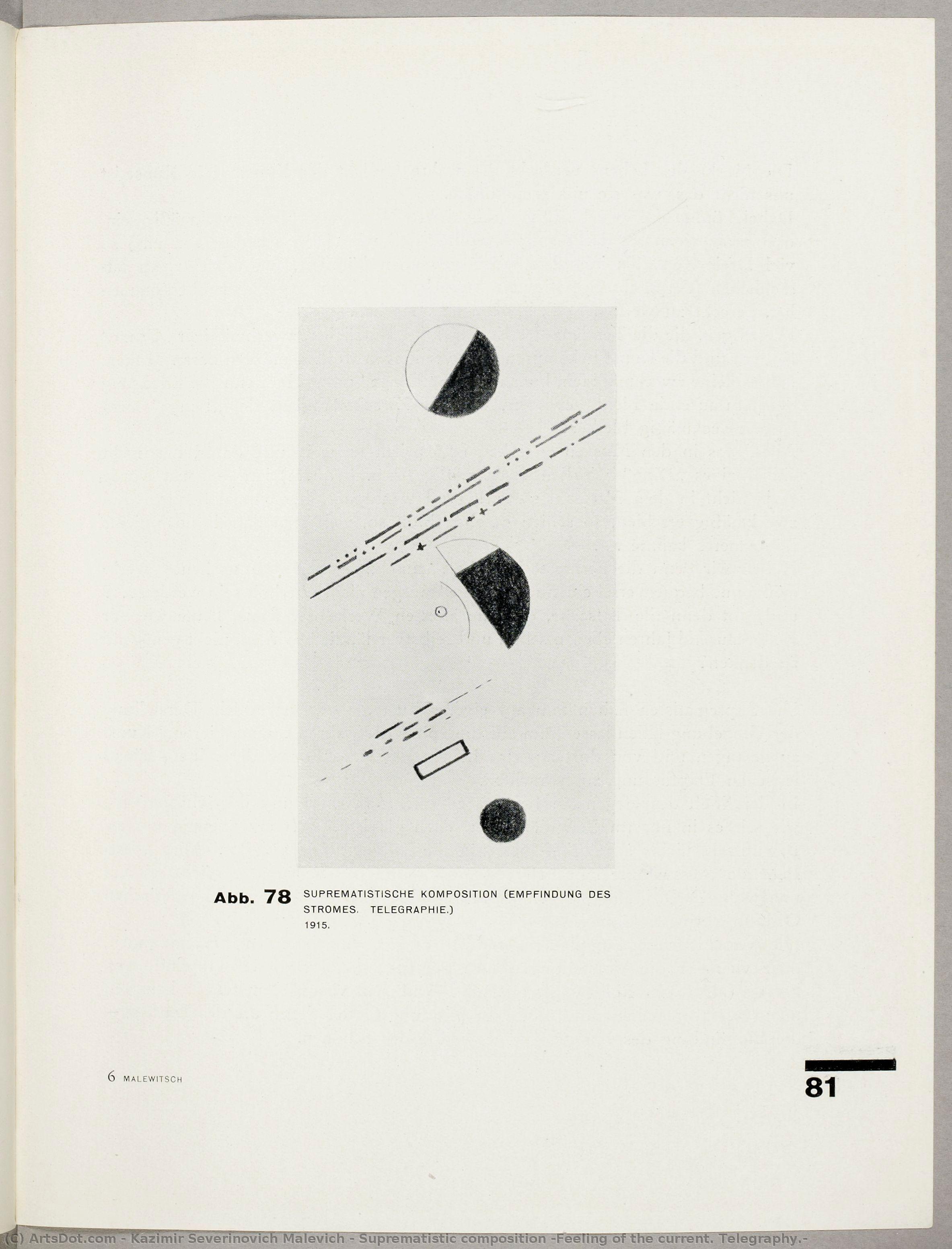
Suprematistic Composition (Feeling of the Current. Telegraphy.): A Pioneer’s Vision
Kazimir Malevich's "Suprematistic Composition (Feeling of the Current. Telegraphy.)" transcends mere visual representation, embodying a radical departure from traditional artistic conventions and capturing the spirit of its time—the turbulent years following the Russian Revolution. Created in 1927, this monochrome masterpiece exemplifies Suprematism, Malevich’s groundbreaking movement that championed pure geometric abstraction as a vehicle for expressing fundamental spiritual truths. The photograph showcases a meticulously reproduced page from a German publication, highlighting the artwork's austere beauty and intellectual depth.
- Composition: The piece utilizes a deceptively simple arrangement of concentric circles and rectangles against a stark white background. Lines intersect these forms, generating an energetic dynamism that subtly suggests movement—a visual echo of the telegraph’s instantaneous transmission of information, reflecting Malevich's fascination with technological advancements and their impact on human perception.
- Color Palette: Strikingly devoid of color, the monochrome palette reinforces the artwork’s focus on pure form and eliminates distractions, allowing viewers to contemplate the underlying geometric relationships. This deliberate restriction aligns perfectly with Suprematism’s core principle—the rejection of illusionistic representation in favor of conveying emotion through abstract shapes.
- Use of Lines: Malevich’s masterful use of lines is crucial to the composition's expressive power. Thick, horizontal lines dominate the canvas, anchoring the geometric forms and establishing a sense of stability amidst the apparent chaos. Conversely, thinner lines weave between circles and rectangles, creating visual connections and suggesting an underlying rhythm—a deliberate attempt to capture the essence of feeling itself.
- Shapes: The dominant shapes – circles and rectangles – are reduced to their most fundamental geometric qualities, mirroring Malevich’s belief that these forms represent the purest expressions of existence. Their concentric arrangement evokes a sense of unity and harmony, symbolizing the artist's aspiration for transcendence.
Historical Context & Theoretical Significance
“Suprematistic Composition” emerged from the crucible of artistic experimentation following World War I and the October Revolution. Malevich’s rejection of traditional art forms coincided with a broader intellectual movement questioning established norms and embracing new paradigms—particularly those rooted in mathematics and philosophy. His manifesto, “The Non-Objective World,” articulated Suprematism's theoretical underpinning: the belief that art should liberate itself from the constraints of objective reality and access the realm of pure feeling. This painting stands as a testament to Malevich’s conviction that geometric abstraction could serve as a conduit for spiritual contemplation—a radical proposition that challenged conventional notions of beauty and artistic expression.
Technique & Material Considerations
Executed in pen on paper, “Suprematistic Composition” exemplifies Malevich's meticulous attention to detail and his commitment to achieving maximum clarity and precision. The delicate lines of the pen convey a remarkable level of control, capturing subtle variations in texture and tonal nuance—a testament to the artist’s mastery of drawing techniques. The choice of paper contributes to the artwork’s understated elegance, emphasizing its materiality and grounding it within the tangible world.
Symbolic Resonance & Emotional Impact
Beyond its formal qualities, “Suprematistic Composition” resonates with profound symbolic significance. Malevich envisioned his paintings as representations of cosmic harmony—a visual embodiment of the artist’s spiritual quest for unity and transcendence. The concentric circles symbolize wholeness and interconnectedness, mirroring Malevich's belief that art should illuminate the hidden truths underlying everyday experience. Viewing this artwork evokes a feeling of calm contemplation, prompting viewers to consider the fundamental questions of existence and beauty—a legacy that continues to inspire artists and collectors alike.