A Symphony of Lines: Rediscovering Jiji Manga
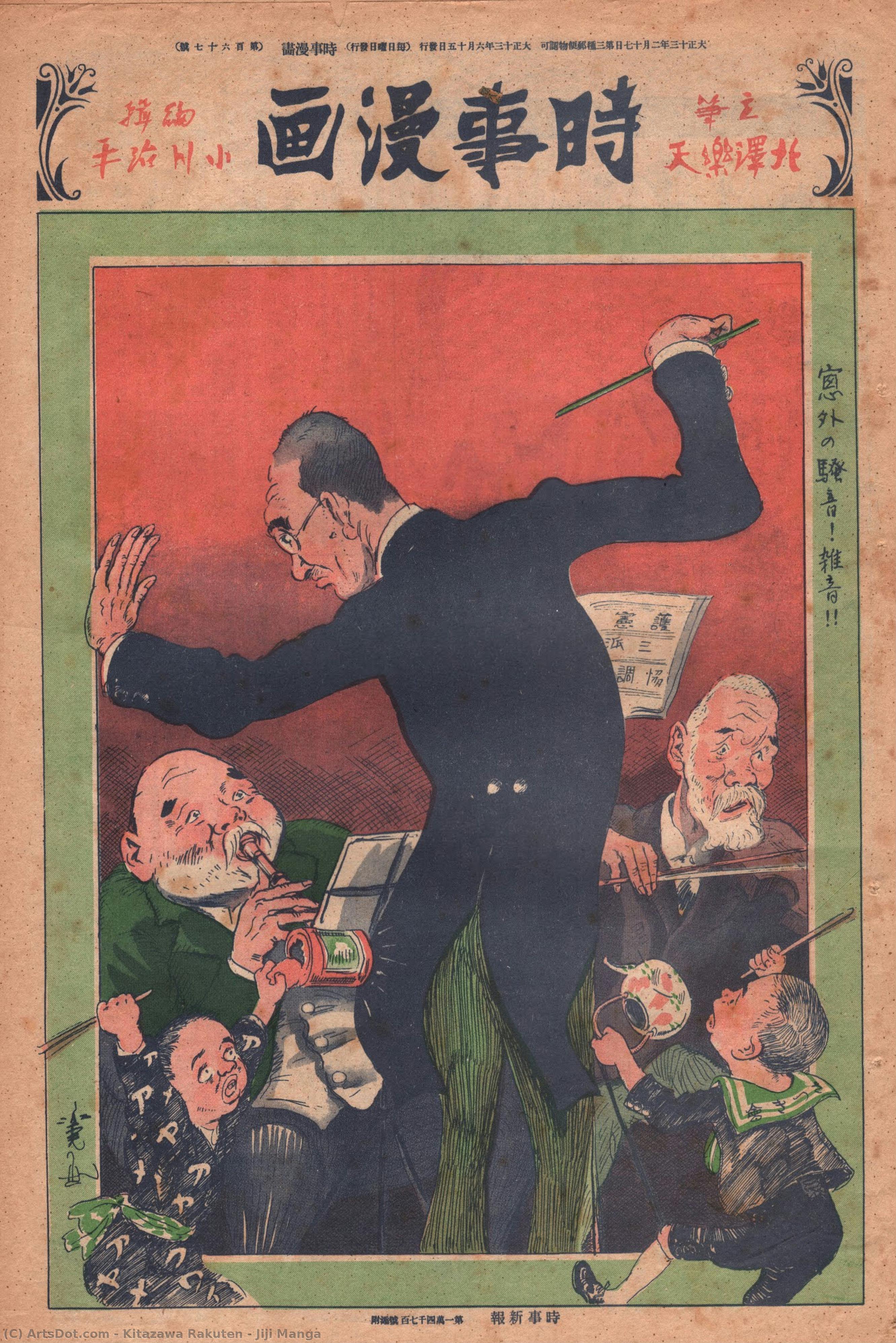
In the delicate interplay of ink and imagination, Jiji Manga emerges as a captivating window into the cultural pulse of 1924 Japan. This evocative piece, crafted by the legendary Kitazawa Rakuten, transcends the boundaries of mere illustration to become a profound narrative of communal harmony. At first glance, the viewer is drawn into a meticulously detailed scene where a conductor, poised with a baton, directs an ensemble of musicians. The composition breathes with the energy of a live performance; one can almost hear the rhythmic cadence of instruments and the focused breathing of the players. Rakuten’s ability to capture the subtle tension between the conductor's leadership and the collective effort of the group creates a sense of movement that is both static and vibrantly alive.
The artistry within this work lies in its masterful use of detail and spatial arrangement. The figures, some seated with quiet intensity and others standing in attentive readiness, are rendered with a precision that speaks to Rakuten’s foundational role in the evolution of modern manga. Through fine lines and thoughtful positioning, the artist establishes a hierarchy of focus, guiding the eye from the commanding gesture of the baton to the individual faces of the ensemble. The presence of formal attire, such as ties, hints at a sophisticated social gathering, grounding this artistic moment in a specific historical era of transition and modernization in Tokyo.
The Visionary Legacy of Kitazawa Rakuten
To understand the emotional depth of Jiji Manga, one must look toward the man behind the pen. Kitazawa Rakuten was not merely an illustrator; he was a pioneer who bridged the gap between traditional Japanese aesthetics and the burgeoning global language of sequential art. As the "father of modern manga," Rakuten infused his work with a satirical wit and a deep empathy for the human condition. In this particular piece, we see a departure from pure satire toward a more lyrical, observational style. The technique reflects a sophisticated command over line weight and density, allowing the artist to suggest texture—from the fabric of a suit to the polished wood of an instrument—without the need for heavy shading.
For the discerning collector or interior designer, this artwork offers much more than visual appeal; it provides a historical anchor. The piece serves as a testament to the Taisho and early Shōwa era's spirit of collaboration and cultural synthesis. It is an ideal acquisition for those looking to introduce a sense of intellectual depth and nostalgic elegance into a space. Whether placed in a contemporary gallery setting or a classic study, Jiji Manga acts as a conversation starter, inviting viewers to contemplate the enduring power of collective harmony and the timeless beauty of the artistic process.