A Moment of Quietude: Exploring Lilla Cabot Perry’s “Girl Playing a Cello”
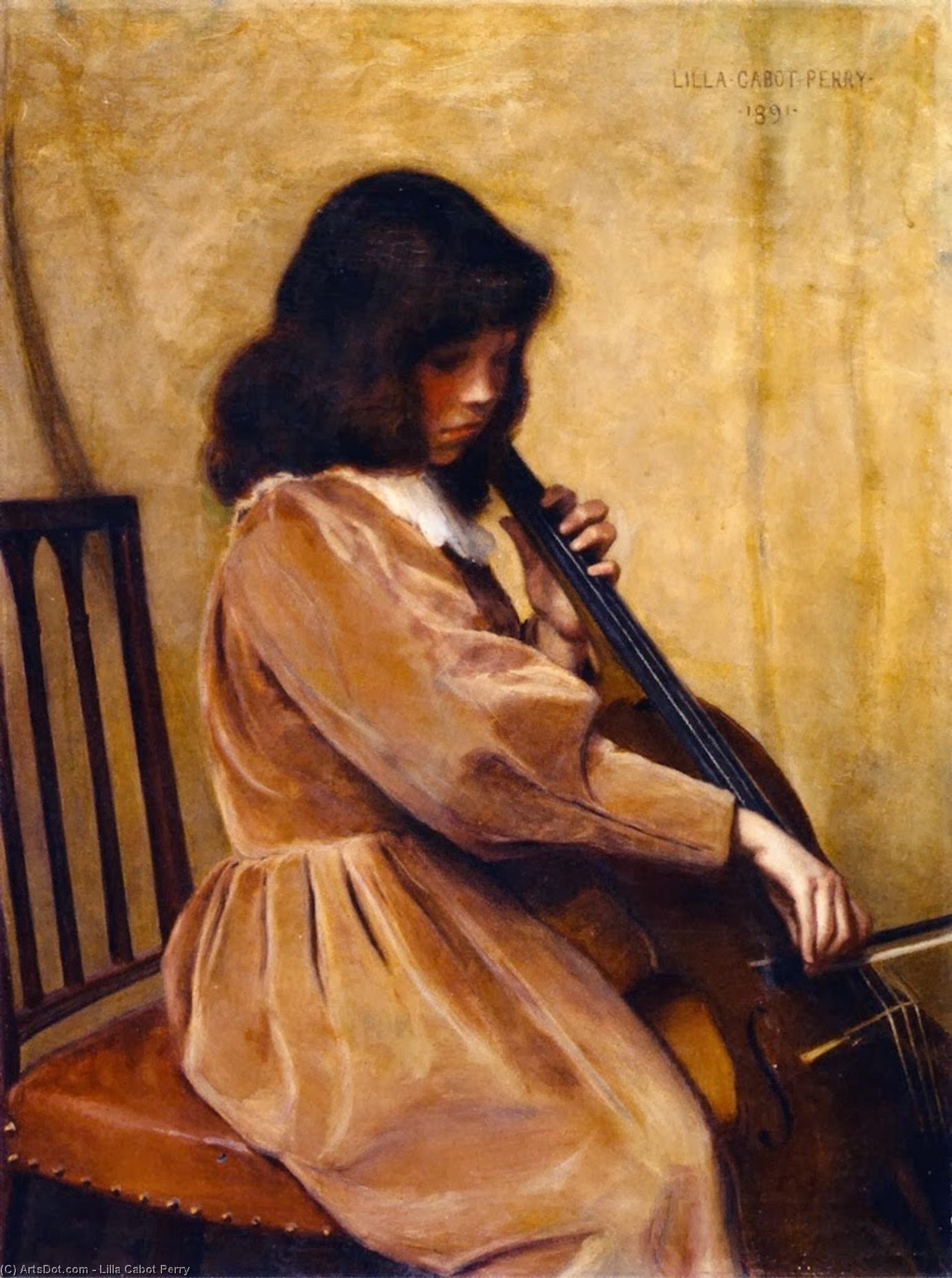
Lilla Cabot Perry's "Girl Playing a Cello," painted in 1891, isn’t merely a portrait; it’s a carefully constructed tableau of intimacy and contemplative beauty. This work, currently residing within the hallowed halls of the Fogg Art Museum at Harvard University, offers a glimpse into late 19th-century American Impressionism – a movement characterized by its loose brushwork, emphasis on light and color, and a profound interest in capturing fleeting moments of everyday life. Perry’s masterful handling of light and shadow, combined with her sensitive portrayal of the young musician, creates an atmosphere of serene stillness that draws the viewer into the scene.
The painting immediately establishes a sense of quiet domesticity. The girl, dressed in a sumptuous yellow velvet gown adorned with a delicate white collar, is completely absorbed in her music. Her posture – slightly hunched over the cello, her gaze lowered – speaks volumes about concentration and passion. Perry’s use of color is particularly noteworthy; the warm golden light bathing the room contrasts beautifully with the cool blues and greens of the background, creating a harmonious balance that enhances the painting's overall mood. The subtle details—the texture of the velvet, the gleam of the cello strings—are rendered with remarkable precision, demonstrating Perry’s keen observational skills.
Impressionism in Boston: A Local Pioneer
Perry’s artistic journey is inextricably linked to the vibrant art scene of Boston during this period. Influenced by the teachings of Robert Vonnoh and her exposure to European Impressionist techniques, she developed a distinctive style that blended elements of realism with an expressive use of color and light. Her work reflects the broader trends of the time – a growing interest in capturing the beauty of nature and the lives of ordinary people. Notably, Perry’s early training with Alfred Quinton Collins, a Boston School painter, instilled in her a deep appreciation for portraiture, while her travels to France provided her with invaluable experience in adopting the “en plein air” style championed by Monet and Pissarro.
Furthermore, Perry's background as the daughter of prominent Boston figures – Dr. Samuel Cabot III and Hannah Lowell Jackson Cabot – afforded her access to a world of culture and intellectual stimulation. Her friendships with artists like Camille Pissarro and exposure to the works of Old Masters through Bernard Berenson undoubtedly shaped her artistic sensibilities. The painting, therefore, can be seen as a reflection of both her personal experiences and the broader cultural currents of her time.
Symbolism and Emotional Resonance
Beyond its technical merits, “Girl Playing a Cello” resonates with profound symbolic meaning. The cello itself is a potent symbol of creativity, passion, and introspection. The girl’s absorption in her music suggests a desire for escape, self-expression, and connection to something larger than herself. The simple setting—a single chair, a few subtle hints of other figures—creates an atmosphere of intimacy and privacy, inviting the viewer to contemplate the girl's inner world.
The painting’s overall effect is one of quiet contemplation and emotional depth. It’s not simply a depiction of a young girl playing an instrument; it’s a meditation on beauty, innocence, and the power of art to transport us to another realm. Reproductions of this iconic work offer a wonderful opportunity to bring this evocative scene into your home, allowing you to experience its timeless appeal firsthand.
Further Exploration