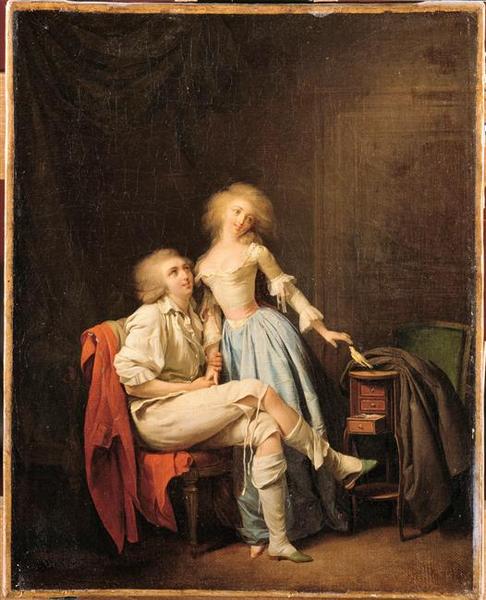
A Glimpse into Parisian Serenity
In the twilight of the eighteenth century, as the winds of revolution began to stir the foundations of France, Louis Léopold Boilly captured a moment of profound, quiet intimacy. L'oiseau privé, dit le couple et l'oiseau envolé, painted in 1789, serves as more than a mere domestic scene; it is a window into the refined soul of Parisian society. The artwork presents a tender tableau of a couple seated at a table, their attention captivated by a birdcage that holds a single, delicate inhabitant. Through Boilly’s masterful hand, we are invited into a world where elegance and stillness act as a sanctuary against the encroaching uncertainties of a changing era. For the discerning collector or interior designer, this piece offers an unparalleled sense of tranquility and timeless grace, making it a centerpiece capable of anchoring a room with historical depth and emotional warmth.
The composition is a masterclass in balance and classical structure. Boilly employs a subtle triangular arrangement, positioning the figures at the apex to naturally draw the viewer’s gaze toward the central interaction. This geometric precision is softened by the organic flow of draped fabrics and the gentle contours of the subjects, creating a harmony between rigid form and fluid movement. As the eye wanders through the scene, the use of linear perspective provides a convincing sense of depth, leading us past the foregrounded furniture into the soft, receding shadows of the background. This careful layering ensures that the painting feels less like a flat image and more like an inviting space one could almost step into.
The Artistry of Light and Texture
Technically, Boilly’s work is a triumph of traditional oil painting, characterized by a luminous quality that seems to radiate from within the canvas. He utilized meticulous layers of glaze to achieve a breathtaking realism, particularly in the way light interacts with different surfaces. One can almost feel the contrast between the cool, smooth texture of fine silk drapery and the warm, tactile softness of human skin. The lighting is intentionally diffused, eschewing harsh shadows in favor of a gentle, even glow that bathes the couple in a romantic, ethereal light. This soft illumination enhances the nuanced color palette—a sophisticated arrangement of muted whites, beiges, blues, and deep reds that avoids ostentation to embrace an understated, aristocratic elegance.
Beyond its aesthetic beauty, the painting is rich with symbolic resonance. The birdcage, a central motif, serves as a potent metaphor for the complexities of human existence; it can represent the safety of domesticity or the melancholy of confinement. This duality invites deep contemplation, mirroring the tension felt in 1789 Paris between the desire for stability and the inevitability of change. For those looking to adorn a space with art that provokes thought, this reproduction offers a perfect blend of decorative splendor and intellectual intrigue. It is an exquisite choice for any curated collection, bringing with it the spirit of a lost age of refinement and the enduring beauty of the human connection.