A Flight Through Memory: The Dreamscape of Marc Chagall
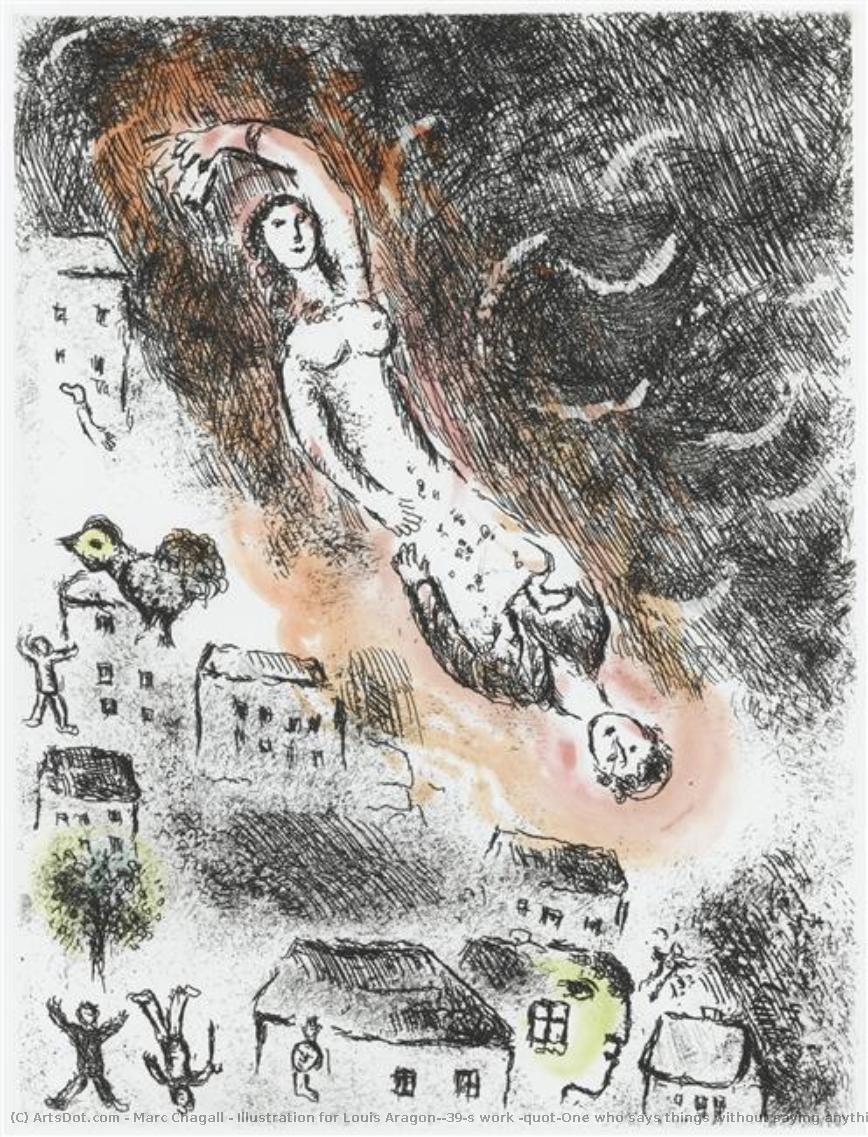
In the ethereal realm of Marc Chagall’s 1976 masterpiece, Illustration for Louis Aragon's work "One who says things without saying anything", the boundaries between the terrestrial and the celestial dissolve into a singular, poetic vision. This work is not merely an illustration; it is a profound distillation of dreams, folklore, and the indelible imprint of Vitebsk—the town that served as the emotional compass for Chagall’s entire artistic journey. As one gazes upon the scene, a woman appears to soar through a cityscape bathed in the soft glow of moonlight, her arms outstretched in a gesture of pure transcendence. Accompanied by birds that dance through the ether and scattered figures that inhabit the edges of our perception, the piece invites the viewer to abandon the heavy constraints of gravity and enter a world where memory and imagination are one.
The technique employed here is a masterful display of Chagall’s signature approach, where intuitive precision meets a rejection of academic rigidity. Eschewing the strictures of traditional perspective, Chagall utilizes a flattened space that prioritizes emotional resonance over anatomical or architectural accuracy. His brushstrokes—often loose and fluid—create a sense of movement that mirrors the very subject matter: flight. While some interpretations of his work lean into vibrant color, this specific monochrome rendering emphasizes the stark, evocative power of light and shadow. The interplay of black and white lends a timeless, lithographic quality to the piece, allowing the viewer to focus on the symbolic weight of the silhouettes and the rhythmic placement of the birds and houses that ground this surreal landscape in a palpable, albeit dreamlike, sense of place.
Symbolism and the Poetic Connection
To understand this artwork is to understand the profound literary connection between Chagall and the French Surrealist poet Louis Aragon. The illustration serves as a visual companion to Aragon’s poem, capturing that elusive essence of human experience—the unspoken truths that reside beneath the surface of everyday life. Every element within the composition acts as a metaphor for the soul's aspirations. The woman in flight symbolizes the liberation of the spirit, while the birds represent both freedom and the spiritual messengers that traverse the gap between the conscious and the subconscious. Even the architectural forms, though simplified, evoke the nostalgic architecture of Chagall’s youth, grounding the surrealist elements in a deeply personal history.
For the discerning collector or interior designer, this piece offers more than just aesthetic beauty; it provides a window into the human psyche. The artwork possesses a unique ability to transform a space, injecting a sense of wonder and contemplative depth into any environment. Whether placed in a quiet study or as a focal point in a contemporary living area, Chagall’s vision of a world where "one says things without saying anything" resonates with anyone who finds beauty in the unspoken and the profound. It is an invitation to linger, to dream, and to rediscover the magic that exists within the fragments of our own memories.