Mary Vaux Walcott’s “Wind Poppy”: A Delicate Dance Between Observation and Artistic Expression
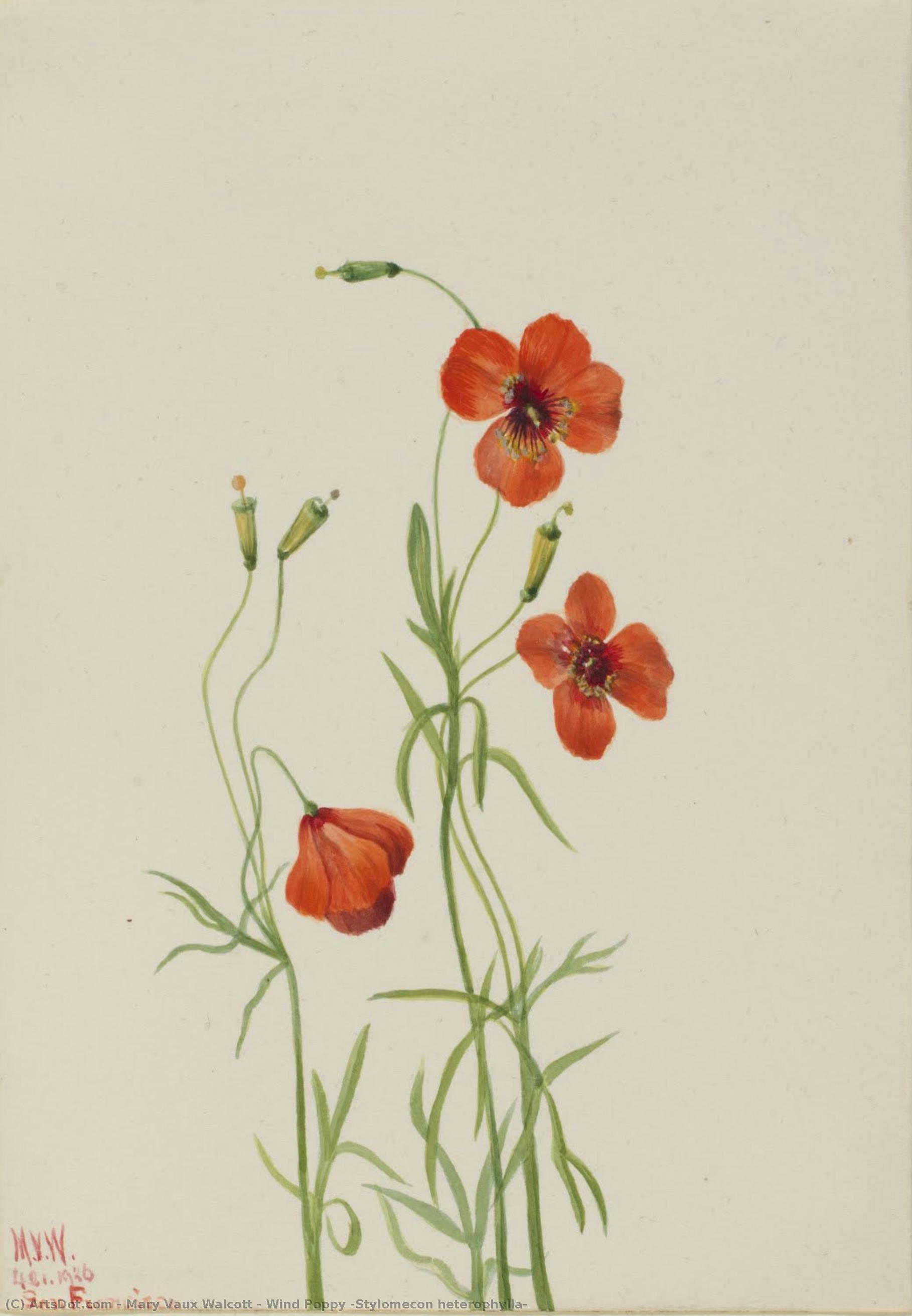
Mary Vaux Walcott (1860-1940), affectionately dubbed “the Audubon of Botany,” stands as a monumental figure in the history of American botanical illustration. Her unwavering dedication to meticulously documenting North American flora—particularly wildflowers—yielded an astonishing body of work that continues to captivate audiences today. Among her celebrated paintings is “Wind Poppy (Stylomecon heterophylla),” completed in 1926, a piece that exemplifies Walcott’s unparalleled skill and artistic vision.
This watercolor depicts three Stylomecon heterophylla poppies against a subtly textured beige backdrop—a palette chosen to enhance the luminosity of the blossoms themselves. The composition is vertically oriented, prioritizing an upward gaze that mirrors the plant's growth trajectory and conveying a sense of natural dynamism. Lines are predominantly soft and flowing, skillfully mimicking the organic contours of the poppy stems and petals; shapes are curvilinear, reflecting the graceful curves inherent in floral forms.
Walcott’s technique is characterized by wet-on-wet watercolor application—a masterful approach that builds up layers of pigment with remarkable subtlety. This method allows for nuanced tonal transitions and captures the velvety texture of the poppy heads and the smooth sheen of their stems, achieving a level of realism rarely matched in botanical art of its time. Careful attention to detail is evident throughout; minute variations in leaf textures contribute to the overall impression of authenticity.
Beyond its technical brilliance, “Wind Poppy” speaks volumes about Walcott’s artistic philosophy. The painting isn't merely a scientific record; it’s an emotive response to the beauty and fragility of the natural world. Like Audubon’s ornithological drawings before her, Walcott sought not only to accurately represent plants but also to convey their essence—their vitality, their resilience, and their inherent aesthetic appeal. This dedication to capturing both observation and emotion solidified Walcott's legacy as a pioneer in botanical art and cemented her place among America’s most influential artists.
The Smithsonian American Art Museum holds this remarkable artwork (Object Number: 1970.355.33), generously gifted by the artist herself, offering visitors an opportunity to experience firsthand the exquisite artistry of Mary Vaux Walcott and appreciate her enduring contribution to the visual arts.