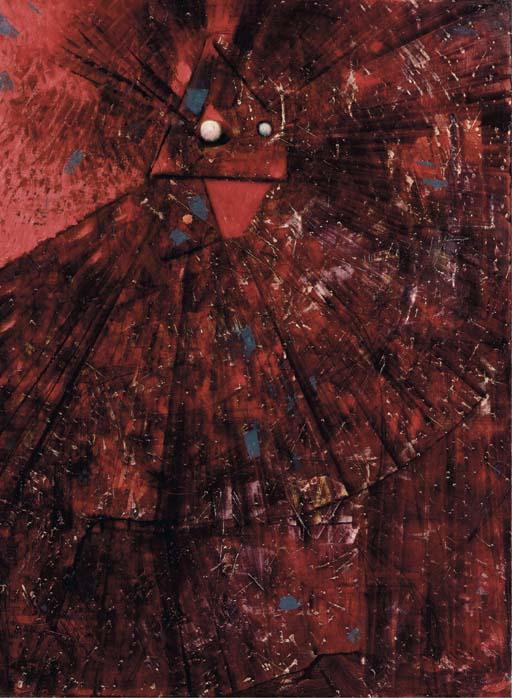
Max Ernst’s ‘Etude pour Le Grand Albert’ presents a striking surreal composition featuring a cutout bird amidst symbolic objects like clocks and bowls, reflecting the artist's exploration of the subconscious during the 20th century. Discover this enigmatic masterpiece and bring its unique vision home.
Unveiling the Enigma: *Etude pour Le Grand Albert* by Max Ernst
Max Ernst’s *Etude pour Le Grand Albert*, a seemingly simple depiction of a crimson bird amidst a collection of disparate objects, is anything but straightforward. Painted in the mid-20th century, this work embodies the core tenets of Surrealism – a movement that sought to unlock the subconscious and challenge conventional notions of reality. The painting’s power lies not just in its visual elements but in the unsettling juxtaposition of familiar forms rendered with an almost dreamlike quality. It's a meditation on isolation, memory, and the fragmented nature of experience, hallmarks of Ernst’s deeply personal artistic explorations.
- Subject Matter: The central figure – a stylized bird – immediately draws the eye, its bold red hue acting as a focal point. However, the surrounding elements—a clock, bowls, and scattered spoons—introduce an element of disorientation, suggesting a disrupted timeline or a collection of disconnected thoughts.
- Style & Technique: Ernst’s technique is characterized by meticulous detail combined with a deliberate sense of ambiguity. The precise rendering of each object contrasts sharply with the overall surreal atmosphere, creating a tension that invites interpretation. His use of collage elements, though not explicitly visible in this particular study, reflects his broader experimentation with various media and techniques, including frottage and decalcomania.
- Historical Context: *Etude pour Le Grand Albert* was created during a period of intense artistic and intellectual ferment. The rise of psychoanalysis, particularly the work of Sigmund Freud, profoundly influenced artists like Ernst, who sought to tap into the hidden depths of the human psyche. Surrealism emerged as a direct response to the horrors of World War I and the perceived failures of rational thought.
Decoding the Symbolism
The symbolism within *Etude pour Le Grand Albert* is deliberately open to interpretation, reflecting the core principles of Surrealist art. The bird itself has multiple layers of meaning; it can represent freedom, instinct, or even a lost soul. Its vibrant red color adds to this intensity, often associated with passion, danger, and vitality. The clock, a recurring motif in Ernst’s work, symbolizes time – its relentless passage and the anxieties surrounding mortality. The bowls and spoons, seemingly random additions, could be interpreted as vessels of memory or tools for manipulating perception.
- The Clock: Represents the distortion of time within the subconscious mind, a common theme in Surrealist art.
- Red Bird: Symbolizes vitality, instinct, and perhaps a yearning for escape from the constraints of reality.
- Displaced Objects: Contribute to the overall sense of unease and challenge the viewer’s ability to establish a coherent narrative.
Max Ernst's Vision – A Legacy of Subconscious Exploration
Born in Brühl, Germany, in 1891, Max Ernst was a pivotal figure in the development of modern art. His artistic journey was marked by constant experimentation and a relentless pursuit of new ways to express his inner world. *Etude pour Le Grand Albert* exemplifies this spirit – it’s not merely a painting but a carefully constructed puzzle designed to provoke thought and emotion. Ernst's work continues to resonate with audiences today because it taps into universal themes of identity, memory, and the search for meaning in an increasingly complex world. His exploration of the subconscious remains profoundly relevant, offering a powerful reminder of the importance of embracing intuition and challenging conventional perspectives.
Reproductions Available