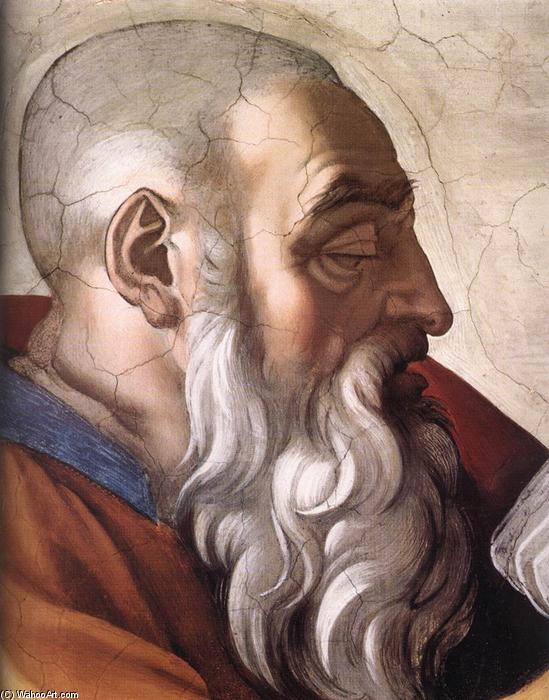
Zechariah (detail) by MICHELANGELO Buonarroti
Michelangelo Buonarroti’s
Zechariah (detail) stands as a testament to the unparalleled artistry of the High Renaissance—a masterpiece that transcends mere visual representation and delves into profound theological contemplation. Painted between 1509 and 1512 as part of the monumental Sistine Chapel ceiling project commissioned by Pope Julius II, this intimate fragment captures a pivotal moment in biblical narrative: the prophetic vision granted to Zechariah, husband of Elisabeth, foreshadowing the birth of John the Baptist.
The Artist and His Vision
Michelangelo Buonarroti (1475-1564) wasn’t simply a sculptor; he was an intellectual titan who wrestled with questions of faith and human potential. Influenced by classical ideals—particularly those championed by artists like Donatello and Brunelleschi—he sought to elevate art beyond mere decoration, aiming for sublime beauty that mirrored divine truth. His unwavering dedication to anatomical accuracy combined with expressive dynamism—a hallmark of his style—established him as the foremost artist of his time. The Sistine Chapel ceiling wasn’t merely a commission; it was an ambitious undertaking designed to reaffirm papal authority and celebrate God's majesty, reflecting Michelangelo’s profound belief in the transformative power of art.
A Study in Fresco Technique
The painting exemplifies Michelangelo’s mastery of fresco—a technique involving applying pigment onto wet plaster—which demanded meticulous planning and execution. Layers upon layers of color were painstakingly applied to create a luminous surface that retains its vibrancy for centuries. Observe the subtle gradations of tone achieved through careful blending, demonstrating Michelangelo's profound understanding of light and shadow. The artist’s attention to detail is evident in every brushstroke, capturing the texture of Zechariah’s robe and conveying the solemnity of his gaze. This meticulous process underscores the monumental effort required to produce such a lasting work of art.
Symbolism and Spiritual Depth
Beyond its technical brilliance,
Zechariah (detail) is laden with symbolic significance. The halo above Zechariah’s head signifies divine inspiration and holiness—a visual reminder of his prophetic role in Jewish tradition. His outstretched hand holds a scroll bearing Hebrew text, representing God's word and prophecy—a central theme within the biblical narrative. Michelangelo skillfully conveys this spiritual message through gesture and expression, inviting viewers to contemplate the mysteries of faith and divine providence.
Legacy and Relevance Today
Michelangelo Buonarroti’s
Sistine Chapel ceiling continues to inspire artists and scholars alike—a beacon of artistic achievement that embodies the ideals of the Renaissance. Its enduring beauty resides not only in its visual splendor but also in its profound contemplation of faith and human aspiration. To explore more about Michelangelo’s work or delve into the broader context of High Renaissance art, visit
Michelangelo Buonarroti: Zechariah (detail) and
Sistine Chapel ceiling for comprehensive information.