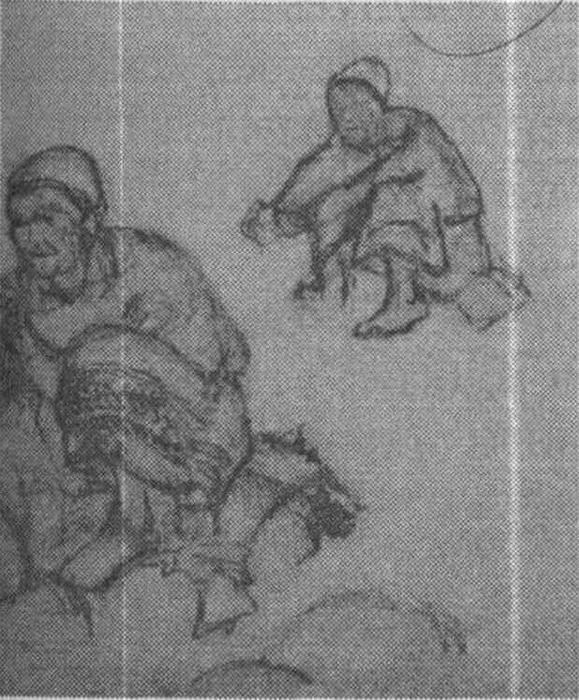
Nicholas Roerich’s "Sketch to Holy Fire", a captivating black and white sketch from 1900, showcases the artist's realism style with figures in a landscape study. Explore this preparatory drawing and discover more iconic works by Roerich at ArtsDot.com.
Nicholas Roerich’s “Sketch to ‘Holy Fire’”: A Study in Spiritual Contemplation
This evocative black and white sketch by Nicholas Roerich, titled "Sketch to 'Holy Fire'," offers a rare glimpse into the artist's creative process – a preparatory study brimming with potential that speaks volumes about his artistic vision. Executed around 1900, this piece transcends a simple drawing; it’s a concentrated distillation of Roerich’s fascination with spiritual themes and his profound connection to the landscapes of Central Asia. The loose, gestural lines immediately convey a sense of urgency and immediacy, hinting at a moment captured before fully realized in a larger work. The composition centers on two figures, their postures suggesting an interaction imbued with quiet contemplation, perhaps a ritual or simply a shared observation within a vast, undefined landscape.
- Style & Technique: The sketch exemplifies Roerich’s characteristic Realism style, but crucially, it's rendered as a preliminary study. The technique is deliberately unrestrained – a rapid deployment of graphite or charcoal on paper utilizing varied line weights and extensive hatching and cross-hatching to build tonal values. This isn’t about meticulous detail; it’s about capturing the *essence* of the scene, the feeling of movement, and the suggestion of profound significance.
- Materials & Medium: The work is executed in graphite or charcoal on paper, a testament to Roerich's preference for directness and immediacy. The choice of monochrome further amplifies the sketch’s inherent qualities, stripping away distractions and focusing attention entirely on form and gesture.
Decoding the Symbolism: ‘Holy Fire’
The title itself, “Sketch to ‘Holy Fire,’” is laden with symbolic weight. Roerich was deeply invested in exploring spiritual concepts through his art, often drawing upon Eastern philosophies and esoteric traditions. The phrase "holy fire" evokes notions of illumination, transcendence, and the divine spark within humanity. Within this sketch, the two figures could represent seekers, engaged in a personal quest for understanding or perhaps embodying aspects of a larger cosmic order. The ambiguity is deliberate; Roerich’s sketches rarely offer definitive answers but rather pose questions and invite contemplation.
- Subject Matter & Context: The subjects are rendered with simplified forms, emphasizing their gestures over precise anatomical detail – a hallmark of Roerich's approach. Their clothing suggests a historical or cultural context, likely reflecting the landscapes and traditions of Central Asia, a region that profoundly influenced his artistic output.
Roerich’s Vision: A Bridge Between Art & Spirit
Nicholas Roerich’s work is more than just beautiful imagery; it's a testament to his belief in the interconnectedness of art and spirituality. Born in 1874, he dedicated his life to exploring these themes, becoming a prolific painter, writer, and explorer. This sketch exemplifies his ability to capture not only the visual aspects of a scene but also its underlying spiritual resonance. The diffused lighting and minimal perspective contribute to an atmosphere of quiet contemplation, inviting the viewer to share in Roerich’s own search for meaning.
- Historical Significance: Created around 1900, this sketch provides a valuable insight into Roerich's early artistic development and his evolving engagement with spiritual themes. It represents a crucial stage in the creation of “Holy Fire,” ultimately contributing to one of his most celebrated works.