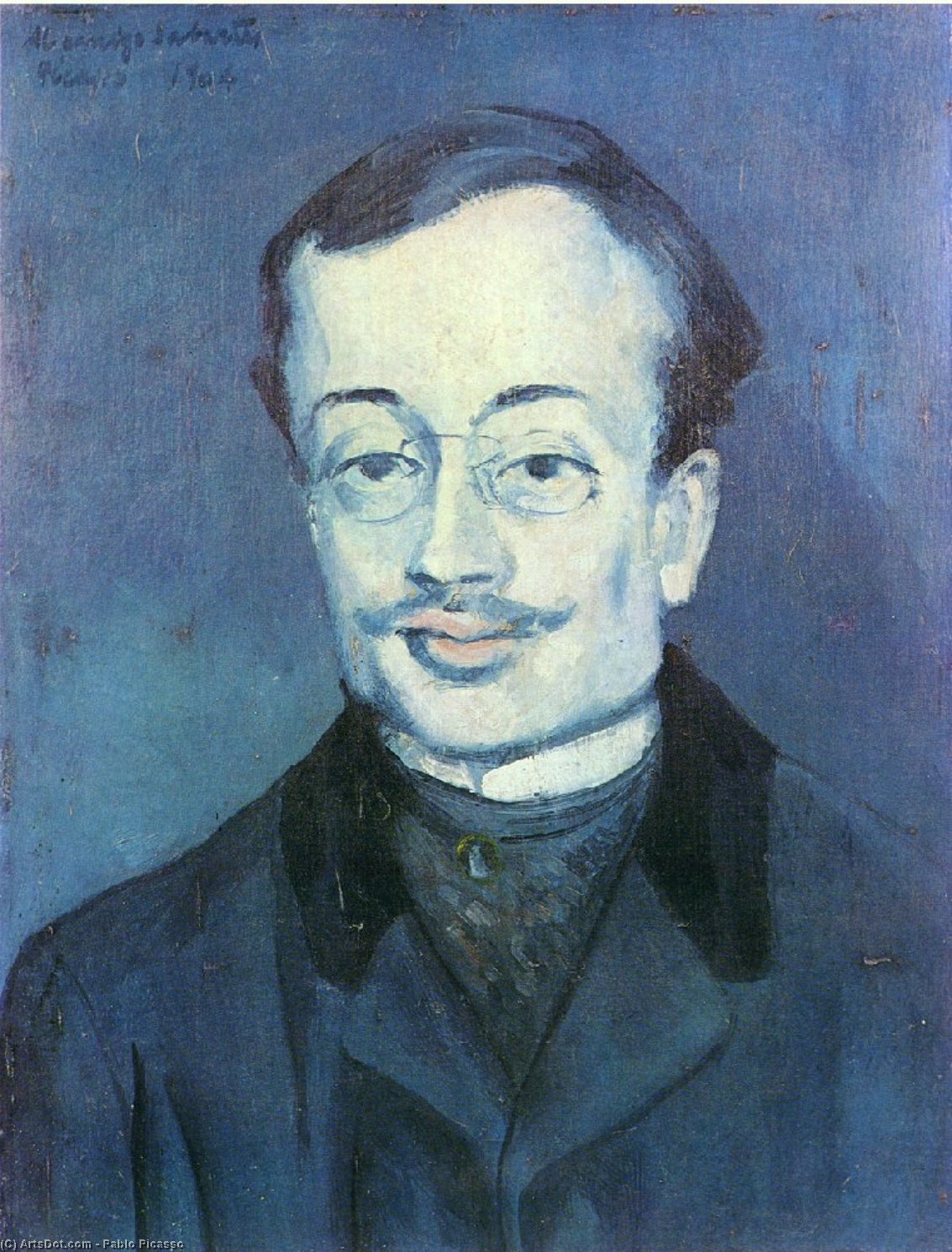
El retrato de Jaime Sabartes, pintado por Pablo Picasso en 1904, captura el estilo realista temprano del artista y la amistad con Sabartes. Una obra maestra monocromática que anticipa el cubismo. Descubre más arte aquí!
Portrait of Jaime Sabartes: An Early Exploration into Realism
The
Portrait of Jaime Sabartes, painted by the renowned artist
Pablo Picasso in 1904, stands as a pivotal work demonstrating Picasso’s nascent commitment to realism amidst the burgeoning artistic currents of his time. Measuring 49 x 38 cm and executed on canvas with oil paints, this piece immediately captivates viewers with its monochromatic palette—primarily shades of blue—a deliberate choice reflecting the melancholic mood characteristic of Picasso's Blue Period.
The Subject: Jaime Sabartes – A Familiar Face
This portrait depicts Jaime Sabartes, a close confidante and frequent model for Picasso’s artistic endeavors. Sabartes is portrayed in formal attire, complete with spectacles perched upon his nose and a prominent mustache—details meticulously rendered by Picasso to convey an aura of sophistication and quiet dignity. His subtle smile adds a touch of warmth to the painting's somber tone, fostering a sense of intimacy between artist and subject that transcends mere representation.
Artistic Style: Realism – Capturing Essence
During this formative period, Picasso wrestled with diverse stylistic influences, yet realism remained a dominant thread woven throughout his oeuvre. The artist’s unwavering attention to detail—from the texture of Sabartes' clothing to the subtle nuances of facial expression—is quintessential to the realist approach. This technique allowed Picasso to distill the essence of his subject into a visual form that resonated with profound emotional truth, mirroring the broader artistic movement striving for truthful depiction.
Influence of Cubism – Seeds of Geometric Innovation
Although
Portrait of Jaime Sabartes predates the full flowering of Cubism, it subtly foreshadows the geometric fragmentation and structural simplification that would soon define Picasso’s groundbreaking style. The careful reduction of shapes—particularly in the background—hints at the radical departure from traditional perspective championed by Cubist artists like Georges Braque, signaling Picasso's burgeoning engagement with avant-garde experimentation.
Context: Early 20th Century Art – A Moment of Transformation
The early 20th century witnessed an explosion of artistic innovation, fueled by movements such as Fauvism and Expressionism—each challenging established conventions and prioritizing subjective emotion over objective observation. Picasso’s work during this era embodies the spirit of these transformative trends while simultaneously establishing a foundational groundwork for Cubism, which irrevocably altered the landscape of modern art and cemented Picasso's legacy as one of history’s most influential figures.
Discover more about the art of Pablo Picasso and other renowned artists at ArtsDot.com. Visit
Discovering the Kunstmuseum Bern, Switzerland to explore a wide range of art pieces and learn about their historical context.