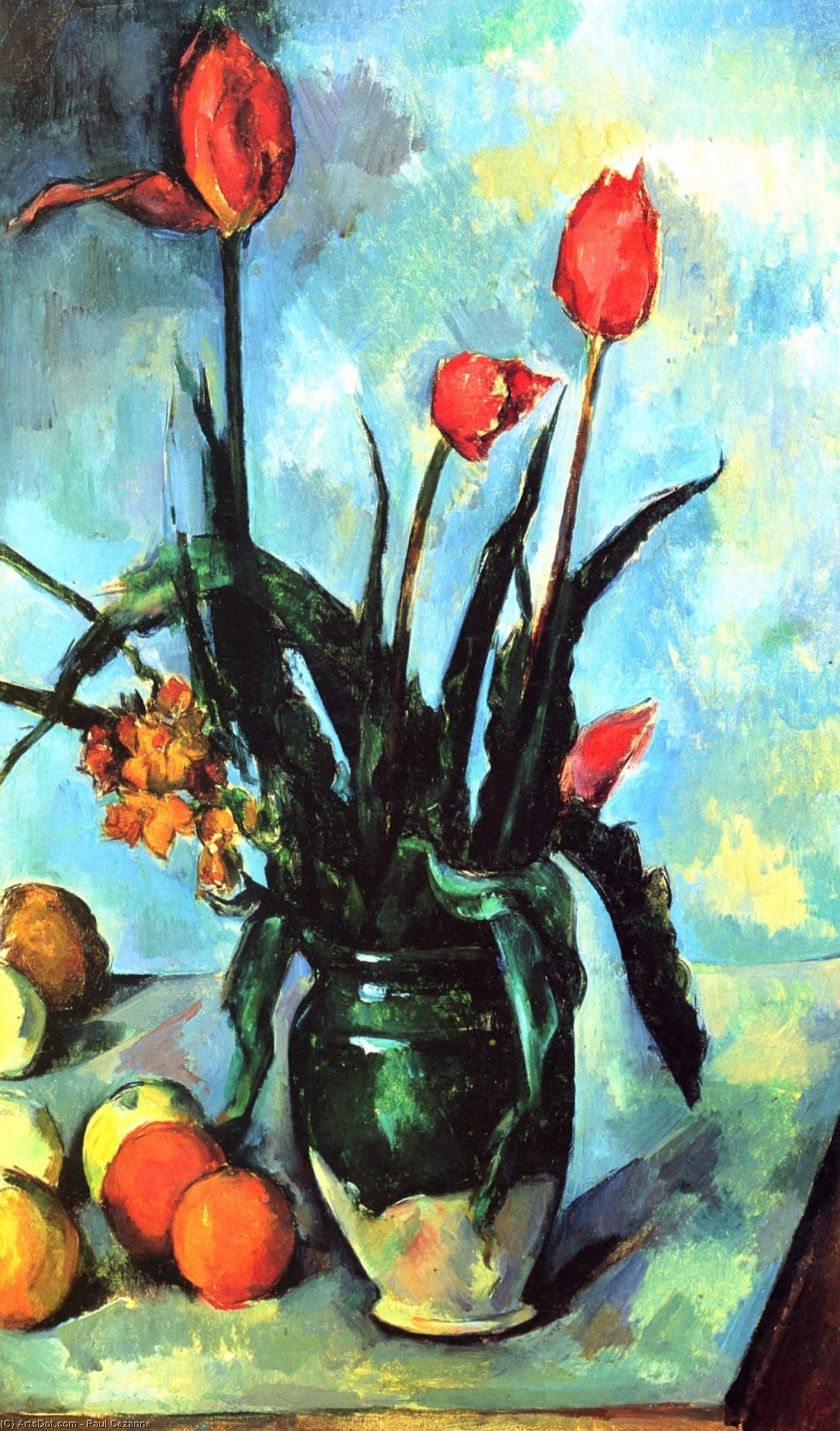
Descubre la maestría de Cézanne en 'Tulipes en un Vase', una obra clave del Postimpresionismo que revolucionó la pintura moderna con sus formas geométricas y colores vibrantes. Reproducción artística excepcional.
Explora el arte revolucionario de Paul Cézanne (1839-1906), un maestro del Postimpresionismo que conectó el Impresionismo y el Cubismo. Descubre sus formas geométricas, pinceladas únicas, pinturas de bodegones e impacto duradero en el arte moderno. #Cézanne #PostImpres
Cézanne’s Tulips in a Vase: A Revolutionary Exploration of Form and Color
Paul Cézanne's “Tulips in a Vase” stands as an emblem of Post-Impressionism, marking a pivotal moment in the artistic landscape of the late 1890s. Painted in Aix-en-Provence during his final productive years, this deceptively simple still life transcends mere representation; it’s a deliberate challenge to conventional artistic norms and a profound meditation on visual perception. Measuring 72 x 42 cm, the canvas exudes an understated elegance that belies its groundbreaking significance.
Composition and Symbolism: Beyond Mere Decoration
The arrangement itself is meticulously considered. Cézanne presents us with red tulips and orange carnations nestled within a vase of muted green—a palette chosen not for picturesque beauty but for conveying underlying structural realities. Alongside these blossoms are three oranges and two apples, strategically positioned to introduce textural variations and further complicate the illusionistic space. These commonplace objects aren’t merely decorative elements; they serve as conduits for Cézanne's exploration of how light interacts with surfaces and how forms emerge from a flattened perspective—a technique that foreshadowed the radical innovations of Cubism. The vase, in particular, acts as an anchor point, grounding the composition while simultaneously suggesting instability and dynamism.
Artistic Style: Breaking Free From Impressionist Conventions
Cézanne’s approach decisively departs from the shimmering effects of Impressionism, championed by artists like Monet and Renoir. Instead of capturing fleeting moments of light and atmosphere—a hallmark of Impressionist painting—Cézanne sought to distill the essence of his subjects into fundamental geometric shapes: cylinders, cones, and planes. He achieved this through a technique characterized by short, broken brushstrokes that build up layers of color, creating an illusion of depth without resorting to traditional shading or perspective. This method was revolutionary at the time, provoking criticism from many contemporaries who struggled to grasp its conceptual ambition. Cézanne’s unwavering commitment to his vision—a conviction fueled by influences from artists like Gauguin and Seurat—established him as a pioneer of modern art.
Historical Context: Bridging Impressionism and Cubism
The Post-Impressionist movement arose in response to the perceived limitations of Impressionism, which Cézanne viewed as prioritizing optical sensations over intellectual contemplation. Artists like Cézanne, Gauguin, Matisse, and Picasso were united by a desire to push artistic boundaries and experiment with new expressive possibilities. Cézanne’s work served as an indispensable stepping stone toward Cubism, pioneered by Picasso and Braque—a movement that would dismantle traditional pictorial conventions altogether. By simplifying forms and fracturing perspectives, Cézanne paved the way for artists like Picasso to explore abstract representations of reality—a legacy that continues to inspire creativity today.
Relevance to Modern Art: An Enduring Influence
The impact of Cézanne’s stylistic innovations extends far beyond his immediate peers. His exploration of geometric abstraction and flattened space profoundly influenced subsequent artistic movements, including Fauvism and Art Deco. These styles embraced bold colors and simplified forms—a direct consequence of Cézanne's pioneering approach—reshaping the visual aesthetic of the early 20th century and establishing him as one of the most influential artists of his era. “Tulips in a Vase” remains not only a beautiful artwork but also a testament to the transformative power of artistic experimentation and a cornerstone of modern art history.