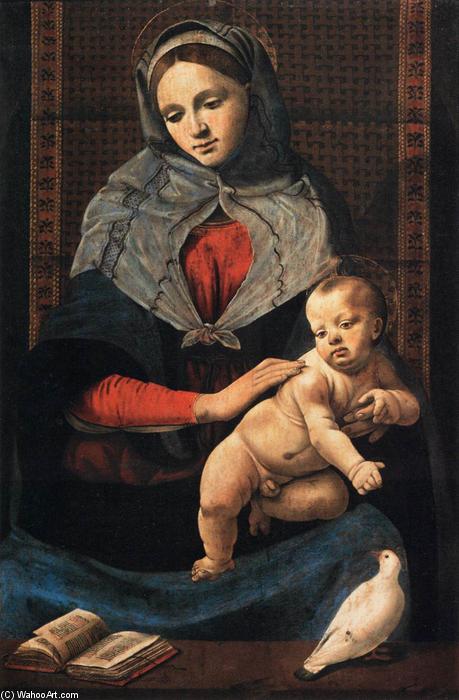
A Vision of Serenity: The Divine Grace of Piero di Cosimo
In the heart of the Florentine Renaissance, a period often defined by rigid classical perfection, there existed a singular voice capable of blending the tangible world with the ethereal. Piero di Cosimo, an artist of profound imagination, achieved this delicate balance in his masterpiece, Virgin and Child with a Dove. Created around 1490, this painting is not merely a religious icon but a window into a soul that found beauty in both the meticulous observation of nature and the whispers of the divine. The composition draws the viewer into a sacred intimacy, where the weight of the world seems to lift, replaced by an atmosphere of profound stillness and spiritual grace.
The painting presents a tender, pyramidal arrangement—a hallmark of Renaissance stability—featuring the Virgin Mary cradling the infant Jesus, accompanied by the presence of Saint Anne. This structural harmony provides a sense of eternal permanence, yet it is the softness of the figures that captures the heart. Clad in a deep blue cloak that suggests both royalty and heavenly devotion, Mary’s form is rendered with a gentle realism that makes her maternal warmth palpable. The child, resting securely in her arms, embodies an untouched innocence, his simple tunic and unadorned presence serving as a poignant reminder of the purity central to this sacred narrative.
Symbolism and the Language of Light
Beyond its surface beauty, Virgin and Child with a Dove is a rich tapestry of theological symbolism designed to elevate the viewer's consciousness. One cannot gaze upon this work without being drawn to the two white doves perched delicately upon a manuscript in the foreground. In the iconographic language of the Quattrocento, these birds are far more than mere decorative elements; they represent peace, divine inspiration, and the presence of the Holy Spirit. Their placement near the book suggests that true wisdom is found through spiritual contemplation, bridging the gap between human learning and divine revelation.
The artist’s mastery of technique further enhances this symbolic depth. Through a sophisticated command of oil paint, Cosimo achieved nuanced tonal gradations that allow light to dance across the folds of the Virgin's veil and the soft skin of the Christ child. The palette, dominated by muted golds and celestial blues, creates a somber yet luminous environment. This interplay of light and shadow—a precursor to the dramatic chiaroscuro of later eras—serves to pull the figures forward from the darkened, architectural background, making the holy family appear as if they are emerging into the viewer's very space.
An Enduring Legacy for the Discerning Collector
For the art lover, the collector, or the interior designer, this painting offers much more than historical significance; it offers an emotional sanctuary. The work possesses a timeless quality that transcends its 15th-century origins, making it a profound addition to any curated space. Its ability to evoke feelings of tranquility and reverence makes it an ideal centerpiece for rooms designed for reflection, such as a private library, a study, or a serene sitting area.
Integrating a high-quality reproduction of this work into a modern or classical interior allows one to invite the spirit of the Renaissance into the contemporary home. The painting’s subtle textures and profound subject matter provide a sophisticated focal point that complements both minimalist aesthetics and opulent decor. To possess such an image is to hold a piece of Florentine history—a testament to a time when art sought to capture the very essence of the human soul and its connection to the infinite.