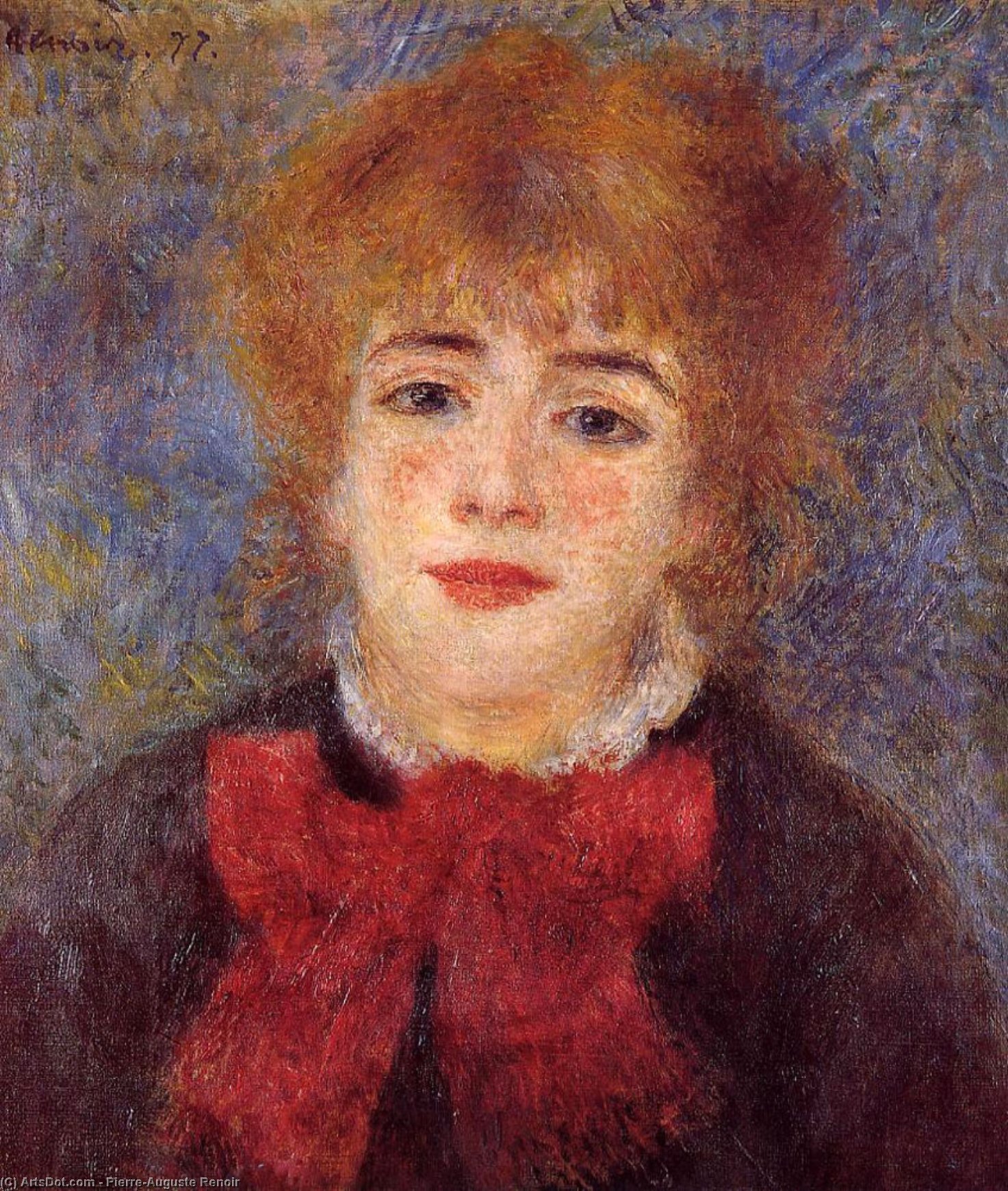
Una obra maestra impresionista de Pierre-Auguste Renoir que captura la elegancia y gracia de Jeanne Samary en 1877, destacando su cabello rojo y expresión pensativa bajo un cielo azul.
Explore el vibrante mundo de Pierre-Auguste Renoir (1841-1919), un destacado pintor impresionista celebrado por sus luminosas retratos, escenas de la vida parisina y la belleza femenina. Descubre su legado y las contribuciones artísticas de su familia.
Jeanne Samary: A Portrait of Elegance Captured in Impressionist Light
Pierre-Auguste Renoir’s ‘Jeanne Samary’, painted in 1877, stands as an emblem of Impressionism's fascination with fleeting moments and luminous color palettes. More than just a depiction of actress Jeanne Samary—a frequent muse for Renoir—the painting embodies the spirit of Parisian life during its Belle Époque era, reflecting a burgeoning interest in capturing beauty and emotion through innovative artistic methods. This oil on canvas masterpiece isn’t merely aesthetically pleasing; it's imbued with subtle symbolism that speaks to themes of femininity, contemplation, and the artist’s personal connection to his subject.
### The Artist and His Vision
Pierre-Auguste Renoir (1841–1919) emerged as a pivotal figure in Impressionism alongside Claude Monet and Camille Pissarro. Unlike academic painters who prioritized meticulous detail and idealized representations, Renoir championed spontaneity and observation—principles that profoundly shaped his artistic approach. Influenced by Rubens and Watteau’s masterful use of color and light, he sought to convey not just what he saw but how he *felt*. His early life in Limoges instilled a deep appreciation for natural beauty, which would permeate throughout his oeuvre. The Salon exhibitions of the 1860s and 70s proved crucial in establishing Renoir’s reputation as a visionary artist who dared to challenge convention.
### A Moment Frozen in Time: Description & Technique
The painting portrays Jeanne Samary seated beneath a dappled shade, gazing serenely into the distance. Her auburn hair is styled elegantly, secured with a bun—a deliberate gesture emphasizing her poise and grace. Renoir skillfully employs Impressionist technique to achieve this effect. Notice the broken brushstrokes—a hallmark of his style—which capture the interplay of light and shadow on Samary’s skin and clothing. The palette is dominated by warm hues—russet reds, ochres, and blues—creating an atmosphere of tranquility and inviting contemplation. Renoir's meticulous attention to detail isn't about rendering every nuance accurately; rather, he prioritizes conveying the overall impression of light and color, mirroring the experience of observing a scene in natural daylight. The background sky is rendered with hazy brushstrokes, furthering the sense of atmospheric perspective—a technique central to Impressionist painting.
### Symbolism & Contextual Significance
‘Jeanne Samary’ transcends its portrait likeness; it encapsulates the cultural values of its time. Samary herself was a celebrated performer at the Comédie-Française, representing artistic ambition and social status. Renoir's choice of pose—seated, contemplative—suggests an inner life rich in emotion and thought. The red dress and bow around Samary’s neck symbolize elegance and sophistication—elements highly valued during the Belle Époque. Furthermore, the painting resides at The Museum BOZAR (Belgium), a testament to its enduring artistic merit and its recognition as a cornerstone of Belgian cultural heritage. Its inclusion in Ivan Morozov's collection underscores its importance within the broader context of Russian art history.
### Similar Works & Legacy
For those captivated by Renoir’s Impressionist style, exploring works like Jozsef Rippl Ronai: Red-haired Parisian Girl and Amedeo Clemente Modigliani: untitled (4195) offers comparable explorations of portraiture and expressive color palettes. These paintings demonstrate Renoir's ability to distill complex emotions into simple visual forms—a legacy that continues to inspire artists today. The enduring fascination with ‘Jeanne Samary’ speaks to the timeless beauty of Impressionism and its profound impact on artistic expression.