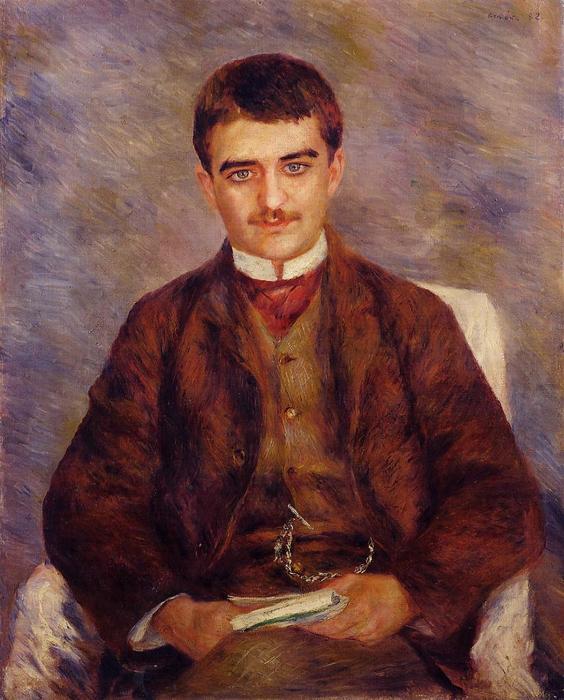
A Moment Captured in Light: Examining Pierre-Auguste Renoir’s Joseph Durand Ruel
The painting “Joseph Durand Ruel” by Pierre-Auguste Renoir stands as a quintessential embodiment of Impressionist aesthetics—a testament to the artist's masterful ability to distill complex emotion and atmosphere into deceptively simple brushstrokes. Completed in 1882, this oil on canvas depicts Joseph Durand Ruel, a prominent Parisian art dealer, seated calmly in a chair with his hands folded thoughtfully on his lap. Renoir’s gaze is directed squarely at the viewer, conveying an aura of quiet confidence and understated elegance—a characteristic found throughout his oeuvre, notably “The Estaque,” where he similarly captures fleeting impressions of natural beauty.
- Style & Technique: Impressionism Defined
- Historical Context: The Parisian Art World in the Late 1880s
- Symbolism & Composition: Interpreting Renoir’s Choices
- Influences Beyond Cézanne: Exploring Artistic Connections
- Emotional Resonance: Capturing Tranquility and Dignity
### Style & Technique: Impressionism Defined
Renoir's approach to “Joseph Durand Ruel” exemplifies the core tenets of Impressionism. Unlike academic painting’s meticulous realism, Renoir prioritizes capturing the ephemeral qualities of light and color—a pursuit championed by artists like Claude Monet and Camille Pissarro. The brushstrokes are loose, visible, and blended subtly, eschewing sharp lines in favor of a hazy luminescence that mimics how the human eye perceives visual experience. This technique isn’t merely decorative; it's fundamentally expressive, conveying a sense of immediacy and spontaneity that distinguishes Impressionism from its predecessors. Observe how Renoir utilizes dappled light to illuminate Ruel’s face and clothing—a deliberate decision designed to evoke warmth and intimacy within the viewer’s imagination.
### Historical Context: The Parisian Art World in the Late 1880s
“Joseph Durand Ruel” emerged during a period of significant artistic ferment in Paris, marking a pivotal moment in European art history. Following the groundbreaking innovations of Impressionism, artists were increasingly rejecting traditional conventions and experimenting with new visual languages. The Salon des Refusés of 1884—where Renoir’s work was initially rejected by the official Académie Royale de Peinture et de Sculpture—served as a catalyst for challenging established artistic norms and fostering dialogue about the future of painting. This rebellious spirit permeated Parisian society, influencing not only art but also literature and philosophy, creating an environment ripe for groundbreaking creativity. The Musée de Region Auguste Chabaud in France continues to celebrate this legacy, showcasing works by artists who pushed boundaries and redefined artistic expression.
### Symbolism & Composition: Interpreting Renoir’s Choices
Beyond its technical brilliance, “Joseph Durand Ruel” possesses subtle symbolic layers that enrich its interpretation. The seated posture of Ruel—relaxed yet attentive—suggests contemplation and inner reflection. His folded hands convey a sense of composure and dignity, mirroring the quiet confidence projected by his gaze. Furthermore, the inclusion of two books on his lap symbolizes intellectual pursuits and erudition—a characteristic often associated with Renoir’s subjects. The chair itself is rendered in muted tones, emphasizing the simplicity of the setting and focusing attention on Ruel's figure as the central point of interest. These compositional choices contribute to the painting’s overall mood of serenity and understated elegance.
### Influences Beyond Cézanne: Exploring Artistic Connections
While Paul Cézanne undeniably influenced Renoir’s artistic vision—as evidenced by his exploration of geometric forms and tonal harmonies—Renoir's stylistic development extended beyond Cézanne’s singular contribution. He absorbed inspiration from Japanese prints, particularly those depicting landscapes bathed in soft light, incorporating elements of asymmetry and flattened perspective into his compositions. The Musée de Region Auguste Chabaud serves as a valuable resource for delving deeper into the broader artistic landscape of the era, illuminating the interconnectedness of stylistic trends and fostering appreciation for diverse artistic traditions.
### Emotional Resonance: Capturing Tranquility and Dignity
Ultimately, “Joseph Durand Ruel” succeeds in conveying a profound emotional resonance—a palpable sense of tranquility and dignity that transcends mere visual representation. Renoir’s masterful manipulation of light and color evokes feelings of warmth, intimacy, and contemplative repose. The painting invites viewers to linger on its surface, absorbing the subtle nuances of atmosphere and appreciating the beauty of human presence captured in fleeting moments. Like “The Estaque,” this artwork exemplifies Renoir's ability to transform ordinary subjects into emblems of artistic excellence—a testament to his enduring legacy as one of Impressionism’s foremost practitioners. To explore more about Renoir’s remarkable achievements, visit Pierre-Auguste Renoir on ArtsDot.com.