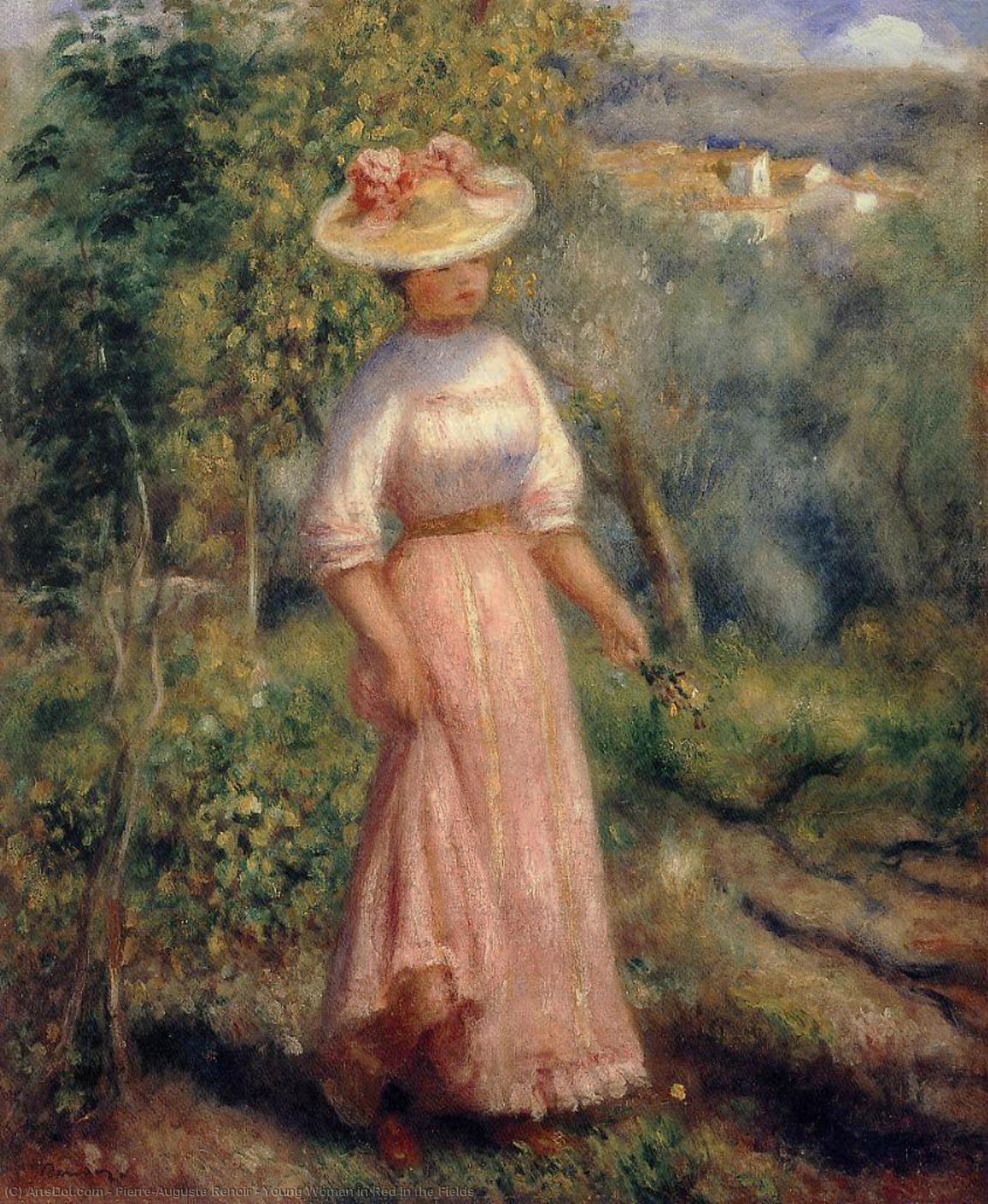
Young Woman in Red in the Fields
Pierre-Auguste Renoir, a luminary of French Impressionism, possessed an unparalleled ability to capture fleeting moments of beauty and emotion—a talent that cemented his place among the most celebrated artists of his era. One masterpiece embodying this vision is
Young Woman in Red in the Fields (1900), a painting that continues to resonate with audiences worldwide and serves as an exemplary illustration of Renoir’s distinctive artistic approach.
The Painting's Details
Executed on canvas using oil paints,
Young Woman in Red in the Fields depicts a serene scene: a young woman dressed in a vibrant red gown strolls through a sunlit meadow dotted with trees. Renoir’s meticulous brushstrokes—characterized by soft, blended hues—capture the dappled light filtering through the foliage, creating an atmosphere of tranquility and warmth. The subtle inclusion of birds soaring overhead adds to the idyllic panorama, symbolizing freedom and spontaneity – elements central to Impressionist ideals. This portrayal isn't merely a visual representation; it’s an embodiment of Renoir’s fascination with capturing the essence of everyday life and its transformative power on human perception.
Artistic Style and Influence
Renoir’s artistic style firmly rooted in Impressionism, profoundly influenced subsequent movements like Fauvism and Cubism. His technique—characterized by loose brushstrokes and a deliberate disregard for traditional perspective—prioritized conveying the sensory experience of light and color above precise anatomical accuracy. Consider
The Boating Party Lunch, another iconic Renoir canvas available on ArtsDot.com—a painting that exemplifies the Impressionist preoccupation with capturing the immediacy of a social gathering and its luminous atmosphere. This influence extended beyond stylistic considerations; it fostered a broader artistic ethos centered on subjective observation and emotional resonance.
Historical Context and Significance
The history of painting reveals Renoir’s pivotal role in shaping the trajectory of art during his time. Like many Impressionists, he reacted against academic conventions that favored idealized depictions and meticulous detail—a stance championed by artists such as Gustave Courbet and Jean-François Millet. Renoir's work challenged established artistic norms, advocating for a more truthful representation of reality—albeit one filtered through the artist’s perceptual experience. This courageous defiance paved the way for experimental approaches to artmaking that would define the early 20th century. Furthermore,
History of Painting documents how Renoir's pioneering spirit inspired generations of artists to explore new avenues of expression and to prioritize emotional impact alongside technical skill.
Light in Painting
Renoir’s masterful manipulation of light—a cornerstone of Impressionist aesthetics—is evident throughout
Young Woman in Red in the Fields. As elucidated in scholarly texts on “Light in Painting,” light serves not only as a visual element but also as a conduit for conveying mood and emotion—a principle meticulously observed by Renoir. The artist skillfully utilizes color variations to simulate the shifting qualities of sunlight, creating an illusion of depth and vibrancy that captivates the viewer’s gaze. This deliberate consideration of illumination underscores Renoir's profound understanding of how visual perception shapes our experience of the world.
Conclusion
Young Woman in Red in the Fields stands as a testament to Renoir’s unparalleled artistic vision—a painting that encapsulates the spirit of Impressionism and its enduring legacy. For those seeking to immerse themselves in the beauty of this masterpiece or explore other captivating artworks by Pierre-Auguste Renoir, ArtsDot.com offers exceptional reproductions that faithfully reproduce the original's luminous colors and delicate brushstrokes—bringing Renoir’s artistic genius to life for a new generation of admirers.