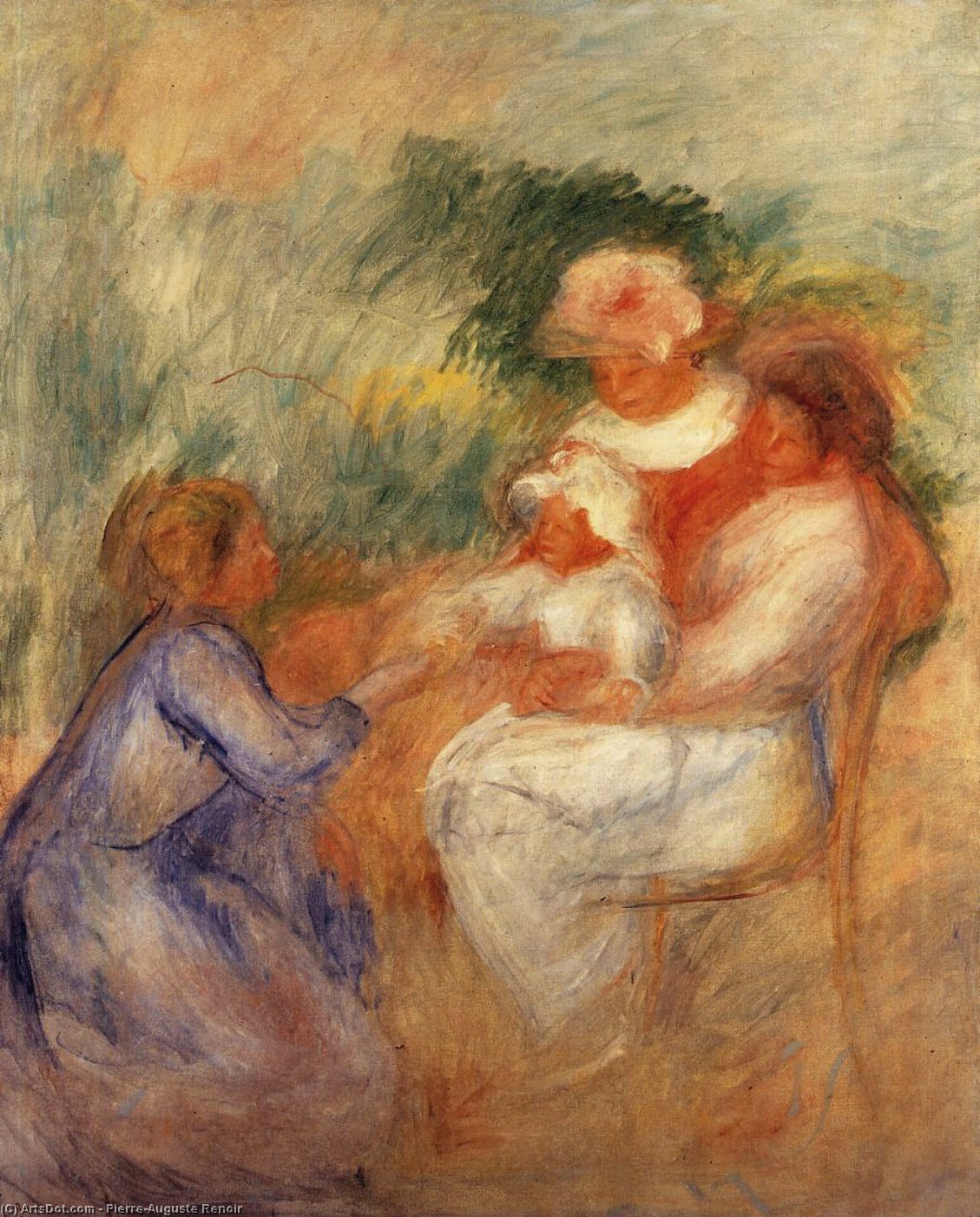
La Familia: A Window Into Impressionistic Domestic Tranquility
Pierre-Auguste Renoir’s
La Familia, painted in 1896, transcends mere portraiture—it's a masterful distillation of Impressionist ideals: capturing fleeting moments of everyday life with luminous color and delicate brushstrokes. More than just depicting a family gathering, Renoir’s canvas embodies the spirit of his era – a yearning for beauty found within the commonplace, a reaction against academic rigidity that defined much of the preceding artistic landscape.
- Composition & Observation: The scene unfolds with remarkable precision. Two women seated comfortably on chairs cradle infants, while three additional figures occupy the background—a gardener tending to roses and a man observing the family. Renoir’s genius lies in his ability to render these individuals not as idealized subjects but as believable human beings bathed in dappled sunlight. He meticulously observes how light interacts with surfaces, creating an atmosphere of warmth and serenity that draws the viewer into the intimate space of the home.
- Impressionistic Style: Renoir’s technique is quintessential Impressionism. Loose, visible brushstrokes—almost vibrating with energy—are layered upon one another to build up tonal variations rather than striving for photographic realism. Color plays a crucial role; Renoir employs vibrant hues – reds, blues, yellows – blended subtly to convey the impression of light and shadow simultaneously. This approach prioritizes sensory experience over intellectual analysis, mirroring the broader artistic movement’s fascination with capturing the ephemeral beauty of the natural world.
- Historical Context: The late 1890s witnessed significant societal transformations in France—urbanization accelerated, industrialization reshaped daily life, and anxieties about modernity permeated cultural discourse. Renoir's depiction of familial warmth serves as a counterpoint to these pressures, reflecting a desire for stability and connection amidst rapid change. It’s a poignant reminder that even within the bustle of modern life, moments of quiet contemplation and tenderness could still be found.
- Symbolism & Emotion: Beyond its formal qualities, La Familia speaks to deeper themes of motherhood, family bonds, and the passage of time. The roses in the background symbolize beauty and fertility—a visual echo of the nurturing role played by the women in the painting. Renoir’s masterful use of color and light evokes a feeling of profound peace and contentment, inviting viewers to savor the simple joys of domestic life.
- Influence & Legacy: Renoir's work profoundly impacted subsequent artistic movements, notably Cubism. Artists like Picasso and Braque sought to break free from traditional perspective, experimenting with fragmented forms and multiple viewpoints—a stylistic rebellion fueled by Cézanne’s groundbreaking explorations of form and space. The Family by Charles Webster Hawthorne or Portrait of a Gentleman of the Herrick Family on ArtsDot.com offer similar explorations of domestic tranquility and artistic innovation.