The Luminous Echoes of a Golden Age
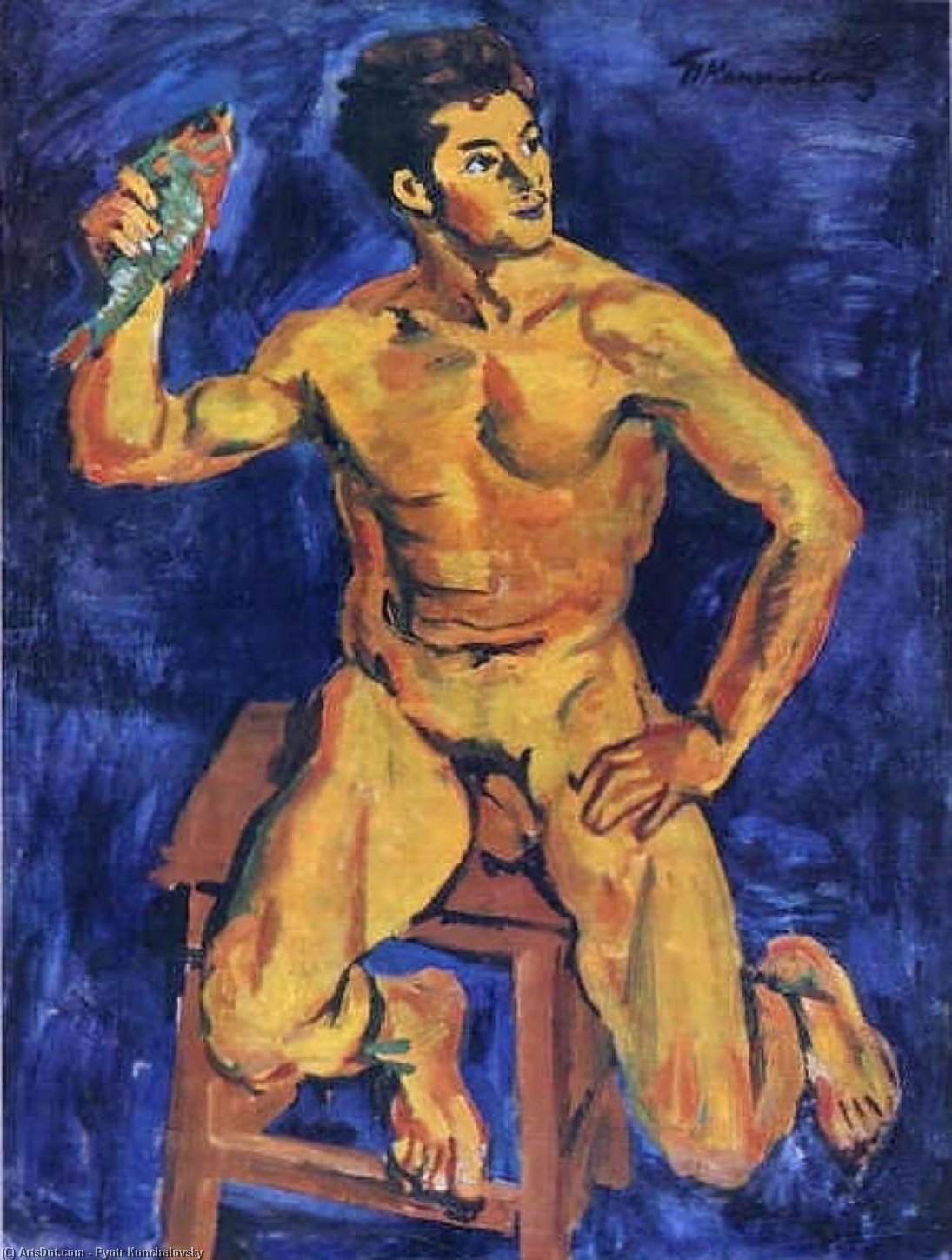
To stand before Pyotr Konchalovsky's "Golden Age" is to step into a moment suspended between memory and vibrant possibility. This 1946 canvas does not merely depict a scene; it captures an atmosphere—a rich, almost palpable sense of repose tinged with the energy of artistic awakening. The eye is immediately drawn to the central figure, seated in a posture of profound ease, his legs crossed over what appears to be a simple stool. He holds a fish, an object that anchors the narrative, suggesting a connection to sustenance, tradition, or perhaps the quiet bounty found at the close of a day’s labor. The entire composition breathes with a warmth emanating from the man's skin tone, rendered in luminous golden hues that seem to absorb and reflect the light.
A Symphony of Fauvist Color
Technically, the painting is a masterful exercise in expressive color theory, firmly rooted in the spirit of Fauvism. Konchalovsky employs brushwork that is wonderfully loose and unrestrained, allowing the paint itself to sing across the canvas. This technique moves far beyond mere representation; it prioritizes emotional resonance over photographic accuracy. The bold application of color—the vibrant golds against the cool, enveloping blue background—creates an immediate visual vibration. It is a dialogue between warm earth tones and cool ether, giving the piece a dynamic yet strangely tranquil energy. One can almost hear the rhythmic scrape of the brush as it laid down these confident strokes.
Symbolism and the Passage of Time
The title itself, "Golden Age," invites contemplation on what that period might represent—a time perceived by the artist as idyllic, perhaps a return to foundational truths or a moment of perfect balance. The fish, in art history, is often a potent symbol of abundance, prosperity, and even spiritual renewal. Coupled with the man's neutral, slightly averted gaze, which suggests introspection rather than direct engagement with the viewer, the painting becomes an invitation into a private meditation. It speaks to moments of quiet fulfillment, where simple elements—a chair, a fish, a patch of blue sky—are elevated to profound statements about life’s enduring rhythms.
A Touch of Russian Modernism
Understanding Konchalovsky's context enriches the viewing experience. As an artist whose career spanned Russia's tumultuous modern history, his work carries the weight of cultural endurance. While influenced by the grand currents of French Impressionism and Fauvism, his signature remains distinctly personal—a blend of European avant-garde techniques filtered through a deeply Russian sensibility. For those who collect art that speaks to historical depth while embracing modernist freedom, this piece offers a perfect nexus point. It is not merely decoration; it is a conversation across decades, offering the collector or designer a piece imbued with intellectual weight and undeniable visual poetry.