A Moment of Quiet Anticipation: Unpacking Rembrandt’s ‘Young Woman in Bed’
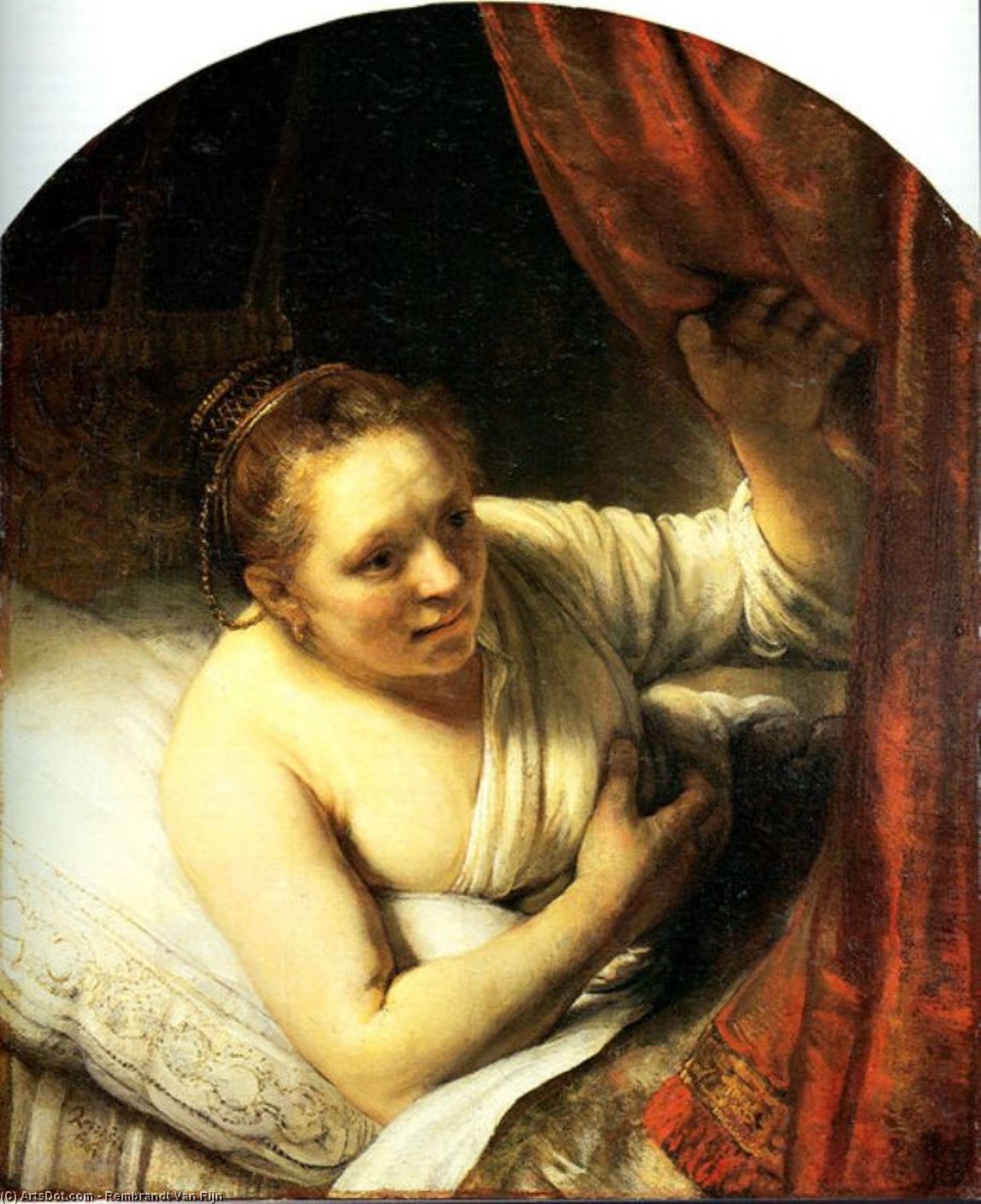
Rembrandt van Rijn's “Young Woman in Bed,” often referred to as “Sarah Waiting for Tobias,” is more than just a portrait; it’s a masterclass in psychological depth and the evocative power of light. Painted in 1647, this oil on canvas resides within the Von Der Heydt Museum in Wuppertal, Germany, offering viewers an intimate glimpse into a private moment suspended between expectation and uncertainty. The painting immediately draws us in with its muted palette – primarily deep reds, browns, and creams – creating a sense of quiet intimacy and almost palpable stillness. It’s a scene stripped bare of grand gestures or dramatic action, yet brimming with unspoken emotion.
At the heart of the composition lies a young woman, partially obscured by a crimson curtain that acts as both a barrier and a veil. Her face, only partially visible, is not one of overt beauty but rather one imbued with a profound sense of contemplation. Her gaze, directed outwards towards an unseen presence, speaks volumes about her inner life – a mixture of longing, anticipation, and perhaps even a touch of melancholy. The subtle curve of her lips, the slight furrow in her brow, all contribute to this captivating portrayal of human vulnerability. Notice how Rembrandt skillfully uses chiaroscuro—the dramatic contrast between light and shadow—to sculpt her form and draw our attention to the most expressive features. The darkness surrounding her isnrsquo;t merely absence of light; it actively shapes the narrative, suggesting a hidden world just beyond the frame.
- The Red Curtain: More than just decoration, the red curtain is a potent symbol. It represents privacy, intimacy, and perhaps even secrecy – hinting at a clandestine meeting or a deeply personal experience. Its color itself evokes passion, desire, and a hint of danger.
- The Unseen Tobias: The figure waiting for “Tobias” remains deliberately ambiguous. Rembrandt never explicitly identifies him, allowing the viewer to project their own interpretations onto the scene. Is he a lover? A family member? A messenger bearing news? This deliberate ambiguity is key to the paintingrsquo;s enduring appeal.
- The Room as Stage: The sparsely furnished room – the bed, the pillows, the sheets – creates a sense of domestic tranquility, yet it also feels strangely isolated and vulnerable. It's a stage set for a private drama, carefully constructed by Rembrandt to heighten the emotional impact.
Rembrandt’s Revolutionary Technique: Chiaroscuro and Emotional Resonance
“Young Woman in Bed” is a prime example of Rembrandtrsquo;s mastery of chiaroscuro, a technique he pioneered and perfected throughout his career. He doesnrsquo;t simply paint light and shadow; he uses them to sculpt the forms, define the space, and most importantly, to convey emotion. The strong contrasts between light and dark create a sense of drama and immediacy, pulling us into the scene and forcing us to confront the womanrsquo;s inner state. Observe how the light gently illuminates her face, highlighting her features while leaving the rest of the room shrouded in darkness — a deliberate choice that emphasizes her isolation and vulnerability.
Furthermore, Rembrandtrsquo;s use of impasto—thickly applied paint—adds texture and depth to the canvas, creating a tactile quality that invites us to reach out and touch the scene. The brushstrokes themselves are visible, adding another layer of complexity to the paintingrsquo;s visual language. This technique wasnrsquo;t merely about aesthetics; it was a means of expressing his artistic vision and imbuing the work with a sense of immediacy and authenticity.
A Timeless Portrait: Relevance in Modern Times
“Young Woman in Bed” continues to resonate deeply with contemporary audiences. Its themes – isolation, longing, anticipation, and the complexities of human relationships – are universal and timeless. The paintingrsquo;s quiet intimacy invites us to contemplate our own experiences of waiting, hoping, and yearning for something beyond our grasp.
Rembrandtrsquo;s ability to capture such profound emotion with such subtle means is a testament to his genius as an artist. “Young Woman in Bed” serves as a poignant reminder that the most powerful art often speaks volumes without uttering a single word. For those seeking to experience this masterpiece firsthand, ArtsDot.com offers meticulously crafted, hand-painted oil reproductions of “Young Woman in Bed,” allowing you to bring this iconic work into your own home and appreciate its beauty and complexity for years to come. Visit ArtsDot.com today to discover more about this painting and other stunning reproductions by Rembrandt van Rijn.
Photo Description: The painting is a portrait of a woman in bed with her head covered by a red curtain. She appears to be looking at something or someone outside the frame. The womanrsquo;s face is visible, but only half of it can be seen as she is partially hidden behind the curtain. In addition to the main subject, there are two other people in the painting, one on the left side and another on the right side. Both of these figures are also partially obscured by red curtains. The room has a bed with sheets and pillows, which adds to the cozy atmosphere of the scene.
Size: 81 x 68 cm
Date: 1647
ARTIST INFORMATION:
==================
Artist: Rembrandt van Rijn
Birth Year: 1606
Death Year: 1669
Birth City: Leiden
Birth Country: Netherlands
Biography:
A Life Illuminated: The World of Rembrandt van Rijn
Rembrandt Harmenszoon van Rijn, a name synonymous with the Dutch Golden Age and the mastery of light and shadow, was born in Leiden, Netherlands, on July 15, 1606. His arrival coincided with a period of unprecedented prosperity and artistic flourishing for the young republic, a climate that would profoundly shape his life and work. The son of a miller, Harmen Gerritszoon van Rijn, and Neeltgen Willemsdochter van Zuytbrouck, from a family of bakers, Rembrandt received an education at Leidenrsquo;s Latin School, providing him with a foundation in classical learning that would later subtly inform his artistic narratives. His early artistic inclinations led to apprenticeships – first with Jacob van Swanenburg in Leiden around 1620, and then, crucially, a six-month period of study under Pieter Lastman in Amsterdam beginning in 1624. It was Lastmanrsquo;s dramatic use of light and shadow, his dynamic compositions filled with historical and