A Celestial Encounter in Venetian Gold
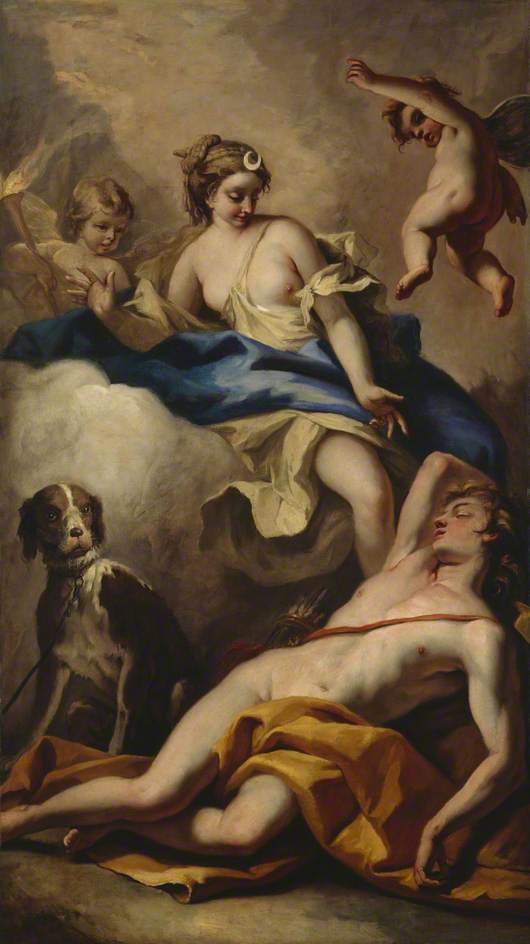
In the soft, luminous glow of the Venetian Baroque, Sebastiano Ricci’s “Diana and Endymion” emerges as a breathtaking vision of mythic intimacy. Completed around 1716, this monumental canvas captures a moment suspended in time, where the boundaries between the divine and the mortal dissolve. The scene invites us into a pastoral dreamscape, centered on the eternal slumber of Endymion, a handsome shepherd whose peaceful repose serves as the stage for a celestial visitation. As Diana, the goddess of the hunt and purity, gazes upon him, the viewer is drawn into a narrative of profound tenderness and quiet longing. It is not merely a depiction of a myth; it is an invitation to witness the sublime beauty of a love that transcends the physical realm.
Ricci, a master of the grand manner, employs a technique that breathes life into every shadow and highlight. The painting is a masterclass in chiaroscuro, where dramatic contrasts of light and dark sculpt the figures with an almost tactile presence. One can feel the weight of Endymion’s limbs and the ethereal lightness of Diana’s gaze through Ricci's confident, deliberate brushstrokes. The artist utilizes a rich, warm palette characteristic of the Venetian school, using light to create an illusionistic depth that pulls the observer into the lush, atmospheric landscape. This interplay of light does more than illuminate; it creates a sense of movement and vitality, making the stillness of the sleeping shepherd feel heavy with the breath of life.
Symbolism and the Echoes of Antiquity
Beyond its visual splendor, “Diana and Endymion” is a tapestry of deep symbolic meaning. Drawing heavily from Ovid’s Metamorphoses, the work explores themes of eternal youth and spiritual devotion. The presence of the mirror held by Diana serves as a poignant metaphor for reflection—not only of the physical beauty before her but of the inner virtue and the divine gaze that watches over all creation. The sleeping shepherd represents a state of pure, undisturbed innocence, a soul at peace through contemplation. Even the subtle inclusion of a watchful dog and an angelic figure adds layers to the composition, suggesting a universe that is both grounded in nature and overseen by heavenly grace.
For the discerning collector or interior designer, this masterpiece offers more than just aesthetic appeal; it provides a focal point of profound emotional resonance. The painting’s ability to evoke a sense of tranquility and classical grandeur makes it an incomparable addition to any curated space. Whether placed in a sun-drenched gallery or a sophisticated study, a high-quality reproduction of this work brings with it the prestige of the Venetian Baroque. It serves as a window into an era of artistic fervor, offering a timeless elegance that inspires awe and invites endless contemplation of the beauty found in the intersection of myth and reality.