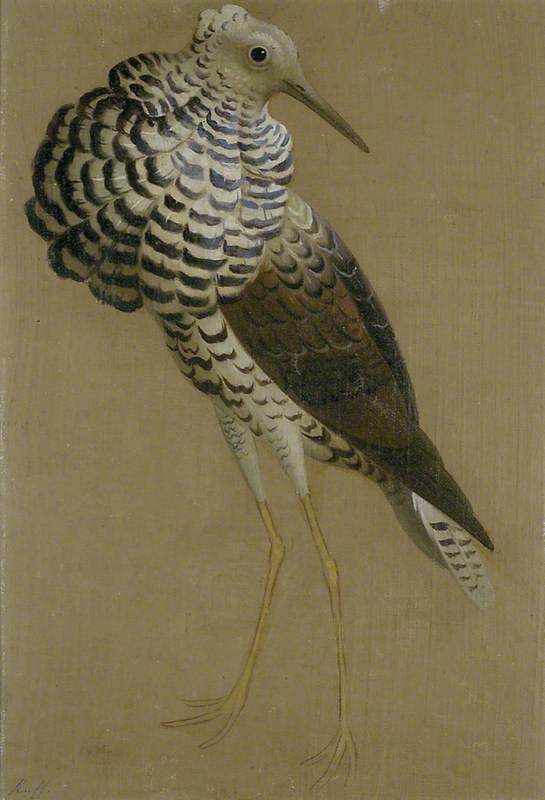
A meticulous study by Sir Edwin Landseer (1802-1873) of a wading bird, showcasing academic realism & Asian influences. Explore this detailed 1845 watercolor.
Descubre a Edwin Landseer (1802-1873), el icónico pintor y escultor británico, famoso por sus majestuosas pinturas de animales: caballos, perros y ciervos. ¡Admira 'Monarca del Glen' y los leones de Trafalgar Square!
Descubre arte y arqueología desde hace seis millones de años en el Museo Ashmolean de Oxford! Admira momias egipcias, obras maestras prerrafaítas e instalaciones contemporáneas en este museo universitario histórico.
A Portrait of Observation: Exploring Sir Edwin Landseer’s “Study of a Ruff”
The canvas holds an arresting stillness – a single wading bird, meticulously rendered in shades of brown and ivory against a muted beige backdrop. This isn't merely a depiction of ornithology; it’s a testament to Victorian artistic sensibilities, embodied in the masterful brushwork of Sir Edwin Henry Landseer (1802-1873), a painter whose unwavering dedication to anatomical accuracy cemented his place as one of Britain’s foremost animal artists. Examining “Study of a Ruff” reveals layers of artistry that extend far beyond mere representation.
The Anatomy Beneath the Surface: Technique and Innovation
Landseer's approach was revolutionary for its time. Recognizing the importance of understanding the musculature of animals to accurately portray their form, he pioneered the practice of anatomical dissection – an audacious step considering the societal norms of Victorian England. Guided by Benjamin Robert Haydon’s mentorship, Landseer painstakingly studied animal skeletons and muscles, translating this knowledge into breathtaking realism on canvas. The technique employed is undeniably egg tempera, a medium known for its luminosity and ability to capture subtle tonal variations. Tiny, controlled brushstrokes build up layers of pigment, creating an astonishingly textured surface that convincingly simulates the plumage of the curlew or similar bird – a species Landseer obsessively observed in his native Scotland. The artist’s meticulous attention to detail is palpable; every feather appears to quiver with life, conveying not just visual information but also a profound respect for the natural world.
A Window into Victorian Sentiment: Historical Context and Symbolism
“Study of a Ruff” emerged during a period marked by burgeoning scientific inquiry alongside an enduring fascination with the pastoral ideal – a longing for simplicity and communion with nature that resonated deeply within Victorian society. Landseer’s work reflects this cultural preoccupation, presenting the bird not as an exotic specimen but as a symbol of dignity, resilience, and quiet contemplation. The muted color palette—primarily browns, whites, and yellows—mirrors the earthy tones of Scottish landscapes, reinforcing the painting's connection to its environment. Furthermore, Landseer’s stylistic choices align with the broader trend toward academic realism prevalent in British art during the mid-19th century, drawing inspiration from the traditions of Asian animal paintings – specifically Chinese landscape art – which prioritized careful observation and understated beauty.
Beyond Representation: Emotional Resonance
More than just a scientifically precise study, “Study of a Ruff” possesses an undeniable emotional impact. The painting’s serene composition invites contemplation, prompting viewers to consider themes of solitude, perseverance, and the sublime grandeur of the natural world. Landseer's ability to convey these intangible qualities speaks volumes about his artistic vision—a conviction that art could illuminate not only what is seen but also what is felt. It stands as a poignant reminder of a time when artists sought to capture the essence of existence through meticulous observation and unwavering devotion to craft, leaving behind a legacy of enduring beauty and intellectual curiosity.
Dimensions & Materials
The artwork measures 33 x 24 cm (approximately 13 x 9 inches) and was completed in 1845. It is executed on a prepared panel using egg tempera pigments mixed with traditional binding agents, ensuring exceptional archival stability and preserving the artist’s original vision for generations to come.