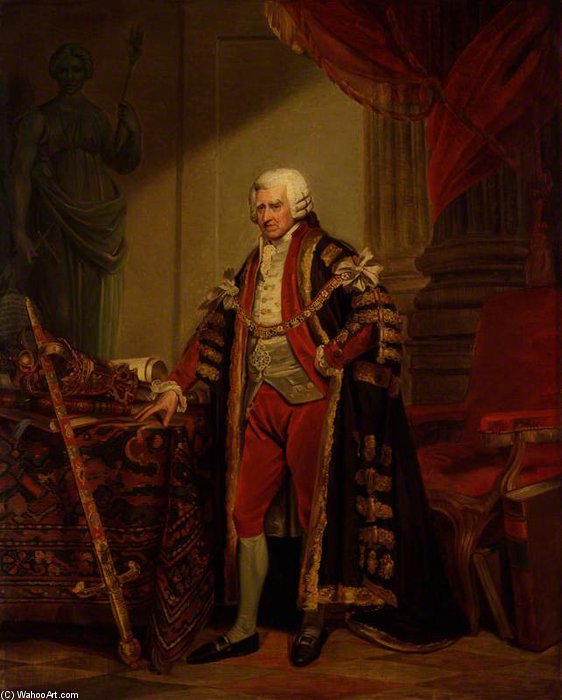
Admire John Boydell’s masterful portrait! A 18th-century masterpiece showcasing his elegance & status. Explore this iconic artwork's rich details & historical significance.
Descubre a Sir William Beechey (1753-1839), retratista inglés conocido por sus íntimos retratos de la realeza y su dominio de la luz. ¡Explora su obra en ArtsDot!
A Portrait of Power: John Boydell by Sir William Beechey
This striking portrait, painted by Sir William Beechey, captures *John Boydell*, a prominent figure in 18th-century British art and commerce. The painting presents Boydell as a man of considerable status and authority, meticulously rendered with an attention to detail that speaks volumes about both the subject and the artist’s skill. He is depicted in a grand interior setting, adorned with symbols of wealth, taste, and intellectual pursuit – a testament to his success as a publisher and champion of the arts. Boydell's confident pose, holding a sword (a symbol of authority and perhaps civic duty), combined with his opulent attire—a black coat trimmed with gold, red breeches, and white stockings—immediately establishes him as a man of importance.
Artistic Style & Technique
Beechey was renowned for his refined portraiture, favored by the British aristocracy and even Queen Charlotte herself. This work exemplifies his signature style: a blend of realism and elegance. The artist’s technique is characterized by soft brushstrokes and a masterful use of light and shadow to create depth and texture. Notice how the velvet drapes fall in rich folds, and the polished wood floor reflects the ambient light. Beechey doesn't merely depict Boydell; he creates an atmosphere of opulence and refinement. The composition is carefully balanced, drawing the viewer’s eye to Boydell’s face and conveying a sense of his commanding presence. The inclusion of the classical statue in the background subtly alludes to Boydell’s patronage of the arts and his connection to the cultural heritage of antiquity.
Historical Context & Boydell's Legacy
John Boydell (1720-1804) was far more than just a wealthy merchant; he was a pivotal figure in revitalizing British engraving and fostering a national school of history painting. He actively challenged the dominance of French engravers by commissioning works from leading British artists, and his ambitious *Shakespeare Gallery* project—a gallery exhibiting paintings illustrating scenes from Shakespeare’s plays, accompanied by an illustrated edition and folio prints—was groundbreaking. This portrait was likely commissioned during Boydell's most successful period, reflecting his influence and contribution to the arts. The painting serves as a visual document of a man who actively shaped the cultural landscape of late 18th-century Britain.
Symbolism & Emotional Impact
Beyond its aesthetic qualities, the portrait is rich in symbolism. The sword suggests Boydell’s civic role as Lord Mayor of London and his commitment to public service. The patterned cloth on the table hints at his wealth and refined taste. The overall impression is one of power, prosperity, and intellectual curiosity. While the painting doesn't reveal Boydell’s inner thoughts, it evokes a sense of confidence and determination. It invites viewers to contemplate not only the man himself but also the era he represented—an age of burgeoning British artistic identity and commercial enterprise. The portrait is more than just an image; it’s a window into a fascinating period in history and a tribute to a visionary entrepreneur.